





































































































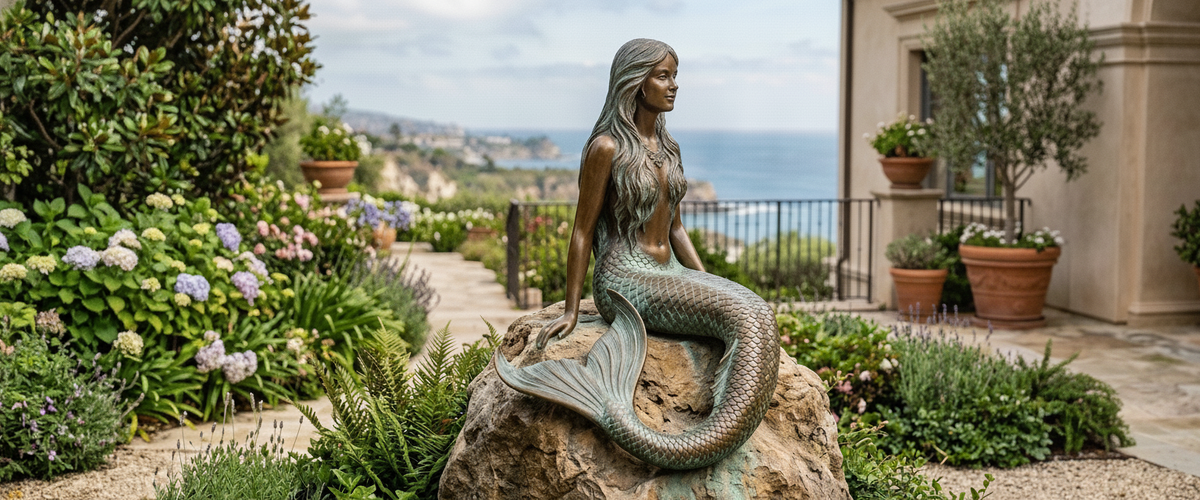

Most people choose a bronze mermaid sculpture by her face, then spend years looking at her tail. The water around the figure decides almost everything else: which pose reads, how fast the patina turns green, how big she should be, and whether a weak casting seam ever gets noticed. Get the water right and the mermaid looks like she has always lived there. Get it wrong and she looks delivered.

Quick Answer
Match the pose to the edge. Seated figures want a rock or wall, reclining figures want a long low rim, and rising figures want open water around them.
Pool rims show the tail; fountain centers often hide it. Decide which you want before you shortlist.
Spray means green. Constant water pushes bronze toward verdigris, while a dry setting holds warm browns far longer.
Inspect the tail joins. Water sits in weak seams and highlights them.
Scale to the pond you already have, judged from where people actually stand.
On a Rock, Rising or Reclining: Pose Sets the Edge
For a bronze mermaid sculpture, a seated figure on a rock is the most forgiving pose, because the rock does the job of a plinth. At about 6.5 feet (200 cm), a figure such as the Life-Size Classical Seated Mermaid on Rock Bronze Sculpture - 200cm brings her own base, so she can take a pool corner or a boulder bank without extra masonry. A reclining mermaid asks for length: a wide coping stone, a broad step into the water, a low rill wall. Rising-from-the-water poses need depth and breathing room. Set one against a hedge and she looks stranded.
Pool Rim or Fountain Center?
A pool rim flatters the tail of a bronze mermaid sculpture. The viewer sees the whole curve, the fin and the scale pattern where the sculptor spent the most hours. A fountain center tends to crop the figure at the hip, because the basin lip and the water curtain cut across it. That works well when the design is built for it. Where the mermaid has to anchor the spray rather than sit beside it, a purpose-modeled fountain such as the Life-Size Classical Seated Mermaid Bronze Fountain - 250cm, roughly 8.2 feet (250 cm) tall, is the better starting point: the plumbing and spray belong to the composition, with the upper body and tail tip carrying the silhouette. Buying a rim figure and dropping it into a fountain is where most disappointment starts.

How Water Changes a Bronze Mermaid Sculpture's Patina
Bronze is a copper alloy, and copper reacts with moisture and air to form the green copper salts known as verdigris; the Copper Development Association explains how that natural patina develops. Constant spray, especially from hard or chlorinated water, speeds the change sharply. We have seen a fountain mermaid show green streaks down the torso within a couple of seasons. A bronze garden mermaid sculpture at a dry lawn edge, wet only when it rains, can keep its brown hot-applied patina for years with an annual wax. Tell us which color you want to live with and we will tune both the patina and the placement advice. For an older or inherited bronze with heavy corrosion, call a trained conservator; the American Institute for Conservation keeps a directory.
Still Water Gives You a Second Figure
Place a bronze mermaid sculpture beside still water and one casting becomes two figures. The reflection doubles her, flips the tail and makes a modest piece read larger from across a lawn. Moving a reclining figure from a planted border to the edge of a dark-lined reflecting pond can change how she reads almost overnight, especially at dusk. Low, horizontal poses double most cleanly because they sit close to the surface, which is why a reclining figure like the Life-Size Classical Reclining Mermaid Bronze Sculpture - 120cm, about 4 feet (120 cm) long, suits a reflecting pond better than an upright figure does. Keep jets off a reflecting pond. Ripples erase the second figure.
The Tail Is the Hardest Casting
Large bronzes are cast in sections by the lost-wax method and welded together, and a long tapering tail usually means several sections meeting across curved scale work. Chasing those welds so the pattern runs unbroken takes patient, skilled hands. In our studio we check tail joins under raking light before patination, because water magnifies every weak join: it pools in a shallow seam, leaves mineral lines and turns green faster than the metal around it. Whoever you buy a bronze mermaid from, ours included, ask for close photos of the tail.
Nude or Draped: Restraint Reads Better Near Water
A classical bronze mermaid is usually bare-torsoed, and next to water, restrained modeling works best. Long hair drawn over one shoulder and calm, smooth surfaces let the figure rest against moving light. Heavy drapery and ornament compete with the water. For public venues or family gardens, hair falling loosely across the chest or a held shell gives modesty without fuss. The same logic runs through our bronze angel and cherub statues, where quiet surfaces age more gracefully than busy ones.

Scaling a Commissioned Mermaid to the Pond You Already Have
Most commissions start with existing water, and the pond sets the size. Stand where guests usually stand, then judge the figure's height against the pond's width from that spot. A 3-foot (90 cm) seated fountain can hold a courtyard basin in Austin; a lake on a Napa estate needs something closer to a monumental dual-figure group of around 12.5 feet (380 cm). Send us the pond dimensions, depth at the proposed spot, water source and whether it freezes, and Giant Sculptures can size a bespoke figure, engineer the base and plan fixings for coping, rock or a submerged plinth. Budget depends on scale, casting complexity, engineering, installation and finish, so we quote each piece individually.
Buyer Checklist
The pose suits the edge you have: rock, rim, step or open water.
The tail is visible from the main viewpoint, or the design deliberately frames it.
You have chosen wet green or dry brown, and accept how fast each arrives.
You have seen close photos of tail welds and scale continuity.
Fountain models have internal plumbing routes and drainage for winter.
Fixings and base engineering are specified for your surface.
You have tested size with a cardboard silhouette on site.
If you have been comparing catalog results, such as listings for an Enhaven bronze sculpture mermaid or collectible tabletop bronzes, check that the piece is actually cast and engineered for outdoor water. Then explore our bronze garden statues or send us your pond measurements to start a commission.
For wider placement ideas, Why a Custom Figurative Bronze Sculpture Should Be Signed off on Site, Not in the Studio is useful companion reading before finalising the setting and sightlines.