





































































































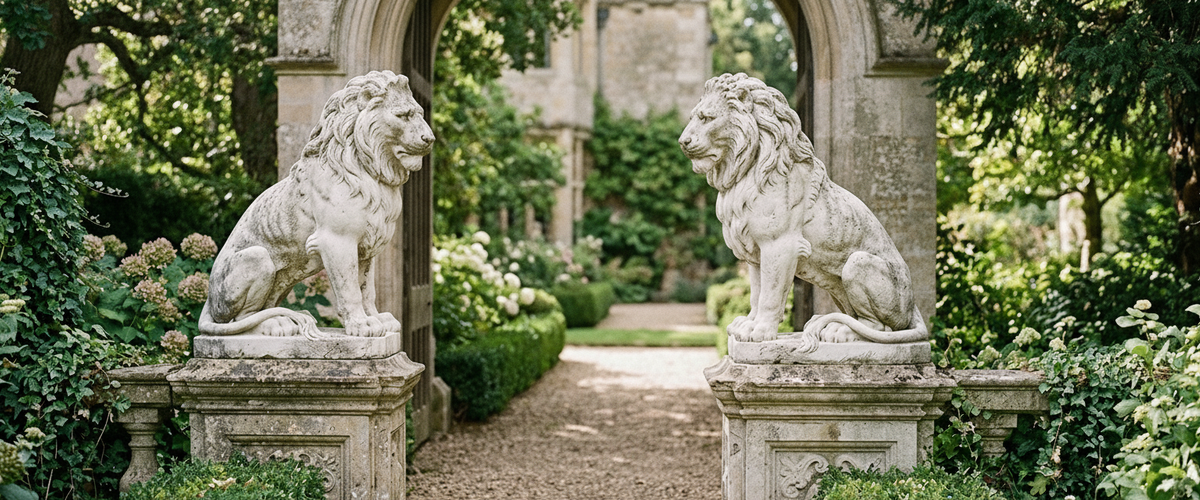

A marble lion sitting on the grass next to a clipped boxwood reads as a garden ornament. Lift the same animal onto a pier, set it back a few feet from the front door, and it reads as architecture. The carving did not change. Choosing a marble lion statue outdoor is really two decisions, and most buyers only make one of them: they pick the lion carefully and then let the position happen by accident.
Looking for the full range in this category? Browse our Lion Statues & Sculptures collection for every available finish, size, and configuration.

Key Takeaways
Placement decides everything. A marble lion statue outdoor is judged on height, setback and aspect long before carving quality.
Height changes the meaning. Ground level says decoration; a pier or plinth says gateway.
Lions almost always work in mirrored pairs. Two identical castings facing the same way look like a delivery error.
Setback matters more than size. A lion crowding a door will always look oversized, even when it is not.
North-facing, shaded, drip-line positions age carved stone fastest. Sun and airflow are free conservation.
Manes, ear edges and tail tips erode first, so undercut detail belongs where water can leave, not pool.
Height does the work: a handed pair on gate piers reads as architecture rather than ornament.
Match the Pose to the Walk
Before anything else, walk the approach. At thirty paces a visitor sees silhouette only: the mass of the haunches, the line of the back, whether the head is up or turned. At ten paces the pose registers, along with the direction of the gaze, and this is where a badly aimed lion starts to feel wrong. At arm's reach the visitor reads tooling marks, the depth of the mane curls, and the way the paws sit over the front edge of the base.
Carve that walk into your brief. A marble lion statue outdoor at a driveway entrance, seen at speed from a car, needs a bold, blocky silhouette and a raised head. A courtyard piece that people pass within touching distance every day rewards fine mane undercuts and crisp claw detail. Commission the wrong one for the position and you either lose the detail entirely or pay for carving nobody sees.
Ground Level Reads as Ornament, a Pier Reads as Architecture
Setting a lion straight onto gravel or turf collapses the animal into the planting behind it. Weight also becomes an issue: solid marble sinks, tilts and stains from ground splash-back. Some subjects genuinely belong low, because they are designed to be looked down onto; a carved piece such as the Snail Marble Sculpture - 60cm earns its keep at ankle height in a fern bed precisely because its best view is from above. A lion is the opposite animal. It wants eye contact.
Plan the base with the same seriousness as the sculpture, because a marble lion statue outdoor is only as good as the footing beneath it. That means a compacted, frost-resistant footing, a load path that carries the combined weight of stone and pier, and a bedding detail that lets water escape rather than wick upward. We have had clients pour piers before commissioning and then discover the cap was two inches too narrow for the lion's base. Measure the sculpture footprint first, then build.

Pairs and Handedness: Why Two Lions Facing the Same Way Look Like a Mistake
Guardian lions are a paired tradition across Chinese, Venetian, Renaissance and Beaux-Arts architecture, and the pairing is almost always mirrored. In the Chinese arrangement the male rests a paw on an embroidered ball and the female shelters a cub, a pattern repeated across centuries of temple and palace guardians, including examples held by the Metropolitan Museum of Art. Western heraldic lions follow a similar logic: left-hand and right-hand versions, heads angled slightly inward toward the visitor.
If you buy two of the same casting and set them either side of a gate, both will look the same way and the composition will read as an accident. Ask for a handed pair. Where the site has no masonry piers to build from, an integrated stepped base does the lifting instead: the Large Traditional Chinese Guardian Lion Bronze Sculpture (Tiered Greek Key Plinth) - 140cm arrives with its own elevation, closing the gap between sculpture and architecture without a separate pier being poured.
Steps, Gateposts and Terrace Corners, Ranked
Gate piers. The strongest position. The lion gets height, a flat cap, a clear silhouette against sky, and an obvious job.
Flanking a flight of steps. Excellent, provided the lions sit on the top or bottom landing rather than mid-run. Half-height plinths keep heads near standing eye level.
Terrace corners. Good for single pieces. A corner gives two viewing angles and a natural stop to the paving.
Either side of a front door. Works only with genuine setback. See below.
Loose in a border. Weakest. Planting grows, the lion disappears, and you spend spring cutting a shrub back off a carved mane.
For lawn and border pieces where the architecture is not doing the framing, browse the wider garden statues range, where subjects are chosen to hold their own against planting.

Setback and Plinth Height for a Marble Lion Statue Outdoor
Two numbers save most projects. First, keep at least 36 inches (91 cm) of clear passing width between the lion's widest point and any door swing, gate leaf or handrail. Second, aim for a setback from the facade roughly equal to the full height of lion plus plinth. A 5 ft (1.5 m) assembly sitting 5 ft off the wall looks composed; the same assembly pushed up against the brick looks jammed in.
On plinth height, put the lion's head between standing eye level and a foot above it for entrances, and higher for driveway piers seen from a car. Heraldic subjects tolerate more elevation than naturalistic ones; a piece on the scale of the Monumental Heraldic Winged Lion Bronze Sculpture - 220cm is composed to be read from below, which is why it belongs on a pier rather than on a patio where you meet it head-on.
Deep mane channels hold water. On shaded plinths that is where biological film and frost damage start.
Shade, Drip Lines and Lichen
The north-facing plinth ages worst, every time. It stays damp longest, dries slowest and grows the heaviest biological film, and marble is a calcite stone that slowly dissolves in acidic rainfall. Historic England's guidance on biological growth on masonry is blunt about the cause: persistent surface moisture. Sun and moving air do more for a marble lion statue outdoor than any coating.
Then check what falls on it. A position under a gutter joint, a roof valley or an overhanging tree concentrates runoff onto one patch of stone, and that patch sugars first. Tannin from oaks and limes stains white marble yellow-brown. Move the lion two feet out of the drip line and you have solved a problem no annual clean will fix.
Manes, Paws and Tail Tips: What Goes First
In the studio, the failures we see on a marble lion statue outdoor are predictable. Deep mane undercuts hold water in the curl and freeze there. Ear edges and tail tips are the thinnest sections and take the first knock from a ladder, a hose reel or a careless snow shovel. Paws sitting at pavement level catch de-icing salt spray all winter. Ask for slightly softened mane channels on exposed piers, and specify a base detail that sheds water clear of the paws.
If the site is genuinely hostile, an open driveway in a hard-frost region or a coastal entrance taking salt air, bronze is the honest answer. It handles freeze-thaw and salt far better and develops a patina rather than losing surface. Keep marble for sheltered courtyards and terraces where frost cycles are rare and the stone sits out of the wind.

Checklist Before You Commission
Photograph the approach at thirty, ten and two paces. Brief the carving detail to the closest view.
Confirm you are ordering a handed pair, not two of the same casting.
Measure the pier cap and compare it to the sculpture footprint, not the shoulder width.
Check door swings, gate leaves and the 36 inch (91 cm) passing clearance.
Note the aspect. If it is north-facing and shaded, plan for cleaning or change material.
Trace the drip line, gutter outlets and any overhanging tree canopy.
Agree lifting access, footing spec and fixing method before delivery day.
Giant Sculptures works on bespoke commissions at architectural scale, so a marble lion statue outdoor can have its pose, handedness, base design and material specified to the site rather than chosen off a shelf. Cost follows material, scale, carving complexity and installation, so send site photos and dimensions and ask for a quote against the actual position. Start with the outdoor sculptures and statues collection to see how scale behaves in real settings before you commit.
For wider placement ideas, Marble Garden Statues: What Winter Really Does to White Stone is useful companion reading before finalising the setting and sightlines.