

















































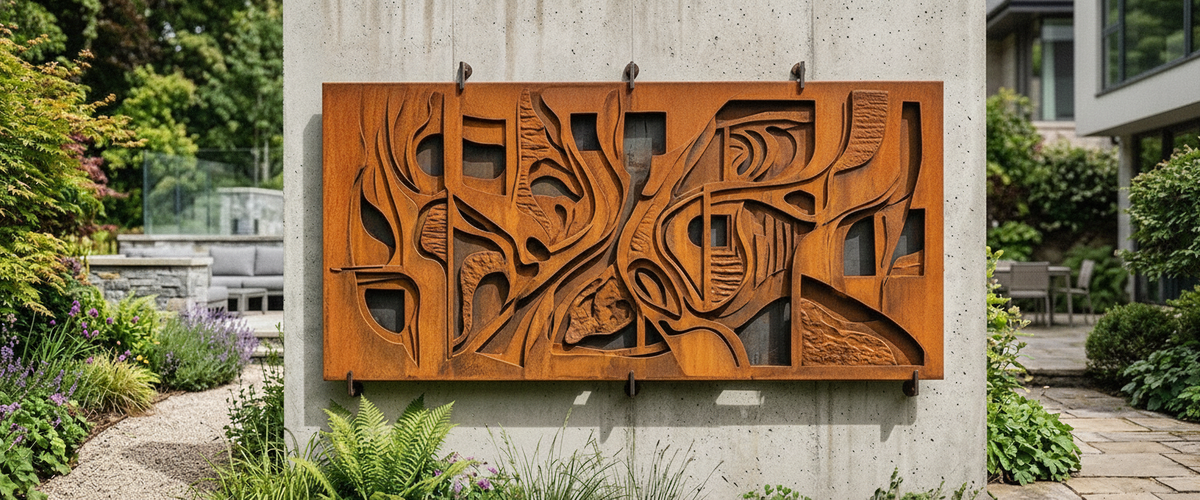

Most large outdoor wall art does not fail at the face. It fails behind it, quietly, where a panel sits flat against masonry and traps water for three years before anyone notices the streak running down the render. By then the fixings are weeping, the wall is stained, and a piece that cost real money to design and install looks like a mistake. The material choice you make at the quote stage decides almost all of this, and it decides it long before the crate leaves our workshop.

At a Glance: The Decisions That Matter
Material first. Mild steel, marine-grade aluminum, 316 stainless and Corten age in completely different directions. None of them is the default answer for large outdoor wall art.
Detailing beats coating. An air gap and standoff fixings will save a panel that a premium finish alone cannot.
Substrate honesty. Brick, render and timber cladding each hold weight differently after a decade of freeze-thaw.
Design for distance. Relief depth reads from 50 feet (15 m); fine surface detail does not.
Budget. Cost tracks material, scale, engineering, finishing and installation access, so ask for a tailored quote rather than assuming a panel price.
Year One to Year Ten: How Each Metal Actually Behaves
Four metals cover almost every piece of large outdoor wall art we build, and each one ages on its own schedule. Mild steel does something the other three never do. It keeps corroding inward. A powder-coated mild steel panel can look flawless for years, then a single chip at a cut edge lets moisture under the film, and the rust creeps sideways beneath the coating until the finish lifts in flakes. Repairable, but only if you catch it. In a dry inland garden in Arizona that day might not come for fifteen years. Two blocks from the ocean in Malibu it can arrive in three.
Marine-grade aluminum, usually a 5000 series alloy such as 5052 or 5083, behaves better in salt air because its oxide layer is self-sealing, and it weighs roughly a third of steel at the same thickness. That weight difference matters enormously on rendered walls and timber cladding. The trade-off is stiffness: a thin aluminum sheet at 8 feet (2.4 m) wide will oil-can and ripple unless the design includes folded returns or a welded backing frame.
Grade 316 stainless is the long-horizon answer for coastal projects. The added molybdenum resists chloride pitting far better than 304, which is why we specify it for anything within sight of open water. It shows fingerprints and water spotting more than clients expect, and a brushed grain hides both better than a mirror polish. For buyers weighing these options across a whole wall, our metal wall art range is a useful reference for how each surface reads at scale.
Weathering steel settles into a stable russet only where the panel drains freely and the back face can dry between rains.

Corten's Runoff Problem and the Detailing That Prevents It
Weathering steel is the most requested material for large outdoor metal wall art, and the most frequently misused. The patina that makes Corten worth specifying is a stabilizing oxide layer, but it only stabilizes properly through repeated wet-dry cycling. Where water sits, or where the panel sits in permanent shade, the layer never locks down and the steel keeps shedding iron oxide. The Federal Highway Administration's guidance on uncoated weathering steel makes the same point about drainage and detailing on bridges, and a wall panel is subject to the same physics on a smaller scale.
We shipped a Corten screen to a Napa property where the client mounted it above pale limestone paving against our advice on drip detailing. The first winter drew orange tears down the stone. The fix was a folded lower edge and a shallow gravel margin at the base to catch runoff, which should have been in the design from the start. Corten is the one case where large outdoor wall art needs its drainage drawn before its outline. Plan for the first eighteen months of runoff, protect anything porous below the piece, and the surface will settle into a dry, stable russet that only deepens.
Powder Coat Chalks, Live Patina Deepens
Every applied finish on large outdoor wall art has a decay curve. Polyester powder coatings lose gloss and chalk under UV, faster in Texas and southern California than in Seattle or Portland, and specification tiers exist precisely because of this. The Powder Coating Institute is the sensible starting point on architectural-grade performance classes. Ask which class your supplier is quoting; the difference between a general-purpose coating and a superdurable architectural one is invisible on day one and obvious in year eight.
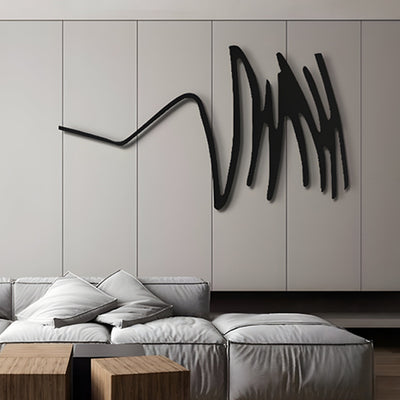
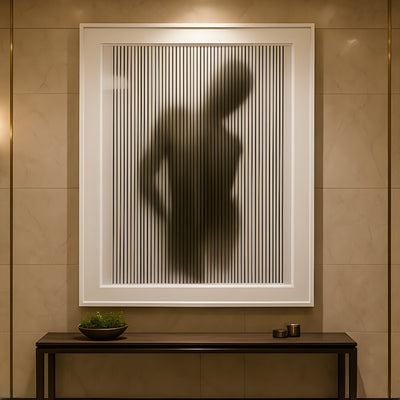
Live finishes go the other way. Bronze patina, hot-waxed steel and Corten all get better with age because the surface is the material rather than a film sitting on top of it. That is the honest argument for spending more at the front end. It also sets the boundary for acrylic and composite work: a sculptural panel such as Panthra Shadow Black Acrylic Stripe 3D Wall Art holds its finish beautifully on a sheltered loggia or an interior wall, but it is not built for a fully exposed elevation taking wind-driven rain.

Rust Bloom Behind the Panel: Air Gaps and Standoff Fixings
Here is the detail that decides the lifespan of large outdoor wall art more than any other. A panel bolted flat to a wall creates a capillary trap. Water wicks in, sits between two surfaces, and never dries. Standoff fixings that hold the piece 20 to 40 mm (roughly 1 to 1.5 inches) off the substrate let air move behind the work, which dries the back face after rain and lets the wall breathe.
Match the fixing metal to the panel metal, too. Carbon steel bolts through a stainless panel will bleed rust in a season, and stainless fasteners driven into aluminum without an isolating washer set up galvanic corrosion at every hole. On coastal jobs we specify 316 (A4) stainless fixings and nylon isolation sleeves as standard.
Brick, Render and Timber Cladding Under Load
Solid brick or block is the most forgiving substrate for large outdoor wall art; resin-anchored fixings into the brick body rather than the mortar joints will carry serious weight. Rendered walls need honesty about what sits behind the render: insulated systems often have 100 mm (4 inches) or more of foam before anything structural, so fixings must be long enough to reach the load-bearing layer. Timber cladding is the one that catches buyers out. Boards move seasonally, and a rigid panel fixed across several boards will either restrain that movement or tear its own fixings loose. Fix through the cladding into the studwork or battens, and allow slotted holes for expansion.
Where a wall genuinely cannot take a single heavy panel, splitting the composition into two lighter framed works, in the manner of Artelis 2-Set Fox & Panda Animal Framed Wall Art, spreads the load across more fixing points and lets each piece land on solid backing rather than on whatever the render is hiding.
Relief Depth Reads Better Than Fine Detail
At 50 feet, shadow does the drawing. Depth reads; line weight disappears.
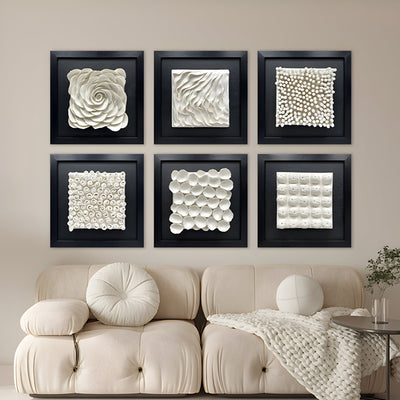
An exterior wall is normally read from 30 to 50 feet (9 to 15 m), from the far side of a lawn, terrace or courtyard. At that distance, laser-cut filigree collapses into gray texture while a 2 to 3 inch (50 to 75 mm) relief throws a shadow that redraws itself through the day. Design large outdoor wall art for shadow, not for line weight. Fine, close-read work such as Blossomkin Bird 3D Floral Wall Art earns its place in a covered courtyard or entry where people stand within a few feet of it, not on a facade seen across a garden. Our 3D wall art range shows how depth changes the reading distance.

The Twenty-Minute Annual Check for Large Outdoor Metal Wall Art
Rinse the face with clean water and a soft brush, then dry stainless with a microfiber cloth to prevent spotting.
Check every fixing head for movement, rust weep or staining on the wall below.
Look behind the panel with a flashlight for trapped leaves, nesting debris or standing water.
Inspect cut edges and welds first; coating failure starts there, never in the middle of a flat face.
Touch in coating chips within the same season using the manufacturer's matched paint.
Rewax hot-waxed or bronze surfaces with a microcrystalline wax on a dry, mild day.
Photograph the piece from the same spot each year so patina change is measured rather than guessed.
Commissioning Large Outdoor Wall Art That Lasts
Give your maker four things before design starts: the viewing distance, the wall build-up, the distance to salt water, and how much maintenance the owner will realistically do. Those answers narrow the material list fast. At Giant Sculptures we build bespoke exterior panels and relief works to a specific wall rather than trimming a standard product to fit, which means fixings, drainage and drip detailing are drawn at the same time as the artwork. Start with our outdoor wall art collection to set a direction, then send us the wall photographs and site conditions and we will quote the piece properly.
For wider placement ideas, Pick the Wall First: How to Get Outdoor Metal Wall Art Right is useful companion reading before finalising the setting and sightlines.