





































































































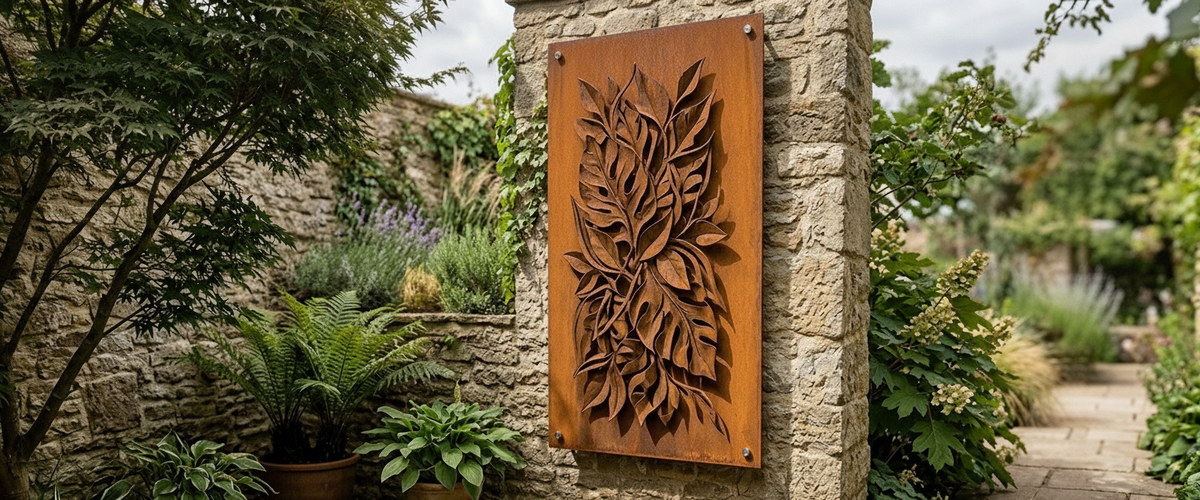

The artwork is almost never the problem. Most of the time, outdoor metal wall art disappoints because someone chose the piece before looking properly at the wall it was going on. Wrong background texture, no drainage gap, fixings sunk into soft render, a surface that sits in shade until noon. The panel arrives beautifully made and then spends five years staining the masonry below it.
Get the wall right and the rest follows. Here is how we work through an outdoor metal wall art brief with clients before a single fixing hole is drilled.

At a Glance
Flat beats textured. Smooth render, painted block and regular stock brick read as background. Feature stone competes and wins.
Leave a gap. Around 1 inch (25 mm) of standoff keeps air moving behind the panel and stops streak staining.
Match material to exposure. Outdoor metal wall art lives or dies on this call: Corten for open, well-drained walls; powder-coated steel for color control; marine-grade aluminum for coastal and pool-adjacent sites.
Size to walk-past distance, not to the tape measure. A 12 ft (3.7 m) courtyard panel and a 40 ft (12 m) terrace elevation are different design problems.
Never fix to a timber fence. It moves, it holds water, and it will not carry the load.
Flat Render and Stock Brick Beat Feature Stone
A busy wall eats artwork. Split-face stone, heavy rubble walling and reclaimed brick with wild color variation all carry their own shadow pattern, and outdoor metal wall art laid over that pattern loses its silhouette from ten paces. You end up with two textures arguing.
The best hosts for an exterior panel are the plain ones: lime or cement render in a single tone, painted blockwork, smooth-faced stock brick, board-formed concrete. Dark, matte surfaces are especially good because they push a laser-cut or layered piece forward and make the shadow gap behind it legible. If you are stuck with a feature stone wall, the honest fix is to build a plain backing plate into the outdoor metal wall art commission so the artwork brings its own background with it. We do this often on Corten and stainless pieces, and it usually costs less than re-facing a wall.

The Standoff Gap That Saves Your Masonry
This is the detail most people skip. Outdoor metal wall art fixed flat to a wall traps water at the interface, and that water has to go somewhere. It runs down the face of the masonry in a narrow band and leaves a streak that no amount of pressure washing removes cleanly.
Standoff fixings of roughly 1 inch (25 mm) solve it. Air circulates, rain sheets off the panel edge instead of wicking sideways, and the wall dries evenly. The gap also throws a shadow line that makes the piece look mounted rather than stuck on. For weathering steel there is a second reason: the patina only stabilizes if the surface runs through proper wet and dry cycles, and detailing that keeps it permanently damp is exactly what the FHWA technical advisory on uncoated weathering steel warns against. Trapped moisture behind a flat-mounted panel is the classic mistake.
A 25 mm standoff gap keeps air moving behind the panel and rain off the masonry.
How Outdoor Metal Wall Art Ages After Two Wet Winters
Two winters is the honest test. Anything looks good in month one.
Corten (weathering steel) settles into a deep orange-brown that stops changing dramatically after roughly eighteen months on an exposed site. It sheds runoff during that first year, so it needs gravel, planting or dark paving below it, never new limestone or pale concrete. One client learned this the expensive way on a pool-house wall, and we re-detailed the drip edge on the replacement panel.
Powder-coated steel gives you exact color and a crisp finish, and holds it well if the coating was applied over properly prepared and primed steel. The weak points are cut edges and fixing holes. Ask whether edges were sealed before coating; a cheap job shows rust blooms at the corners by the second spring.
Marine-grade aluminum is the safest bet for outdoor metal wall art on coastal and poolside walls. It will not rust, it is light enough for fixings into less-than-perfect substrates, and the Aluminum Association notes the naturally forming oxide layer that protects the surface. Specify stainless or isolated fixings so you do not set up galvanic corrosion between metals.

Sizing to the Walk-Past Distance
Scale is a viewing-distance calculation. Outdoor metal wall art gets sized to how close people actually stand, and wall area barely comes into it. In a narrow courtyard where people pass within 6 to 8 ft (1.8 to 2.4 m), a 12 ft (3.7 m) panel works because it fills peripheral vision and rewards close inspection. Detail matters there: layered leaf forms, fine cut work, texture you can read at arm's length. Under cover, where fine work is protected from driving rain, a specimen-case piece such as the Aurelian Butterfly Display Acrylic 3D Wall Art is the sort of close-range detail that only pays off at short viewing distances.
Stretch that to a 40 ft (12 m) terrace elevation viewed from across a lawn and fine detail vanishes. What survives is silhouette and depth of relief. Either commission one large-gesture piece with a strong outline, or run a rhythm of three related panels with real breathing space between them. Sculptural relief works harder than surface pattern at distance, which is why we push clients toward deeper, three-dimensional outdoor metal wall art for long elevations. Browsing the 3D wall art range is a useful way to see how much depth changes legibility.
Where Exterior Panels Fail
Outdoor metal wall art goes wrong reliably in three placements.
Timber fences. They flex in wind, twist with moisture, and the posts were sized for the fence, not for a 90 lb (41 kg) steel panel. If the fence is the only option, build an independent freestanding frame behind it.
Deep, permanent shade. North-facing walls that never dry out grow algae, hold moisture against fixings, and stop Corten patinating evenly. You get blotching, not character.
Anything that moves. Thin cladding panels, cement board, insulated render systems without a fixing plan. Fixings need to reach solid structure behind the finish, and that has to be established before the piece is made, not on installation day.
Hotel Terraces and Courtyards: Fixing into Walls You Cannot Damage
Commercial sites bring a different constraint. Leased restaurant courtyards, heritage-listed hotel facades and glazed atrium walls often come with a flat ban on drilling. Small panels and full outdoor metal wall art decor and sculptures hit the same restriction, and the answer is usually to take the load off the wall entirely.
Ballasted supports let a piece read as wall-mounted on a facade nobody is allowed to drill.
Options we design around for outdoor metal wall art: freestanding A-frame or ballasted supports that sit tight to the wall and read as flush; tension-cable systems anchored top and bottom into permitted structure; and self-supporting screen walls that double as wind baffles for outdoor dining. On one winery terrace we built a Corten panel onto a hidden ballast plinth buried under the gravel, so the historic stone wall behind it was never touched. Photographs show it as wall-mounted. Nothing is fixed to the wall at all.
For sheltered spots such as loggias, covered walkways and hotel lobbies opening onto a terrace, lighter acrylic-and-metal work becomes viable, and the calculation shifts from durability to design language. Where a covered elevation wants graphic weight rather than patina, the Panthra Shadow Black Acrylic Stripe 3D Wall Art carries a long wall on silhouette alone; in a protected courtyard viewed close up, the softer relief of the Blossomkin Elephant 3D Floral Wall Art is the better fit. Full weather exposure calls for a different outdoor metal wall art specification, and we will say so rather than sell you the wrong thing.

Checklist Before You Commission
Photograph the wall in morning and afternoon light, and note how long it stays wet after rain.
Confirm the substrate behind the finish, and whether drilling is permitted.
Check what sits below the piece: gravel and dark paving forgive runoff, pale stone does not.
Measure the closest normal viewing distance, not just the wall width.
Specify standoff depth, fixing metal, and edge sealing in writing.
Agree who does the installation and what access equipment the site allows.
Ask how the outdoor metal wall art finish is expected to look at year two, not year one.
A well-detailed piece of outdoor metal wall art should need almost nothing from you afterward: a rinse, an occasional check on fixings, and that is it. Giant Sculptures builds bespoke exterior panels and relief work in Corten, stainless steel, powder-coated steel and marine-grade aluminum, sized and engineered for the specific wall. Cost depends on material, scale, relief depth, engineering and installation access, so send us the wall photographs and dimensions and we will quote it properly. Start with the outdoor wall art and decor range, or the wider metal wall art collection if you are still narrowing down the look.
For wider outdoor metal wall art placement ideas, Bronze Metal Wall Art: How Placement Changes What You See is useful companion reading before finalizing the setting and sightlines.