






































































































A butterfly sculpture can either anchor a garden or vanish into the shrubbery, and the difference almost never comes down to the piece itself. It comes down to where you put it, how high you lift it, and what sits behind it. We have shipped enough outdoor butterfly sculptures for gardens across the US to know that the same steel wing form reads as sculptural drama in a Napa courtyard and as garden-center clutter in a busy border. The piece did not change. The setting decided. Good outdoor butterfly sculptures gardens placement starts there.
Looking for the full range in this category? Browse our Garden Statues collection for every available finish, size, and configuration.
This guide walks through the placement calls that actually move the needle: scale and sightlines, pedestal height, indoor versus outdoor siting, and the light and backdrop choices that separate a piece with presence from one that just occupies space. Outdoor butterfly sculptures for gardens live on contrast. Get the frame right and the sculpture earns every inch.

Key Takeaways
- Scale should be set against the sightline distance, not the flower bed. A piece viewed from 40 feet (12 m) needs far more mass than one you pass at arm's length.
- Pedestal height changes the entire read of a butterfly form; wings want to be lifted, not planted at ankle level.
- Outdoor placement rewards durable metals like stainless steel, Corten, and bronze; delicate wall sets belong under cover.
- Backdrop contrast is the single most overlooked factor. A silver butterfly against pale render disappears.
- Most placement mistakes come from siting the piece before you have watched how light and traffic move through the space.

What Outdoor Butterfly Sculptures Look Like in Different Settings
The butterfly is a deceptively hard subject. It suggests lightness and movement, yet in metal it has to hold that illusion while weighing a fair amount and standing through weather. The best outdoor butterfly sculptures for gardens lean into the contradiction. A large steel butterfly on a slim stem reads as motion frozen mid-hover, which is exactly what you want catching a low sun.
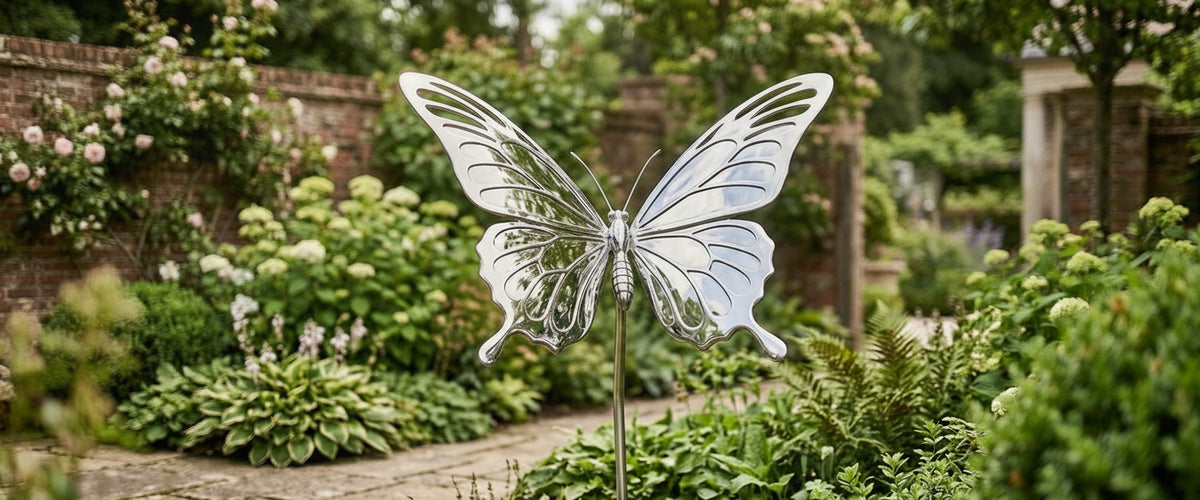
In a formal garden, a single tall piece works as a full stop at the end of a path or a lawn axis. Where a long view needs closing with real height and a polished surface that gathers the sky and greenery around it, a stainless steel form such as the Flutter Silver Butterfly Steel Sculpture at 200cm (roughly 6 ft 7 in) does the work. Set that same piece three feet into a planting bed and you lose the stem, lose the lift, and lose the point.
Classical and courtyard settings ask for something different. Where the setting rewards close approach rather than a distant silhouette, a figurative marble piece like the Playing With Butterfly Cupid Angel Marble Outdoor Sculpture at 80cm (about 2 ft 7 in) makes more sense on a low plinth near a seating area or a fountain than at the far end of a lawn where the detail is lost. Not all outdoor butterfly sculptures for gardens want distance.
Then there is the mixed-material installation. When you want the metal to sit among the planting rather than above it, a wrought iron ground piece like the Butterfly Egg & Fern Garden Wrought Iron Installation at 88cm works to the opposite logic of the tall steel form: it wants ferns and low foliage brushing against it so the metal and the living material read as one composition. Among outdoor butterfly sculptures gardens buyers underestimate how much these grounded pieces owe to their planting.

Scale, Sightlines, and Pedestal Height
Scale is not about the size of the sculpture in isolation. It is about the distance from which people will usually see it. A rough working rule we give clients: the further the primary viewing point, the more visual mass the piece needs to carry.
For a sculpture seen mostly from a terrace 30 to 50 feet (roughly 9 to 15 m) away, a small tabletop-scale butterfly simply will not register. You need height, width, or both. That is where a piece over 6 feet earns its keep. For a courtyard where people pass within a few feet, a smaller, more detailed form holds attention better than a large one, which can feel overbearing at close range.
Pedestal height is the lever most buyers forget. A butterfly reads as flight, and flight needs elevation. Lift a wing form onto a plinth so the widest point sits somewhere near eye level or just above, and it gains lightness. Sit it low and it reads as landed, even grounded. For figurative marble the calculation flips slightly; you often want the face and gesture at a comfortable standing eye line, which usually means a lower base than a pure wing form. This one call decides more outdoor butterfly sculptures for gardens than any other.
One hard-won lesson from a Hamptons commission: the client set a tall steel piece on a base that was correct on paper but too slim for the open lawn around it. From the house it looked precarious. We widened the plinth footprint, kept the height, and the whole thing settled. Sightline and stability are felt, not just measured.

Indoor Versus Outdoor Placement: When Each Wins
For wider placement ideas, Marble Garden Statues After Five British Winters is useful companion reading before finalizing the setting and sightlines.
Not every butterfly piece belongs outside, and pretending otherwise leads to disappointment. Outdoor placement wins when the piece is built for it: stainless steel, bronze, Corten, or treated wrought iron, all of which handle rain, UV, and temperature swings. The best outdoor butterfly sculptures for gardens use these materials precisely because they hold up in the open for decades with sensible care.
Indoor or covered placement wins for the more delicate wall-mounted work. When a piece is designed to read against a clean interior wall or a sheltered loggia rather than full weather exposure, the Papilio Butterfly Cascade Blue Modern 3D Wall Art Set is the right design language. A clear-finish version like the Papilio Butterfly Cascade Clear set depends on translucency and light passing through it, which works beautifully in a stairwell or a covered garden room. Leave that kind of piece in driving rain and you are fighting the material's nature.
A useful middle ground is the covered outdoor space: a portico, a deep porch, a pergola with a solid roof. Here a vertical wall piece such as the Papilio Butterfly Vertical Blue Modern 3D Wall Art gets the outdoor context and airflow without the harshest exposure. If you are unsure whether a piece can live fully outside, ask us before you buy. Material and finish decide it, and we would rather advise honestly than replace a corroded piece a year later.

Light, Backdrop, and Contrast
Light does more for outdoor butterfly sculptures for gardens than almost any other factor. Polished stainless steel wants raking, low-angle light, which is why east or west placement often outperforms a spot that only sees flat midday sun. Early and late light rakes across the surface, throws the wing edges into relief, and makes the piece look alive. The Smithsonian's guidance on outdoor metal sculpture covers how surface finish and orientation affect both appearance and long-term weathering, which is worth reading before you fix a permanent position (Smithsonian's Museum Conservation Institute).
Backdrop contrast is where good placement is won or lost. A silver or clear piece against a pale rendered wall or a bright sky can wash out completely. Give it a darker backdrop: a yew hedge, a weathered fence, a mass of deep green foliage, and the form snaps into focus. A dark bronze or Corten butterfly does the reverse; it needs a lighter ground behind it, whether that is a pale wall, gravel, or open sky.
Think about what sits behind the piece at the height where the wings actually are, not at ground level. This is a common miss. The base might sit against a lovely hedge while the wings float against blank sky, so the part that matters most has no contrast at all. Many outdoor butterfly sculptures gardens owners regret only this detail.

Common Placement Mistakes We See
These are the errors that come up again and again in commissions and enquiries about outdoor butterfly sculptures for gardens, and every one is avoidable.
- Buying to the bed, not the sightline. A piece chosen to fit a flower bed is often far too small for the distance it is actually viewed from.
- Skipping the pedestal. Placing a wing form at ground level kills the sense of flight. Lift it.
- Ignoring backdrop at wing height. Contrast has to work where the sculpture's mass sits, not just at its base.
- Fighting the material. Putting a delicate indoor wall set into full weather, or a heavy outdoor steel piece into a cramped interior.
- Fixing position before watching the space. Light and foot traffic shift through the day. Live with a mock-up (a stake, a cardboard cutout, a temporary stand) for a few days before you commit the foundation.
- Underbuilding the base for open ground. Wind loads on a large wing form are real. Wide, exposed sites need an engineered footing, not a token slab.

Commissioning a Butterfly Piece for Your Garden
If nothing off the shelf fits your sightlines, a bespoke commission lets you set the scale, finish, and mounting to the exact spot. At Giant Sculptures we work through the placement questions first, distance, backdrop, prevailing light, wind exposure, then design the piece and its base around the answers. That is the reverse of how most people shop, and it is why commissioned outdoor butterfly sculptures for gardens tend to sit so naturally once installed.
Budget for outdoor butterfly sculptures gardens depends on material, scale, structural engineering, finish, and installation, so there is no single figure. The honest answer is to describe your site and ask for a tailored quote. A large polished stainless steel form with an engineered footing is a different proposition from a compact marble piece near a seating area, and the quote should reflect that rather than a guess.
Get the placement thinking right and outdoor butterfly sculptures for gardens reward you every day, in every light. Get it wrong and even the finest metalwork struggles. Start with the view, not the sculpture.