





























































































Five winters in, you can tell which marble garden statues were chosen well and which were bought on a whim. The good ones still have crisp drapery, defined fingers and a quietly weathered surface that looks more beautiful than the day it arrived. The bad ones have spalled faces, hairline cracks creeping up the plinth, and a green tidemark where rainwater has pooled for years. The difference is rarely the marble itself. It is the buying decision, the base, and ten minutes of care a year.
This is a buyer's guide written from the workshop floor rather than the showroom. At Giant Sculptures we commission and supply large-scale marble garden statues for private gardens, estates, hotels and memorial settings across the UK, and we see what comes back to us after a few seasons. Here is what you actually need to know before you commit.

Key takeaways
- Real marble outlasts resin outdoors in the UK if it is installed correctly, but it is unforgiving of bad plinths and trapped water.
- The base matters as much as the statue. Most failures we see are drainage and frost issues, not stone quality.
- Cleaning is light and infrequent. Soft water, soft brush, no pressure washers, no acidic products.
- Scale changes everything. A 180cm marble figure reads as architecture; an 80cm piece reads as ornament. Choose for the role.
- Budget depends on stone, scale, carving complexity, plinth engineering and installation. Ask for a tailored quote rather than relying on rough bands.

What actually happens to marble outdoors in UK weather
Marble is a metamorphic limestone, mostly calcium carbonate. Outdoors in the UK it faces three enemies: freeze-thaw cycles, acidic rain and biological growth. Rainwater in Britain is mildly acidic and slowly dissolves the surface of the stone, which is why classical statues from the eighteenth century look softer than they did when they were carved. This is gentle and, frankly, often beautiful. The English Heritage conservation guidance on outdoor stonework describes this slow patination well.
The damaging process is freeze-thaw. Water enters a tiny pore or hairline, freezes overnight, expands, and prises the stone apart from the inside. After five winters you can see where it has happened: a flake of nose, a chipped wing tip, a fissure along a fold of drapery. None of this is inevitable. It almost always traces back to water being allowed to sit on or inside the statue.
Biological growth, mostly algae and lichen, is the third factor. On a north-facing piece in a damp courtyard you will get green within a year. This is cosmetic rather than structural, and it lifts off easily with the right method.

Real marble vs cast marble vs marble-effect resin
The label "marble garden statue" covers three very different products, and buyers are routinely misled.
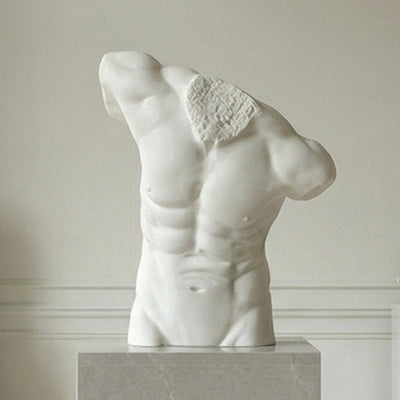
Solid carved marble is what most people picture: a block of Carrara, Bianco or similar, hand-carved by a sculptor. It is heavy, expensive to ship, and the only option that will read as genuine stone at close range. The Marble Sculptures & Statues collection at Giant Sculptures is entirely this category. Properly installed, it is a multi-generational object.
Cast marble (sometimes called reconstituted or bonded marble) is crushed marble dust mixed with a resin or cement binder, cast in a mould. It can be very convincing and is far cheaper to produce in volume. Outdoors, the weakness is the binder rather than the stone: resin binders yellow and embrittle in UV, cement binders can spall in frost.
Marble-effect resin is painted polyresin with no marble content. It looks plausible for a season or two in photographs. In a real British garden it fades, goes brittle, and starts to look plastic by year three. We do not recommend it for any piece you want to keep.
If you are commissioning a feature sculpture as a long-term investment, choose solid carved marble and budget accordingly. If you want a decorative piece for a sheltered courtyard you plan to refresh in a few years, cast marble is a defensible compromise.

Plinths, drainage and the mistakes that crack a statue
More marble garden statues are killed by their plinths than by their winters. The recurring mistakes:
- Setting the statue directly onto a lawn or soil. Capillary action wicks groundwater up into the base of the stone, which then freezes.
- Sealing the joint between statue and plinth with a non-breathable mastic. Water gets in, cannot get out, and pushes the stone apart from inside.
- Using a plinth that is too small or too narrow. A top-heavy figure on a stingy base will eventually shift, and a shifted figure is a cracked figure.
- Placing under a tree. Sap, bird droppings and constant drip lines are all surprisingly aggressive on marble.
- No drainage layer. A proper installation sits the plinth on a compacted hardcore and sharp sand bed, with a damp-proof course between plinth and stone where appropriate.
For a tall piece such as the Garden Angel Marble Outdoor Sculpture - 180cm, the plinth engineering is not optional. A figure of that height carries real wind load, and the base has to be set on a properly excavated foundation, not a paving slab laid on the lawn. We provide an installation specification with every commission for exactly this reason.

Classical figures, animals and abstracts: which suit modern gardens
Marble has a strong default association with classical figurative work, and there is a reason for that: the stone takes fine detail beautifully, and the language of drapery, wings and gesture was developed for it over centuries. But you do not have to put a Roman copy in a contemporary garden for it to work.
Classical figures still belong in formal planting schemes, walled gardens and at the end of long axes. Where a setting calls for a single figure to anchor a long vista, a full-height piece like the Life-Size Garden Angel Marble Outdoor Sculpture - 180cm does the work of architecture rather than ornament. Place it where the eye is meant to land.
Animals and mythological creatures have come back strongly in contemporary commissions. Flanking steps or a gate, a paired form such as the Egyptian Sphinx Garden Marble Sculpture - 110cm in pale marble reads as architectural rather than fussy, and is one of the easier ways to introduce marble to a modern garden without it tipping into pastiche.
Children, cherubs and angels at a smaller scale, around 80 to 100cm, work as quiet focal points in mixed borders, memorial gardens and courtyard corners. For a sheltered corner where a tall figure would dominate, something like the Winged Garden Boy Angel Marble Outdoor Sculpture - 100cm sits at the right scale, half-hidden by planting and discovered rather than announced.
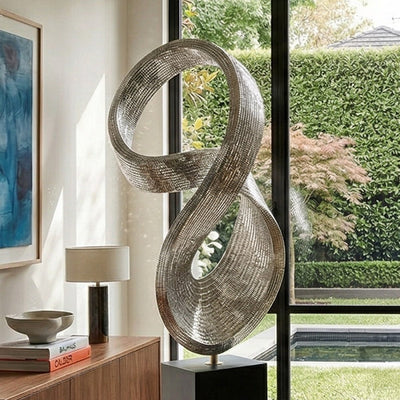
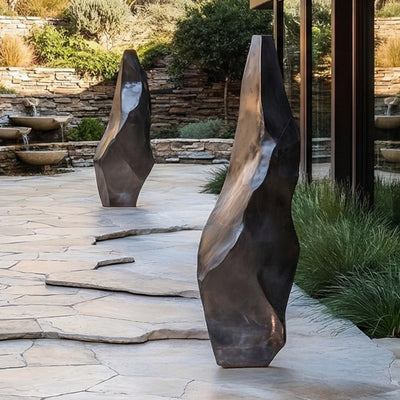
Abstract marble is less common in the UK garden market but increasingly commissioned for contemporary architectural projects. If your house is modernist, an abstract carved form will sit far more comfortably than a classical figure. This is bespoke territory; we work directly with the sculptor on form, scale and finish.

Seasonal care that takes ten minutes a year
For general conservation principles, Canadian Conservation Institute outdoor object care is a useful external reference, though the final care routine should always follow the material and finish specified for the individual commission.
The reassuring thing about marble garden statues is how little maintenance they actually need if you have installed them properly. Forget elaborate routines. This is the real checklist.
Spring
- Brush off loose debris with a soft natural-bristle brush.
- Wash with clean water and a small amount of pH-neutral soap. No vinegar, no lemon, no bleach, no acidic descalers.
- Check the joint between statue and plinth for any movement or open cracks.
Summer
- Inspect for biological growth, particularly on the shaded side. A soft brush and water deals with most of it.
- For stubborn lichen, use a biocide formulated for natural stone, applied sparingly. The Institute of Conservation can point you to qualified stone conservators if a piece needs specialist attention.
Autumn
- Clear fallen leaves promptly. Wet leaves left on a horizontal surface stain marble surprisingly quickly.
- Check drainage around the base is still working after a wet summer.
Winter
- For exposed pieces in colder regions, a breathable fitted cover during the worst frosts is sensible. Never use plastic sheeting against the stone, as it traps moisture.
- Do not de-ice with salt anywhere near the statue.
What you must not do, ever, is reach for a pressure washer. It will drive water deep into the pores of the stone and erode detail in a single afternoon. Likewise, avoid generic patio cleaners; most are acidic.

Commissioning a marble garden statue with Giant Sculptures
If you cannot find the right piece in the existing Large Garden Statues range, a bespoke commission is the route most of our serious clients take. The process is straightforward: we discuss subject, scale, stone, setting and budget, then return concept sketches, then a maquette, then carving. Lead times depend on complexity and the sculptor's workload. Pricing is driven by the stone selected, the size, the difficulty of the carving, the plinth engineering and the installation requirements, which is why we always quote individually rather than offering a tariff.
A marble garden statue chosen and installed well will outlive the people who commissioned it. That is the whole point. Five winters is nothing; it should still be there for fifty.
For wider placement ideas, Outdoor Sculptures Unveiled: Essential FAQs for Stunning Garden Décor is useful companion reading before finalising the setting and sightlines.