






































































































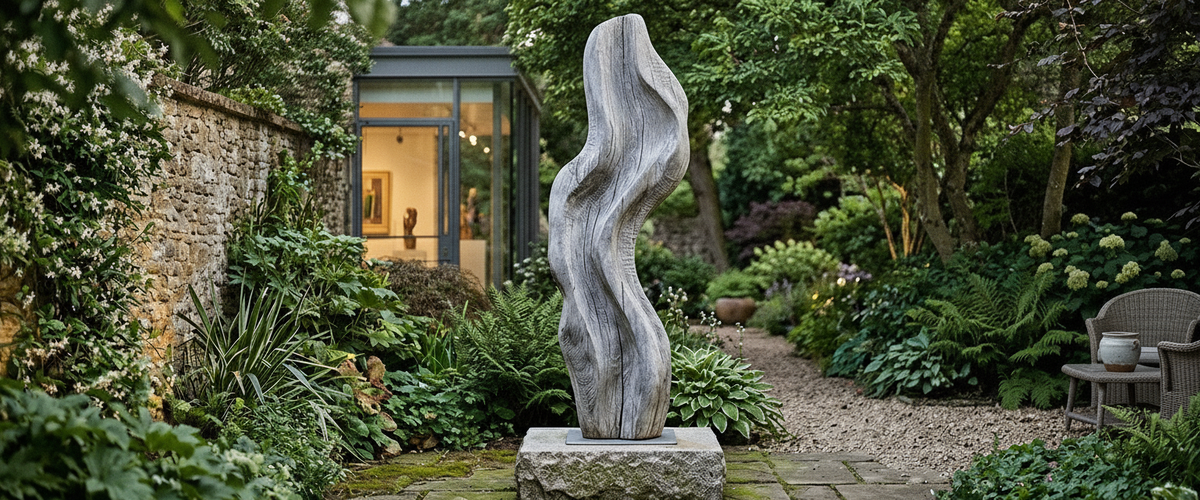

Most outdoor timber sculptures that fail do not fail where anyone is looking. They fail at the base, in the first few inches of end grain sitting on damp soil, long before the carved face shows a single check or crack. If you are planning a garden of large wooden sculptures, or even a single statement piece, start with your boots on the ground rather than the view from the terrace. Drainage, airflow and shade will decide how a piece ages far more than the carving itself.
At a glance
Lift end grain off wet ground with a steel shoe, stone plinth or stand-off.
Favor open, breezy spots over sheltered, still corners.
Expect oak, cedar and larch to weather to silver-gray, and plan a backdrop that flatters it.
Scale large wooden sculptures to the hedge line or tree canopy, not the patio furniture.
Walk the site in wet weather before you commit.

Why Timber Rots From the Bottom First
Wood decay fungi need water. The USDA Forest Products Laboratory's Wood Handbook sets the practical threshold at around 20 percent moisture content: keep timber drier than that and rot struggles to get started. The trouble is end grain. It behaves like a bundle of drinking straws, and a large wooden sculpture standing directly on a lawn takes a long drink every time the sprinklers run.
That is why the base deserves more thought than the silhouette. A carved top can shed rain and dry in an hour of sun. A base buried in turf or mulch can stay wet for weeks, and once the bottom softens, the whole piece starts to lean.
Lawn, Woodland Edge or Gravel Court: Read the Drainage Before the View
Each of the three classic garden settings asks a different question of large wooden sculptures in the garden.
Open lawn. Good sun and wind, but irrigation, mower strikes and string trimmers all attack the base. Plan a mowing strip or hard apron around the footing.
Woodland edge. Atmospheric and forgiving to the eye, yet leaf litter piles up against the base, shade slows drying and fungal spores are already in residence. Budget for regular clearing.
Gravel court. Often the kindest setting, provided the sub-base actually drains. Gravel laid over compacted clay simply hides a puddle.
A quick test we recommend: dig a hole about a foot (30 cm) deep where the piece will stand, fill it with water and come back in a few hours. If it is still full, the location needs engineering, or a different spot.

Plinths and Steel Shoes for Large Wooden Garden Sculptures
The fix for wet ground is separation. On most large wooden sculptures we specify one of three details. A stainless steel shoe cups the base and is bolted to a concrete footing below grade. A stone plinth in granite or dense limestone lifts the whole piece into drier air and gives it a pedestal presence. Hidden stainless stand-off pins hold the timber an inch or more (25 mm plus) clear of the plinth so water drains away instead of pooling under the end grain.
Stainless stand-off pins keep the oak's end grain clear of the plinth so rainwater drains away.
Whatever the detail, give the top surface of the plinth a slight fall and keep every fixing stainless. Oak is rich in tannins, and ordinary steel leaves black iron stains that bleed down the grain within a season. Get the separation and the fixings right at installation and the base of a large wooden sculpture can stay dry for years, which is the whole point of the exercise.
Why a Sheltered, Still Corner Can Be the Worst Spot
Clients instinctively tuck large wooden sculptures into a protected nook, assuming shelter equals protection. Usually the reverse holds true. A walled courtyard with no breeze holds morning dew until midday, and green algae follows. A cedar figure in an enclosed, shaded courtyard can go green on its shaded flank within a single winter. Moving it a few yards out into a cross-breeze is often enough to dry it out and keep the growth from returning.
Moving air is the cheapest preservative there is. If you must use a sheltered spot, choose one that catches afternoon sun and keep planting a good arm's length away from any large wooden sculpture.
Oak, Cedar and Larch Turning Silver, and the Backdrop That Silver Needs
Left unfinished, all three species weather to silver-gray as sunlight breaks down the surface lignin and rain rinses it away. They get there at different speeds. Cedar is lighter and grays quickly and evenly. Larch carries more resin and takes on a slightly warmer gray. Oak is the slowest and moodiest, often patchy for the first couple of years before it settles.
The common mistake with large wooden sculptures outdoors is ignoring what sits behind that silver. Against a pale limestone wall or a weathered gray fence, a silvered sculpture simply vanishes. Against dark yew, clipped boxwood or copper beech, it glows. Choose the backdrop for the piece's tenth year, not its first week.
A dark yew backdrop lets weathered cedar read clearly from across the lawn.

Scale It to the Hedge Line, Not the Patio
Something that looks enormous in the workshop shrinks fast outdoors. Gardens are read from distance, and an 8-foot (2.4 m) hedge or a mature tree canopy resets the eye. When sizing large wooden sculptures for the garden, measure against the tallest green structure in the sightline, then check the view from the house, where most of the looking actually happens.
A practical trick from our site visits: stand a stepladder or a few bamboo canes draped in a sheet where the piece will go, then walk back to the terrace. If the mock-up reads as timid, go bigger.
What We Walk the Site for Before an Outdoor Timber Commission
For wider placement ideas, Choosing a Large Angel Garden Statue Starts With the Wings is useful companion reading before finalizing the setting and sightlines for large wooden sculptures in a garden.
Before Giant Sculptures takes on a bespoke timber commission, we want answers to these questions:
How does the ground drain after heavy rain, and where does water run off?
Where are the irrigation heads, and can any of them be moved?
Which way does the prevailing wind blow, and does the spot actually catch it?
How many hours of direct sun reach the piece, and at what time of day?
What sits behind it from the main viewing point, now and at maturity?
Can a truck, crane or telehandler reach the spot for installation?
Is the owner happy to watch timber gray, or do they expect a finish that needs upkeep?
Sometimes the honest answer is that a site is wrong for large wooden sculptures and wants metal. A boggy hollow or a deeply shaded courtyard may suit bronze or stainless steel far better than wood, and we will say so. You can compare materials across our full sculpture collection before deciding.
Budget for large wooden sculptures follows the same logic as placement. Species, scale, carving complexity, the engineering of the base, shipping and installation all shape the final figure, so the most useful next step is a tailored quote built around your site rather than a generic number. If you have photos of the spot taken after rain, send them with your brief; they tell us more than any garden plan.