






































































































Placing large resin statues gardens rely on as focal points is a scale problem before it is a taste problem. Most disappointing garden sculptures are not badly made; they are badly positioned. A piece that looked commanding in a warehouse or on a screen shrinks the moment it sits ten feet from a mature oak or gets swallowed by a busy planting bed. This article shows you how to place a large resin statue so it holds the space: where to stand it, how high to lift it, what belongs behind it, and when a more permanent material serves you better. Before you choose the subject, answer one question: where exactly is this going to live, and what is the eye doing when it arrives there?
Looking for the full range in this category? Browse our Fiberglass Sculptures collection for every available finish, size, and configuration.
Answer that well and even a modest figure reads as a considered focal point. Answer it badly and a genuinely large piece looks like an afterthought parked on the lawn. That gap between success and failure is why large resin statues gardens plan around always start with the site.

Key Takeaways for Large Resin Statues in Gardens
- Scale is relative. A statue reads against its surroundings, not its own height. A 6 ft (1.8 m) figure against a tall hedge looks smaller than a 4 ft (1.2 m) piece in an open courtyard.
- Pedestal height changes everything. Raising a piece 12 to 24 inches (30 to 60 cm) can turn a floor-level ornament into a landmark.
- Backdrop and contrast decide impact. A pale figure needs a dark, calm background; a dark bronze-look finish needs light behind it.
- Resin has real limits outdoors. Quality and UV protection vary widely, which is why we usually steer serious garden commissions toward bronze, stainless steel, or stone for permanence.

What Large Resin Statues for Gardens Actually Look Like in Different Settings
The same figure behaves differently depending on where it stands. Set a tall, upright piece at the end of a straight gravel path and it becomes the natural stopping point for the eye; the geometry of the path does half the work. Put that identical statue in the middle of a soft, layered border and it fights the planting instead of leading it. This is where most large resin statues gardens use as centerpieces succeed or fall flat.
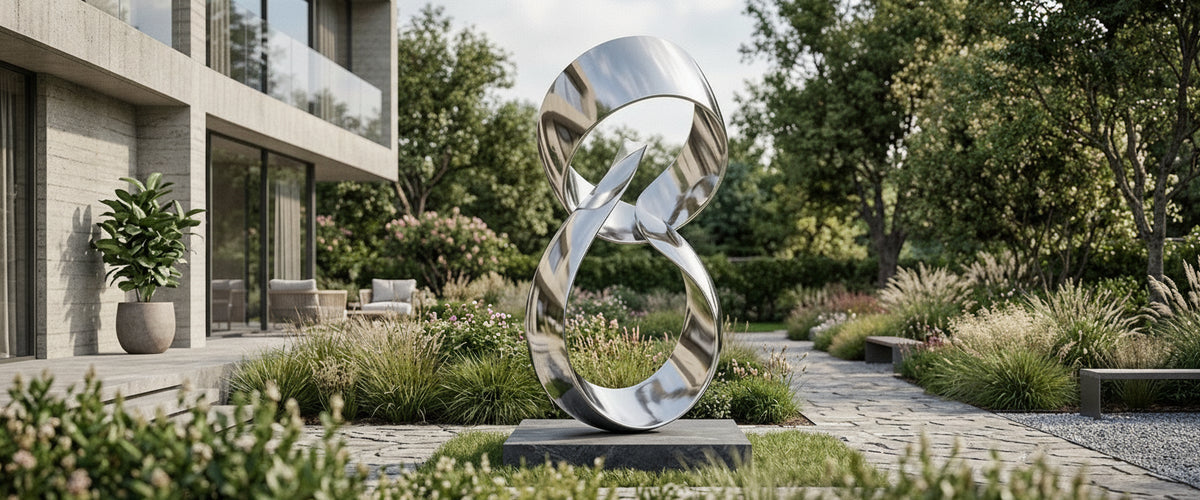
Formal gardens want symmetry and a clear axis. Picture a pale classical figure closing the view down a clipped avenue, the kind of arrangement you see in large estate gardens. Contemporary gardens do the opposite. A single abstract form on a low plinth, off-center against a rendered wall, reads as deliberate and modern. A woodland or naturalistic garden can take a reclining or crouching figure tucked slightly off the main path, so it feels discovered rather than displayed. The best large resin garden statues get matched to the style of the space, not dropped in against it.
Indoors, the rules tighten. A large statue in an entrance hall or a double-height living space needs breathing room on all sides and a clear sightline from the front door. Crowd it against furniture and the scale you paid for evaporates.

Scale, Sightlines, and Pedestal Height
Three choices control how a piece reads, and buyers usually underweight all of them. Get these right and large resin statues in gardens hold their own; get them wrong and even a big piece disappears.
Scale against context. Before you commit to a height, stand where the viewer will stand and picture the piece against what is actually behind it. A statue silhouetted against open sky needs more physical mass than one framed by a low wall. As a rough working rule from commissions we have shipped: if the piece will sit against tall trees or a large building, size up rather than down. Backgrounds eat height.
Sightlines. Walk the approach. Where does the statue first come into view? Is it seen head-on, in three-quarter, or from behind as you leave the house? A figure designed to be read from the front looks awkward if the main approach shows its back. For a piece meant to be circled, like an abstract or an animal form, plan for at least one clear walk-around radius.
Pedestal height. This is the cheapest, most underused lever you have. Lifting a figure onto a plinth raises the focal point toward eye level, adds formality, and protects the base from splashback and mower damage. A 12 to 18 inch (30 to 45 cm) plinth suits most large resin statues gardens keep at standing height; go taller for a piece meant to dominate a courtyard. Keep the pedestal proportion honest, though. A slab that is too chunky makes the sculpture look stranded.

Indoor Versus Outdoor: When Each Wins
Resin, sometimes sold as fiberglass or composite, is light and can be finished to imitate bronze or stone convincingly. That lightness is its selling point and its weakness. Indoors, a resin statue is a sensible choice. It moves easily, needs no crane, and a good faux-bronze finish looks the part in a hallway or gallery space.
Outdoors, the calculation is harder. UV exposure, freeze-thaw cycles, and standing water are the enemies of lower-grade resin. Color can fade and surfaces can chalk if the material was not properly UV-stabilized. This is the honest limit behind large resin statues gardens want to keep for the long haul. The Smithsonian's conservation guidance on outdoor sculpture is blunt about how weather, pollutants, and moisture degrade unprotected surfaces over time, which is why material choice matters as much as placement (Smithsonian Museum Conservation Institute).
For a genuine long-term garden centerpiece, we usually recommend a more permanent material. Cast bronze develops a stable patina and lasts for generations outside. Stainless steel handles coastal and wet climates and reflects the sky in a way that suits contemporary planting. Stone and marble bring weight and permanence that resin cannot match. If a client is set on resin for a large outdoor figure, we are honest about the trade-offs and often propose the same subject cast in metal instead.
Light, Backdrop, and Contrast
Light does more for a sculpture than any amount of detail in the modeling. Watch how the sun tracks across the intended spot. Raking light early and late in the day carves out form and shadow; flat midday light flattens everything. If the piece only ever gets harsh overhead sun, it will look duller than it should. Lighting is where large resin statues gardens showcase after dark either shine or vanish.
Backdrop is the other half of the equation. A dark yew or beech hedge behind a pale figure gives you clean silhouette and contrast; that is the classic reason estate gardens plant hedging as a green wall behind statuary. Reverse it for a dark finish. A near-black or bronze-look piece needs light behind it, whether that is open sky, a pale rendered wall, or water.
For night impact, plan lighting at the same time as placement, not after. A single warm uplight from the front-side quarter throws form into relief without washing it flat. Backlighting an abstract or a piece with negative space turns it into a silhouette after dark, which can be the most dramatic view of the day.
Common Placement Mistakes We See in Commissions
For wider placement ideas, Large Buddha Garden Statues: How Scale and Placement Decide the Whole Effect is useful companion reading before finalising the setting and sightlines.
The same errors come up again and again with large resin statues in gardens, and every one is avoidable.
- Buying for the driveway, not the destination. People size a statue against the delivery truck or the studio floor, then find it looks small in an open garden. Size against the final backdrop.
- Dead center by default. Middle-of-the-lawn placement is rarely the strongest. An off-axis position against a wall or hedge usually reads better and gives the piece something to sit against.
- Skipping the pedestal. A large figure at ground level loses presence and collects splashback. A plinth solves both.
- Ignoring the approach view. A statue oriented to the wrong sightline shows its least interesting angle to arriving guests.
- No thought for winter. Deciduous planting that frames a piece in July leaves it exposed and stranded in January. Evergreen structure behind the sculpture keeps it anchored year-round.
- Wrong material for the climate. A resin piece in a hard-frost region or on a salt-air coast is a maintenance problem waiting to happen. Match material to conditions first.
A Quick Placement Checklist
- Stand at the main viewing point and picture the piece against its real backdrop.
- Confirm the approach angle and which face of the sculpture arrives first.
- Decide pedestal height to lift the focal point toward eye level.
- Check sun path for raking light and plan any night lighting now.
- Ensure evergreen structure or a wall gives contrast in every season.
- Pressure-test the material against your climate before you commit. This last step separates large resin statues gardens keep briefly from pieces that last.
Commissioning a Piece That Fits the Space
The advantage of a bespoke commission is that scale, pose, finish, and base are all designed around the actual spot rather than picked from a shelf. Unlike stock large resin garden statues, a commission answers the site first. At Giant Sculptures we work from the site outward: the sightlines, the backdrop, the climate, and how the piece will be read across the seasons. That is also where we advise on material honestly. If a garden needs something that will still look right in twenty years, we will talk you toward bronze, steel, or stone rather than a resin figure that suits an interior better.
Get the placement right and the sculpture stops being decoration. It becomes the reason the garden holds together, and it is why large resin statues gardens plan carefully reward the effort.