































































































A large fiberglass garden sculpture will either stop you in your tracks from the far end of a lawn, or it will sit there looking oddly apologetic in a corner nobody walks past. The difference is rarely the piece itself. It is placement. We have shipped statement work to gardens from Napa to the Hamptons, and the pattern is consistent: buyers spend weeks choosing the sculpture and about ten minutes deciding where it goes. That ratio is backwards.
Looking for the full range in this category? Browse our Fiberglass Sculptures collection for every available finish, size, and configuration.
Fiberglass earns its place in the garden for practical reasons. It is light relative to its size, which matters when you are lifting a seven-foot figure onto a plinth or moving a piece across soft turf. A hollow fiberglass figure typically weighs 60 to 120 lbs at that height, against several hundred pounds for the same form cast in bronze. It takes color and gloss beautifully, and a well-built large fiberglass garden sculpture with a marine-grade gelcoat and UV-stable finish holds up outdoors for years. But none of that saves a sculpture that has been dropped into the wrong spot at the wrong height against the wrong backdrop.
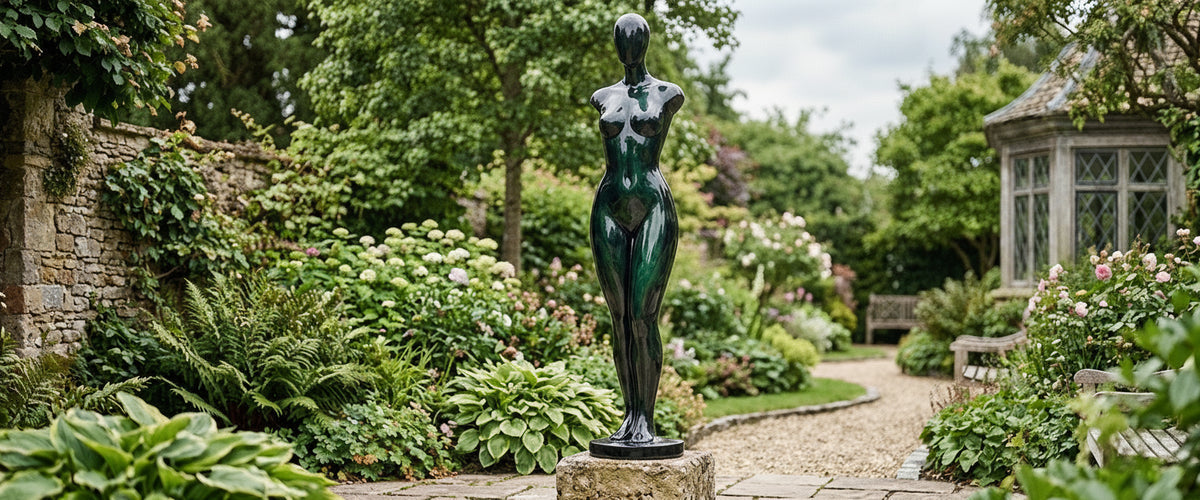
Placement decides impact: a large fiberglass garden sculpture set against a clean backdrop and a primary sightline.

Key Takeaways for a Large Fiberglass Garden Sculpture
Scale to the space, not the room you bought it in. A large fiberglass garden sculpture that felt huge in a showroom can shrink against a wide lawn or a tall hedge.
Pedestal height changes the whole read. Raising a figure even a foot alters sightlines and dignity.
Backdrop and contrast decide impact. A pale sculpture against a pale wall disappears at midday.
Indoor and outdoor placement follow different rules. Light, humidity and viewing distance all shift.
Most placement mistakes are fixable before delivery, which is why we ask about the site before we finish a commission.

What a Large Fiberglass Garden Sculpture Looks Like in Real Settings
Size on a spec sheet lies to you. A sculpture listed at six feet reads as commanding in a courtyard and merely present on a two-acre lawn. The eye judges scale by comparison, so a large fiberglass sculpture always competes with whatever sits near it: a mature oak, a pool house, a boundary hedge trimmed to head height.
Indoors, the math is kinder. In a double-height entrance hall or a gallery-style living room, a large piece has ceilings and walls to push against, and it dominates cleanly. Outdoors, the sky is the ceiling, and the sky is enormous. That is why a figure that looks generous in a great room can feel undersized the moment you carry it out to the terrace. When clients tell us the large fiberglass garden sculpture is for a wide, open garden, we almost always steer them larger than their instinct, often by a full foot or two of height.
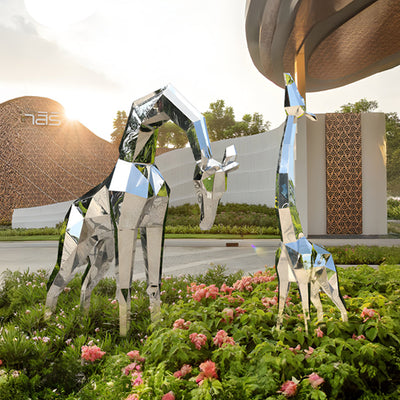
Setting also changes the mood of the same object. A crouching animal figure reads playful on a lawn edge, watchful at the top of steps, and almost heraldic on a plinth flanking a gate. Nothing about the sculpture changes. Only the story around it does.

Scale, Sightlines and Pedestal Height
Three decisions do most of the work, and pedestal height is the one buyers underrate most.
Start with the primary sightline. Where will people actually see this piece from? For most gardens it is the back of the house, through a kitchen or living room window, or from a seating area. Stand at that spot before you commit to a location for your large fiberglass garden sculpture. A piece placed for how it looks when you are standing next to it often disappears from the view that matters, which is the one you get with a coffee in hand every morning.
Pedestal height then sets the sculpture's relationship to the viewer. A figure at ground level invites you to share its space; the same figure raised on a two-foot stone plinth becomes a focal point you look up to. For a classical or heroic pose, height adds gravity. For a naturalistic animal, keeping it low can make it feel like it wandered in. There is no universal rule, only a rule of intent: decide whether you want intimacy or authority, then set the height to match.
Watch the horizon line too. A large fiberglass garden sculpture whose silhouette breaks above a hedge or wall reads sharply against sky. Drop it so the top sits below the hedge line and it merges into a busy background of foliage and loses its edge. If you want a piece to command a long view, give its outline something clean to sit against.
A two-foot plinth lifts the figure above the hedge line and into the view from the house.

Indoor Versus Outdoor: When Each Wins
Fiberglass suits both, but the arguments differ. Outdoors, a large fiberglass garden sculpture wins on weight and weather. It can go where a bronze of the same size would need a reinforced base or a crane, and a quality gelcoat resists UV and rain far better than untreated resin. For rooftop terraces and balconies where load limits are tight, the weight advantage is decisive.
Indoors, fiberglass wins on ambition. You can install a genuinely large piece without worrying about floor loading, and a hand-finished gloss surface reads convincingly under interior light. The trade-off is that indoor viewing distances are shorter, so surface finish gets scrutinized closely. Any seam line or repair shows more under a downlight than it ever would across a lawn.
If longevity outdoors in a harsh climate is your priority, and budget allows, it is worth comparing your large fiberglass garden sculpture against metal before you commit. UV exposure is the main enemy of any polymer finish; the U.S. National Weather Service notes that UV levels are strongest between 10 a.m. and 4 p.m., which is exactly when most gardens are used and when a gelcoat works hardest. For high-exposure coastal or mountain sites, some clients move to a marine-grade option or step up to metal entirely; our stainless steel sculptures and bronze sculptures handle decades of weather with different maintenance profiles. Fiberglass remains the smart choice when scale, color and weight matter more than a hundred-year lifespan.
Light, Backdrop and Contrast
Light does more to a large fiberglass garden sculpture than any other single factor, and it is the one thing buyers plan for least.
Track the sun across your chosen spot for a full day. A glossy white figure that looks pristine at 8 a.m. can flare into a shapeless bright blob under hard noon sun, its form flattened by glare. Matte or mid-tone finishes hold their shape better in strong light. Side light, low in the morning or evening, rakes across the surface and reveals modeling; overhead noon light kills it. If the piece only ever gets seen at midday, choose a finish and color that survive it.
Backdrop is the quiet decision that makes or breaks contrast. A dark bronze-tone piece pops against a pale rendered wall or a clipped light-green hedge. A pale or metallic large fiberglass garden sculpture needs a darker foil: a yew hedge, a shaded pergola, a slate wall. The mistake we see constantly is a light piece set against a light wall, where it simply vanishes at the times of day the garden is used most.
For lawns, remember that grass reads as a mid-tone that shifts with the seasons. What contrasts nicely in high summer can look muddy against a wet spring lawn. If your garden changes dramatically through the year, plan the sculpture around its worst-case backdrop, not its best.
Common Placement Mistakes We See in Commissions
For wider placement ideas, Large Buddha Garden Statues: How Scale and Placement Decide the Whole Effect is useful companion reading before finalising the setting and sightlines.
Over enough shipped commissions, the same errors repeat. Avoid these and you avoid most of the regret.
Buying for the showroom, not the site. A large fiberglass garden sculpture that dominated indoors often needs to be a size up for open ground. Measure the space and the sightline, not just the object.
Setting it too low. Ground-level placement on a wide lawn makes even a large piece look lost. A plinth reclaims presence.
Ignoring the walk-up. A sculpture read only from one angle can look awkward from the approach. Walk the paths people actually use and check the piece works in the round.
Crowding it. Planting right up to the base, or squeezing it between furniture, robs a large piece of the breathing room it needs to read as a focal point. Leave at least 3 feet of clear ground around the base.
Forgetting anchoring. Fiberglass is light, which is a gift for handling and a liability in wind. A large fiberglass garden sculpture in an exposed garden needs proper fixing to a base or ground anchor. We build fixing points into pieces headed for windy or coastal sites.
Poor foundation. Soft turf settles unevenly. A large sculpture wants a level, load-spreading base beneath it, even if that base is then hidden by planting.
Commissioning a Large Piece That Fits Your Site
The reason we ask so many questions before finishing a bespoke large fiberglass garden sculpture is that placement is a design input, not an afterthought. When a client sends us photos of the intended spot, the sightline, and the surrounding planting, we can advise on size, finish color, gloss level and pedestal height before the piece is built rather than after it arrives.
Fiberglass gives us room to be ambitious with scale and shape, and to color-match a finish to a specific garden scheme. It also lets us build large, characterful figures. If you have been searching for where to buy a large fiberglass pig sculpture or another oversized animal, the same placement logic applies: an animal figure needs the right ground, the right height and the right backdrop to read as confident rather than stranded. Giant Sculptures builds these as bespoke commissions and finishes them for outdoor life, so the large fiberglass garden sculpture you place is engineered for the site it is going to.
Whichever direction you go, decide the location before you finalize the sculpture. It is the cheapest way to guarantee the piece looks as good in your garden as it did in your head.