







































































































A Greek statue placed in the wrong corner of a garden looks lost, like a dinner guest who walked into the wrong party. Each of these figures comes with a story, and the best Greek statues for garden settings work because the planting around them tells the same story: a goddess of the harvest among fruit trees, a sun god at the end of a long, bright axis. Get that match right and a single figure can organize an entire acre. Get it wrong and even fine carving reads as a garden-center ornament.

At a Glance
Wild figures for wild places: Pan, Artemis and Demeter suit woodland, meadow and orchard.
Formal figures for formal lines: Apollo and athletic figures belong on axes, long lawns and terminating views.
Sets need rhythm: Muses and Seasons read best evenly spaced against a dark, continuous backdrop.
Material follows climate: bronze tolerates almost any climate, while marble is happiest where winters are mild.
Size up: most buyers underestimate scale once mature trees enter the picture.
Every Figure Carries a Story
The Greeks gave their gods home territory. Pan haunted the hills of Arcadia, Artemis hunted in forests, and Demeter governed the plowed field. Eighteenth-century landscape makers took that geography seriously. At Stowe, temples and statues were sited so that walking the grounds meant reading a sequence of ideas. You do not need a thousand acres to borrow the method. Ask one question before choosing Greek statues for garden use: what kind of ground does this character belong to?
Pan, Artemis and Demeter at the Wild Edges
Among Greek statues for garden edges, these three look awkward on a manicured lawn and completely at home where the garden loosens. Pan wants rough grass, ferns and a little shade. A weathered figure half-glimpsed through birch trunks carries more charge than one fully revealed. Artemis, usually caught mid-stride with a bow or a hound, needs a woodland path or clearing, somewhere a visitor comes upon her rather than facing her head-on. Demeter is the goddess of grain and harvest, and she belongs on cultivated ground. Wheat sheaves, a cornucopia and a calm standing pose suit rows of olives, apples or vines.
Picture a Demeter at the far end of an olive allée rather than beside the house. From the terrace she reads as a small pale accent; walk the row and she grows into the destination. Keep planting around Greek garden statues like these loose and let meadow grasses brush the base. A crisp gravel circle undoes the mood.
Demeter at the end of an olive row: a small accent from the terrace, a destination up close.

Apollo and the Athletes on the Axis
Apollo, god of light, music and order, is the opposite case. He belongs where the garden is most geometric: the center line of a parterre, the end of a long lawn, a terminating view framed by clipped hornbeam. Athletic and heroic figures share that discipline, which makes them the most formal Greek statues for garden axes. Their balanced contrapposto stance and squared shoulders read clearly from the front and from a distance, which is exactly what an axis delivers.
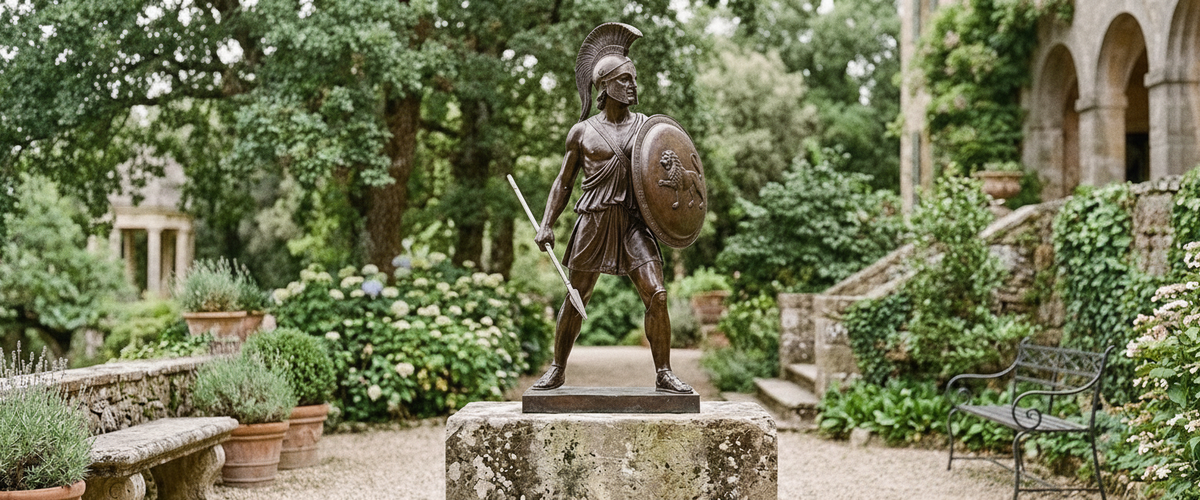
Distance is the trap with formal Greek garden statues. A figure that feels commanding in the studio shrinks fast at 150 feet (about 46m). On a long Texas ranch lawn or a deep Hamptons garden, the terminating figure usually needs to go well beyond human height, and a heroic bronze on the order of the 300cm classical Greek warrior (roughly 9 feet 10 inches) holds the eye in a way a figure at human height cannot, especially once it sits on a plinth.
On an axis, a figure well above human height, raised on a plinth, still reads clearly from the house.
Muses and Seasons in Sets
The nine Muses and the four Seasons were made for repetition, which makes them the most architectural Greek statues for garden terraces. Spaced along a balustrade or set into niches cut into a yew hedge, they create a rhythm the eye follows down the garden. Two rules matter. Keep spacing even and generous, because crowded figures merge into a single pale smear. And give them a dark, continuous backdrop; yew is ideal, since its near-black green makes both stone and patinated bronze stand forward.
If a full set is beyond the space, a pair or a trio of Greek garden statues still works, and so do classical busts on piers. Where the garden is too short for a terrace of Muses, a marble bust such as the Greek Philosopher Marble Bust, about 35 inches (90cm) tall, set on paired piers at the entrance to a yew walk, carries the same learned tone at a fraction of the length.

Marble, Cast Stone or Bronze: What Each Climate Flatters
Marble is the material most people picture when they think of Greek statues for garden display, and in Southern California, Arizona or a Mediterranean-style Napa garden it ages gracefully. Where hard freeze-thaw cycles are normal (Aspen, the Northeast, much of the UK), water enters the stone, freezes and slowly roughens the surface, a condition conservators call sugaring. Marble in those climates needs a sheltered position, a breathable sealant and winter covers, or an owner who is happy to watch it change.
Cast stone is the practical choice for sets of Greek garden statues and for softer, romantic settings. Made from graded aggregate and cement to imitate cut stone (the Cast Stone Institute publishes the industry standards), it takes lichen and moss readily, which suits Pan in the woods far better than gleaming marble does.
Bronze is the most forgiving material in any climate. It handles frost, coastal air and desert heat well, and its patina deepens over decades. A yearly wax is the main upkeep. For axis figures and any Greek garden statue exposed to weather on all sides, it is what we recommend most often.
Bought a Size Too Small? Scaling Against Trees and Hedges
This is the regret we hear most about Greek statues for garden spaces. A buyer measures the figure against a person rather than against the garden, and the statue that looked heroic in photographs ends up dwarfed by a 25-foot (about 7.6m) oak. Mature planting is the real yardstick. Against a hedge, the top of the figure, plinth included, should at least reach the hedge line and usually clear it. Against trees, judge by canopy height, not trunk.
Our studio's simplest test costs nothing: stand a pole at the chosen spot, tape it at the proposed height, then look from the terrace, the main window and the far end of the view. Done honestly, the test usually argues for more height, not less. Clients who expect a bronze like the Monumental Classical Greek Warrior (about 8 feet 2 inches) to overwhelm the space are often surprised. Outdoors, with open sky behind it, it rarely does.

Choosing Greek Statues for Garden Settings: A Buyer's Checklist
Story: does the figure belong to this kind of ground, wild or formal?
Viewing distance: measure from where it will mostly be seen, not where it stands.
Backdrop: is there a dark hedge, wall or tree line for it to read against?
Climate: will marble face freeze-thaw, salt spray or acid rain?
Foundation and access: can lifting gear reach the spot, and will the ground take the weight?
Plinth: treat it as part of the piece; it changes perceived scale more than people expect.
Single or series: if you may add figures later, fix material and finish now so the set matches.
Commissioning a Figure That Fits the Story
Catalog pieces suit many gardens, but bespoke Greek statues for garden sites can answer the setting directly: Artemis turned to face the path you actually walk, Demeter holding fruit from your own orchard, a set of Seasons cast to suit your hedge spacing. Giant Sculptures works with homeowners, garden designers and architects on bespoke figures in bronze, marble and stone. Budget depends on material, scale, complexity, engineering, installation and finishing, so send us a site plan and a few photographs and we will come back with a tailored quote and a clear recommendation on size.
For wider placement ideas around Greek garden statues and other outdoor bronze, Bronze Garden Bird Sculpture: When Verdigris Reads as Plumage and When It Reads as Neglect is useful companion reading before finalizing the setting and sightlines.