





































































































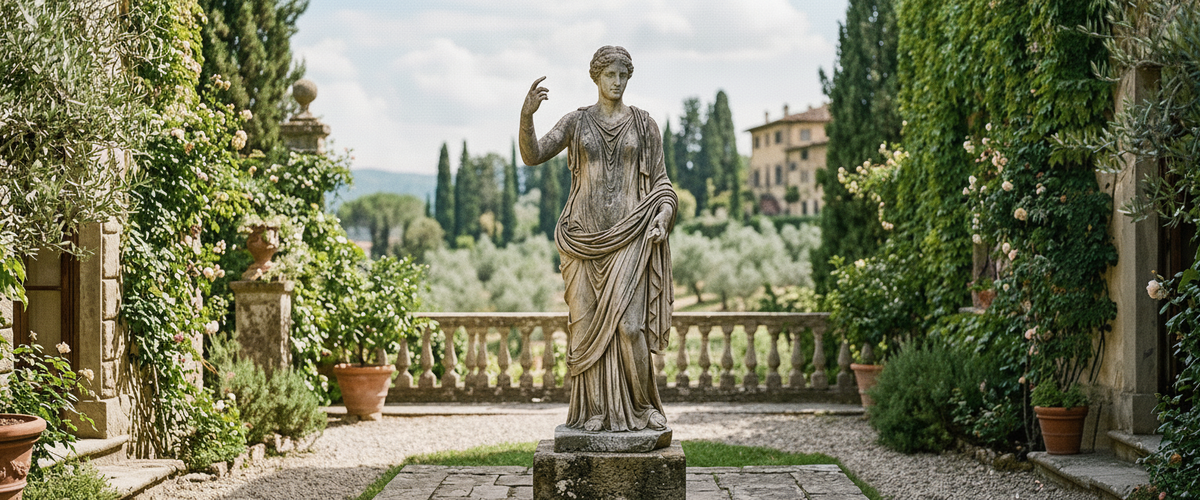

A Carrara goddess can leave the studio looking like polished ice and read chalky, gray and slightly furred after enough winters outside. That is the part almost nobody warns buyers about when they shop for Greek garden statues: the material decision made on day one is really a decision about what the piece looks like in year ten. Marble sugars. Cast stone gets dirty in a way that flatters it. Bronze moves color whether you want it to or not. None of that is a fault, and all of it is predictable if you know what you are buying.

Greek Garden Statues at a Glance
Carrara and statuary marble: beautiful, carveable, and vulnerable to acid rain and freeze-thaw. Best in dry, mild climates or under partial cover.
Cast stone: weathers to a dirty, mottled surface that reads convincingly archaeological. Forgiving and heavy.
Bronze: the long-game choice for exposed sites. Applied patina and natural verdigris behave very differently over five winters.
Reconstituted marble and resin composites: crisp detail, lower weight, but the binder can amber and chalk under UV.
Foundations matter more than finish: frost heave ruins more installations than any accident on site.
Polish goes first, then the surface turns granular: conservators call it sugaring.
Carrara Marble in Rain: The Sugaring Nobody Mentions
Marble is calcium carbonate, which means slightly acidic rainfall slowly dissolves the crystal boundaries at the surface. The polish goes first, then the surface starts to feel granular, like wet sugar. Conservators call it exactly that. Once sugaring starts you cannot polish it back; you can only slow it down.
This is why a marble Aphrodite in a Napa courtyard with overhead canopy behaves nothing like the same carving on an exposed Hudson Valley lawn. Face-up surfaces suffer most: shoulders, the crown of the head, the top of an outstretched forearm. If a client is set on marble outdoors, we push for a sheltered aspect, a plinth that keeps the base clear of splashback, and an annual gentle wash with clean water and a soft brush. No pressure washing, ever. Acidic or bleach-based cleaners are worse than doing nothing. That is the trade with marble Greek garden statues: maximum crispness on day one, minimum patience for weather.

Cast Stone Weathers Dirty, and That Suits a Greek Figure
Cast stone does something marble cannot: it collects grime unevenly and starts to look excavated. Rain runs off the nose and shoulders and leaves the recesses darker, so drapery folds gain depth and the modeling reads better from a distance. Moss and lichen take hold in the shaded quarters within a couple of seasons.
Most buyers of Greek statues for garden settings want that effect without realizing it. The mistake is scrubbing it off every spring. Cast stone Greek garden statues gain from grime rather than suffer for it, so let the piece dirty down for three or four years, then decide whether you want to lift the worst of the biological growth. Cast stone is also porous, so it needs the same frost discipline as marble: water in the pores expands, and expansion spalls corners.
Bronze Verdigris Against Applied Patina After Five Winters
For open lawns and terraces, bronze is where we steer most exposed-site commissions, and the reason is simple: it fails gracefully. An applied chemical patina, whether a warm brown, a dark liver or a green, is controlled surface chemistry sealed with wax. Left alone in a wet climate, the piece will start generating its own copper carbonates on top of that, and the two layers negotiate over a few seasons. Rain-washed areas go lighter and greener; sheltered undercuts hold the original tone. Sculptures under regular irrigation spray develop streaking fast, particularly if the water is hard.
Rain-washed shoulders green first while sheltered undercuts keep the applied tone.
Waxing once or twice a year is the whole maintenance program for outdoor bronze, and the American Institute for Conservation offers clear guidance on caring for outdoor sculpture if you want the conservator's version. For a fully exposed lawn or terrace, a cast figure such as the Life-Size Classical Greek Warrior Bronze Sculpture - 250cm (roughly 8 ft 2 in) is specified differently from a sheltered piece: heavier cast wall thickness, a welded internal armature, and a patina chosen for the aspect it will actually face rather than for the showroom.

Reconstituted Marble and the Resin Binder That Ambers
Reconstituted marble mixes crushed stone with a resin binder, and it holds fine detail extremely well. The catch is UV. Within a few years, especially on south-facing elevations in Texas or Southern California, the binder can yellow and the surface can chalk where it has broken down. White figures shift warm, and that shift is not reversible. For a shaded loggia or an interior atrium, composite Greek garden statues are a sensible way to get scale without weight. For a full-sun terrace you want stone or metal.
Where the Water Sits: Drapery, Raised Arms and Hollow Bases
The classical poses behind most Greek garden statues are full of water traps. Drapery folds catch and hold rain. Raised arms create horizontal surfaces at the elbow. Laurel wreaths and helmet crests act like gutters. Hollow-cast bases fill up if the foundry did not vent them properly, and in a hard freeze that trapped water works like a wedge inside your sculpture.
We check three things on every classical commission before it ships: discreet weep holes at the lowest internal point, drainage cut into any cupped drapery pocket, and a base detail that sits the metal or stone proud of standing water. A client in Aspen once sent us photos of an ice plug growing out of a figure's base like a candle. The sculpture survived; the plinth cap did not.
Frost Heave, Footings and the January Lift That Cracks a Plinth
Heavy Greek garden statues do not sink. They lift. Wet soil freezes, expands, and jacks the footing upward, then thaws unevenly and drops it back out of level. Do that three winters running and the plinth joints open, mortar cracks, and a full-size figure starts leaning.
The fix is unglamorous. Take the footing below the local frost line, which varies enormously between coastal California and upstate New York, sit it on free-draining compacted gravel rather than clay, and pin the sculpture to a reinforced pad. On slopes, deal with the water above the piece before you deal with the piece. Any reputable installer will ask about soil type and drainage before they ask about the statue.
Full-Size God or Weathered Bust: Which Ages More Gracefully
Full-size figures carry more risk and more reward. Every raised limb is a stress point and a water trap, and the visual failure of a leaning eight-foot figure is obvious from the driveway. A bust is compact, structurally simple, and easier to found correctly. It also weathers more forgivingly, because a face and shoulders that soften with age look older and better rather than damaged. Where a courtyard niche or the end of a hedge walk needs classical presence without a monumental footing, a carved head such as the Greek Philosopher Marble Bust at 90cm (about 3 ft) is the more sensible commission.

If the site can carry it, full height wins on presence. Scale should follow viewing distance: a figure read from 60 ft down a lawn or across a drive loses authority at life size, and stepping up to something like the Life-Size Classical Greek Warrior Bronze Statue - 300cm (close to 10 ft before the plinth) holds a long sightline that a 250cm figure does not. Search for Greek garden statues for sale full size and you will find plenty of pieces that photograph well and few that are engineered for a decade outside. The difference sits in wall thickness, internal armature, venting and how the piece meets its base. Worth remembering too that most famous Greek figures we know are Roman marble copies of lost bronzes, a point the Metropolitan Museum sets out well in its overview of Greek and Roman sculpture. Choosing bronze for your garden is arguably the more historically faithful move.
Checklist Before You Commission Greek Garden Statues
Map the exposure: full sun, prevailing wind, irrigation spray, tree drip line.
Confirm frost depth and soil type with your landscape contractor before choosing scale.
Ask where the water exits the sculpture, not just how it is finished.
Check the plinth is drained and pinned, not simply set on pavers.
Agree sightlines: classical figures are designed to be read from the front and three-quarter view.
Plan access for delivery. Craned placement over a wall changes the install spec entirely.
Budget for material, scale, complexity, engineering, installation and finishing together, and ask for a tailored quote rather than a headline figure.
Commissioning Something Site-Specific
For wider placement ideas, Choosing a Memorial Angel Garden Statue That Ages Well is useful companion reading before finalising the setting and sightlines.
Most of the classical work leaving our studio is adjusted rather than taken off the shelf: height changed to suit a hedge line, patina shifted cooler to sit against gray stone, a base redesigned to bolt into an existing terrace. Giant Sculptures works with private clients, landscape designers and venue owners on bespoke Greek garden statues, and the conversation always starts with the site rather than the catalog. Send us the aspect, the soil, the approach view and the surrounding materials, and the right choice among marble, cast stone and bronze usually becomes obvious within one call.