





















































Put the wrong dragon in the wrong garden and it looks like a prop left behind after a party. Most people shopping for dragon statues for garden settings start with size and material. The first decision is older than either: which dragon? Europe and East Asia built the creature on two different body plans, and each one asks for a different kind of ground.

At a Glance
Western dragons stand upright on four legs with wings. They read best on an axis, at gateways, on terraces and at lawn edges.
Eastern dragons are long, serpentine and wingless. They settle among rock, gravel and water.
Western figures claim height; Eastern figures claim length. Plan the footprint of any dragon statue for garden use accordingly.
In cold climates, thin wings and trailing whiskers are the first parts to suffer. Specify thicker sections, or choose bronze.
Choose one tradition per figure. Hybrids rarely sit well unless they come from an established classical type.
Two Traditions, Two Body Plans
The European dragon is a creature of mass. It has haunches, a barrel chest, armored scales and bat-like wings, and it stands on the ground like a predator guarding something. Its sculptural power comes from weight and silhouette, which is why Western dragon statues for garden terraces need room to be seen whole.
The Chinese dragon, and the Japanese and Korean dragons descended from it, is a creature of line. It has no wings and does not need them. It moves through cloud and water in long S-curves, and in Chinese art it has been tied for centuries to rain, rivers and imperial authority, a lineage you can trace through the collections of the Smithsonian's National Museum of Asian Art. In stone or bronze, that means rhythm matters more than bulk.

Why a Western Dragon on a Lawn Edge Reads as Heraldry
An upright winged dragon carries centuries of association with coats of arms, crests and the supporters that flank a shield. The College of Arms still records dragons and wyverns in grants today. Set one at the end of a lawn or on a gate pier and visitors read it as an emblem first and a fantasy creature second. That is a good thing. It gives Western dragon statues for garden gateways their dignity.
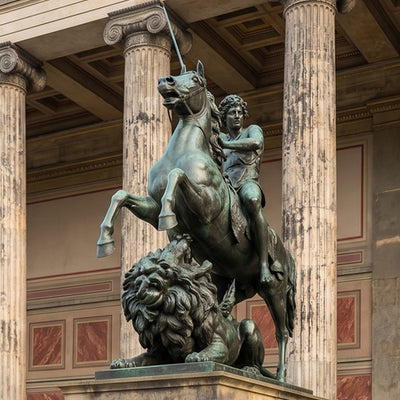
Heraldic figures want symmetry, a plinth and a threshold. Pairs on either side of a drive work well. A single figure at the head of a long vista works too. Once the dragon becomes part of a story rather than an emblem, it needs even more ground: a monumental narrative group such as Saint George and the Dragon in bronze, at 350cm (about 11.5 feet), belongs at the center of a turning circle or the end of a formal axis on an estate drive. Don't tuck it into a shrub border.
Rock, Raked Gravel and Water: Where the Eastern Dragon Looks Settled
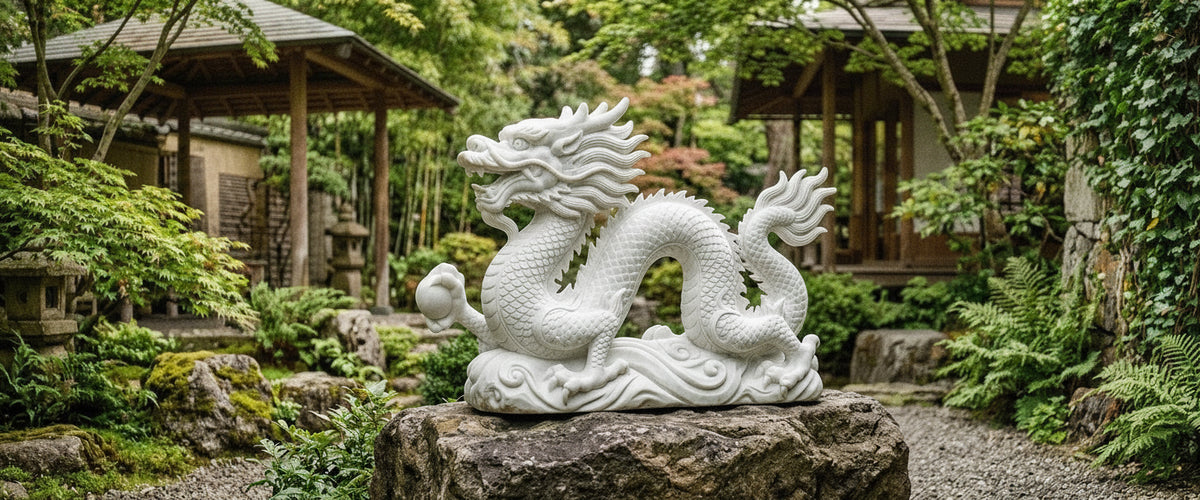
Of all the dragon statues for garden use, the serpentine kind looks most stranded in the middle of an open lawn, like something washed up after a storm. The coil needs context: boulders to wind around, gravel raked into currents, a pond edge to drink from. Those elements complete the story the body is already telling.
For a courtyard or pond-edge setting, a carved marble figure such as the Imperial Dragon in white marble, at 120cm (about 47 inches), is better set low on a rough stone base than lifted onto a formal pedestal. Beside water in a Napa courtyard or a Pacific Northwest garden, the pale marble reads crisply against dark gravel and wet rock. Raise it on a tall formal plinth and the same figure looks oddly displaced.

Height Versus Length: How Dragon Statues for Garden Spaces Claim Ground
A Western dragon claims vertical space. Judge it from the main window or the terrace, and measure it against doors, hedges and steps nearby. Remember the plinth adds height, often more than buyers expect.
An Eastern dragon claims horizontal space. Its footprint matters more than its height, and it rewards being walked around or followed along a path edge. When we help clients plan dragon statues for garden placement, we ask them to stake out the outline with string, or prop up a cardboard silhouette, and live with it for a week. Most people discover the coil needs considerably more ground than they had penciled in.
What a Northern Winter Does to Wings and Whiskers
Freeze-thaw is hard on thin stone, and on stone dragon statues for garden sites up north it finds every weak point. Water gets into fine carved sections, expands as it freezes and opens hairline cracks. Snow sitting on a broad marble wing adds load at the weakest point, the root where wing meets shoulder.
Whiskers are worse. Long, trailing whiskers look wonderful on a studio model and are the first thing to fail outdoors. On frost-prone sites, the better solution is to curl them back and fuse them into the jaw and mane, which keeps the movement and removes every unsupported tip. For winged dragon statues for garden sites in Minnesota, Vermont or Colorado, bronze is the safer choice. It handles thin, open forms far better than stone. If you want marble, keep the wings folded close to the body.
Why Mixing the Two Traditions in One Garden Figure Rarely Sits Well
Bolt wings onto a serpentine body and neither reading survives. The eye can't decide whether it is looking at an emblem or a river spirit, and the garden around it can't support both stories.
Classical hybrids are the exception, because they carry a lineage of their own. Where a formal garden calls for water and a touch of the fantastic, a figure like the dragon-griffin bronze fountain, at 230cm (about 7.5 feet), sits comfortably because it grows out of the European tradition of grotesque fountain figures and stays within a single visual language. That consistency is the test for any bespoke design, and for any dragon statues for garden use you are comparing between makers.

Buyer Checklist Before You Commission a Garden Dragon
Tradition: Upright and winged, or long and coiled? Decide before anything else.
Main viewpoint: Where will it be seen from most? Western figures need a frontal axis; Eastern figures need a route.
Footprint: Mark out the full outline, including the base, on site.
Climate: If you get hard frosts, avoid unsupported thin sections in stone.
Material: Bronze for open wings and fine detail; marble or stone for compact, grounded forms.
Foundation: Large bronze and stone pieces need a proper pad and fixings. Plan access for lifting equipment.
Setting: Budget for the rock, gravel or plinth the dragon needs, not only the figure.
Giant Sculptures makes and ships large dragon statues for garden settings in bronze and stone, and our studio can adapt scale, pose and section thickness for a specific site. The bronze mythology statues collection is a good place to compare poses and scales before you brief us. Cost depends on material, scale, complexity, engineering, installation and finishing, so the best next step is a tailored quote built around your garden.
For wider placement ideas, Choosing a Large Dragon Statue: Why Material Sets the Wingspan is useful companion reading before finalizing the setting and sightlines.