






































































































Most contemporary garden sculptures fail for one reason: the piece was chosen before the site was understood. A form that looked commanding in a showroom shrinks to a lawn ornament the moment it sits in open space, and homeowners in the Hamptons and Napa learn this fast. This guide shows you how to pick contemporary garden sculptures that hold the whole yard, by treating scale, material, and placement as one decision instead of three. Get it right and a single form organizes the garden. Get it wrong and you have spent real money on something people walk past.
Looking for the full range in this category? Browse our Contemporary & Modern Sculptures collection for every available finish, size, and configuration. This guide is for buyers who want the work to do actual work in the landscape, not just fill a corner.
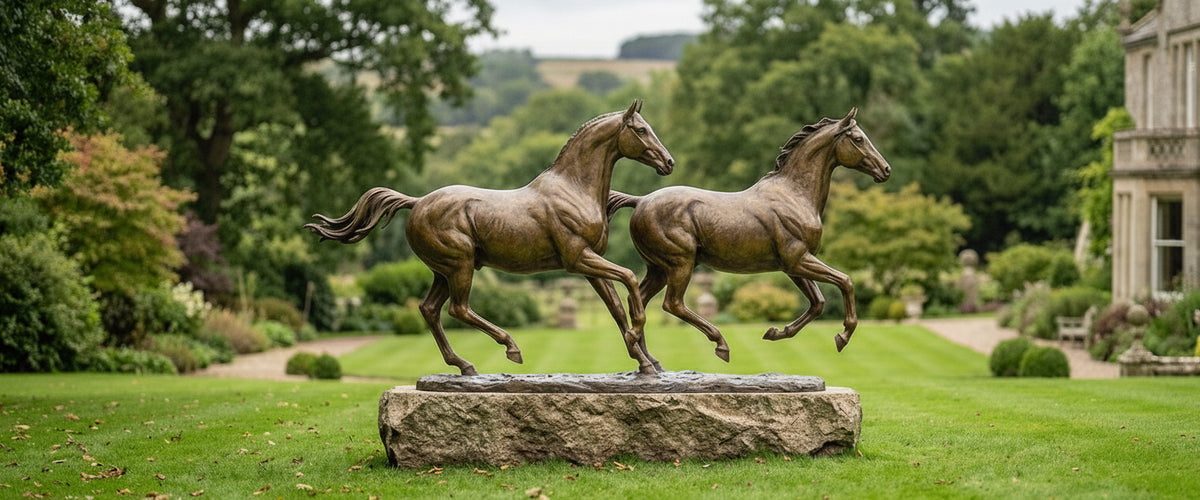
Scale, material, and placement working as one decision on an open lawn.

Key Takeaways at a Glance
Scale first. Outdoor space eats size. In open lawn, go larger than instinct says, often 6 feet (1.8 m) or more.
Material sets the lifespan. Bronze, stainless steel, and Corten steel all handle weather; each ages differently.
Placement decides impact. Sightlines, backdrops, and approach paths matter more than the exact spot.
Budget follows complexity. Material, size, engineering, and finishing drive cost, so ask for a tailored quote.
Bespoke is worth it when your site has an odd sightline, a specific palette, or a scale no stock piece hits.

What Contemporary Garden Sculptures Actually Mean
The term covers modern and abstract work, but also figurative and animal forms handled in a clean, current way. A contemporary garden art sculpture leans on simplified shapes, strong silhouettes, and confident use of material rather than fussy detail. It reads well from a distance, which is exactly what a garden asks for.
This style suits people who want the garden to feel designed rather than decorated. Architects and landscape designers reach for contemporary garden sculptures because a single strong form can anchor a planting scheme without competing with it. Collectors like them because a good abstract or stylized piece holds interest across seasons, when the borders are bare as much as when they are full.
They are not the right pick for every garden. If your home and grounds are firmly traditional, a highly abstract steel form can feel imposed. But even classical settings take well to a contemporary treatment of a familiar subject. Where a courtyard needs something recognizable but not a museum reproduction, a figurative piece like the Large Contemporary Violinist Bronze Sculpture - 220cm is handled modern enough to sit in a pared-back setting while still reading as a subject rather than pure geometry.

Materials, Finishes, and Scale Decisions
Material is the decision that governs how contemporary garden sculptures live outdoors for the next few decades, so treat it as an engineering choice as much as an aesthetic one.
Bronze is the workhorse of serious garden sculpture. Cast well, it lasts for generations and develops a patina that shifts with exposure and care. The green and brown tones you see on historic bronzes come from controlled surface chemistry, and a good foundry applies and seals that patina deliberately rather than leaving it to chance. The Smithsonian American Art Museum's conservation guidance on outdoor bronze is a useful primer on how weathering and waxing actually work over time. Most of our animal and figurative garden work is bronze for exactly this reason.
Stainless steel gives you the opposite mood: bright, reflective, and unapologetically modern. It bounces light and sky into the garden and needs less surface maintenance than people expect, though it does show water spotting near pools and coastal air. Among contemporary garden sculptures, it suits abstract forms and clean geometry best.
Corten (weathering) steel has become a signature of contemporary landscape design, and of contemporary garden sculptures in particular. It forms a stable rust-colored surface that seals the metal beneath, so the warm orange tone is the finish, not decay. It pairs beautifully with grasses and gravel gardens. One caution from the studio: Corten can stain pale stone paving as it settles in its first year, so plan the base carefully.
Stone and marble bring weight and permanence, and read as sculptural even in raw abstract blocks. They are heavier to site and, in freezing climates, need attention to prevent water sitting in seams.
Bronze, stainless, and Corten each age differently outdoors, so weigh climate alongside the look you want from contemporary garden sculptures.
On scale: the single most common buyer mistake with contemporary garden sculptures is going too small. Indoors, a 3-foot piece feels substantial. Drop it into open lawn and it vanishes. As a rule, measure the distance from where people will usually stand or sit, then choose a height that still holds attention from that point. For a large lawn or a long view down a garden axis, contemporary garden sculptures around 6 to 8 feet (1.8 to 2.4 m) earn their place. At the top of that range, the Large Contemporary Dual Pelican Bronze Sculpture - 250cm is the kind of scale that reads cleanly from across a wide terrace rather than needing you to walk up to it.

Where to Place Contemporary Garden Sculptures for Real Impact
For wider placement ideas, Garden Contemporary Sculpture: How to Choose a Piece That Holds the Whole Space is useful companion reading before finalizing the setting and sightlines.
Placement is where good contemporary garden sculptures succeed or quietly fail. A few principles hold across almost every project.
Give it a backdrop. A sculpture set against dark yew, a rendered wall, or a mass of ornamental grass reads far better than one floating in open sky where the silhouette dissolves. Reflective stainless especially needs something behind it to catch.
Work your sightlines. The strongest spot is usually the one you see from inside the house, framed by a window or a doorway, or the terminus of a path where the eye naturally lands. Place the piece where people already look rather than in a spot you hope they will discover.
Respect the approach. Figurative and animal contemporary garden sculptures have a front. A piece built around motion, such as the Large Contemporary Cantering Horse Pair Bronze Sculpture - 180cm, should be oriented so viewers meet that movement as they walk toward it, not from behind.
Consider water. A sculpture near or within a water feature gains a second life in reflection. Our garden fountains and water features collection is a good starting point if you want the piece and the water designed as one element rather than added later.
Leave breathing room. Crowding a strong form with dense planting kills it. Give the base clear space so the shape can be read. This is where well-placed contemporary garden sculptures pull an entire scheme together.
Budget, Commissioning, and Delivery
There is no honest flat price for large garden sculpture, and anyone quoting one before seeing your brief is guessing. Cost is driven by material, size, the complexity of the form, the engineering needed to keep it stable and safe, and the finishing work. A polished stainless abstract and a richly patinated bronze animal of the same height can sit far apart on price for reasons that have nothing to do with which one you prefer. When you compare contemporary garden sculptures, describe your site and intent and ask for a tailored quote.
Commissioning is worth considering when stock contemporary garden sculptures do not fit. Common triggers we see: an awkward sightline that needs a specific height, a color palette the client wants echoed in patina, or a scale no off-the-shelf piece reaches. Bespoke work also lets you match a pair or a series of contemporary garden sculptures across a large garden so the pieces speak to each other.
Delivery and installation deserve early thought, not an afterthought. Large sculpture is heavy and often needs crane access, a prepared foundation, and sometimes internal fixing to resist wind load. We ship worldwide and have crated bronze into gardens from California to the Cotswolds, and the projects that go smoothly are always the ones where access and groundwork were planned before casting finished. Measure your gates, your paths, and any soft ground a truck would have to cross.
A Quick Buyer's Checklist
Measured the main viewing distance and chosen a height that holds from there?
Picked a material suited to your climate, especially freeze and coastal air?
Confirmed a backdrop so the silhouette reads?
Checked crane and truck access to the final spot?
Planned the foundation and fixing for wind load?
Decided whether patina, finish, or scale needs a bespoke solution?
How Giant Sculptures Helps With Bespoke Projects
We are a bespoke sculpture supplier focused on large-scale, durable work built to live outdoors for decades. That means we spend as much time on foundations, fixing, and finish longevity as on the form itself. For buyers who know exactly what they want, our range of contemporary garden sculptures in bronze and steel covers a wide span of subjects and sizes. For those with a specific site problem, we develop pieces from a brief, sketch, or reference, matching scale and patina to the setting.
If you are starting from a stylized figurative direction, a smaller piece like the Large Contemporary Girl with Bird Bronze Sculpture - 130cm is a useful reference for how a modern hand can keep a recognizable subject feeling current. From there we can scale up, adjust the pose, or shift the finish to suit your garden. Whether you want stock contemporary garden sculptures or a fully commissioned piece, send us the view you want to fill and the distance you will see it from, and we will tell you honestly what scale and material the site needs to make your contemporary garden sculptures work.