





































































































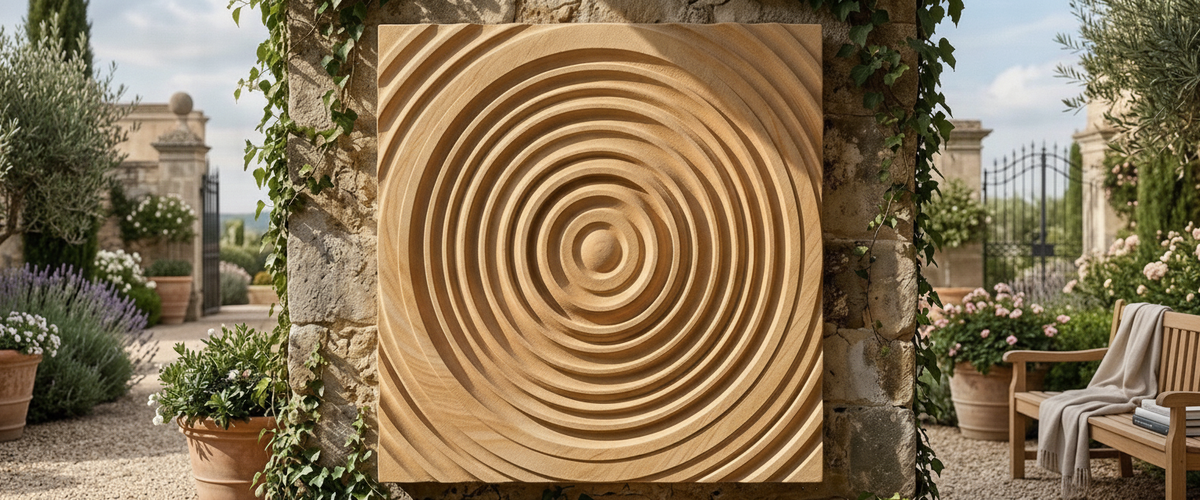

An overcast day punishes marble. Under flat gray light it goes slightly chalky and loses the crispness that justified the carving in the first place. Sandstone art does the opposite. The iron oxides that give the stone its ochre, pink and buff tones act as a counterweight to cool daylight, so a sandstone relief often looks richer at 10am under Seattle drizzle than it does under hard Arizona noon. That one fact should drive where you mount, hang or plant the piece, long before you argue about size.

Key Takeaways Before You Buy
Cool light flatters it. North-facing rooms, shaded courtyards and gray-sky climates suit sandstone better than they suit white marble.
The grain sets the limit. Bedding planes decide how much undercut and fine detail a carver can safely attempt.
Depth of cut is the whole game. Shallow relief disappears in flat light; deep relief holds shadow all day.
Plan for the wet version. Rain-soaked sandstone reads markedly darker, and it rarely wets evenly.
Freeze, salt and algae are the ten-year tests, not the first season.
Budget tracks the specification: stone selection, scale, carving complexity, fixing engineering and finish. Ask for a tailored commission quote rather than guessing.
Why Gray Daylight Is Sandstone Art's Best Friend
Overcast daylight is blue-shifted; direct midday sun is closer to neutral, and low sun is warm. Put a cool wash of light on a warm stone and you get balance. Put it on a cool white stone and you get flatness. This is why sandstone art holds up so well on a shaded terrace in the Hamptons, in a north-facing Manhattan living room, or against the wet-winter light of a Pacific Northwest garden, where marble frequently looks washed out by February.
The corollary matters just as much. In Scottsdale or Palm Springs, full southern sun can bleach the interest out of a pale buff sandstone by flattening its shadows to nothing between 11am and 3pm. If the piece has to live in that light, push the carving deeper or choose a darker, more ferruginous stone with real tonal range.
Bedding Planes Decide What the Carver Can Attempt
Sandstone is sedimentary, laid down in layers, and those bedding planes behave like the grain in timber. Carve with them and the stone cooperates. Cut a slender projecting element across a weak plane and you have built a future fracture line. Good practice is to set the block so the beds run horizontally in the finished position, which is how quarry masons have oriented facade stone for centuries and why guidance on stone selection and decay puts so much emphasis on bedding orientation.
Practically, that means sandstone favors mass, broad planes, strong silhouettes and geometry over lacy filigree. Wing tips, fingers and free-floating drapery are marble and bronze territory. Concentric ridges, chevrons, arches, faceted blocks and deep grooves are where sandstone art genuinely outperforms, because the material's strength lines up with the design intent instead of fighting it.

Relief Panels Versus Freestanding: Depth of Cut Governs the Shadow
A freestanding sandstone form makes its own shadow by turning in space. A wall panel has to manufacture shadow through relief depth alone, which is why the difference between a 1 inch (25 mm) cut and a 3 inch (75 mm) cut is not incremental. It is the difference between a texture and a sculpture. Circular relief works particularly hard here, since the ridges present a different angle to the light at every point around the disc. A deep-cut disc such as Orbitals White Circular Wood Carved Sandstone 3D Wall Art keeps a live edge of shadow whichever side the window sits on, while a shallow rectangular panel in the same position tends to flatten out by midday.
Side light at a shallow angle keeps one edge of every ridge in shadow.
Freestanding sandstone earns its keep in gardens, where you walk around it and the sun does the choreography for you. Sandstone wall art earns its keep where floor space is spoken for: stairwell walls, entry halls, corridors, hotel lobbies and the long blank returns architects leave behind in open-plan houses.
Sandstone Pixel Art: Bold in a Stairwell, Wallpaper Across a Whole Wall
The blocky, pixelated relief look has real force when it is used as a punctuation mark. A single tall run of pixel-style sandstone art climbing a double-height stairwell is a genuine architectural gesture. Tile the same module across 20 feet (6 m) of living room wall and it stops being sculpture and starts being cladding. Our rule of thumb: one dominant field per room, or a rhythm of two or three related pieces with clear wall breathing between them.
Mixing curve against grid also helps. Pair a hard-edged pixel field with an arched or semi-circular form and the eye has somewhere to rest; a quieter counterweight like Orbitals White Semi-Circle Wood Carved Sandstone 3D Wall Art stops a repeated grid from reading as surface treatment. In warmer interiors the same job falls to a terracotta tone, where Arcuza Terracotta III Wood Carving Sandstone 3D Wall Art is closer to the right design language, while the fuller sandstone art collection shows how that language scales up across a wall.

Plan for the Rainy Version of the Piece
Wet sandstone goes noticeably darker, and it almost never wets evenly. Water sheets off the top faces, sits in the grooves, and creeps up from the base by capillary action. What you get after a storm is a piece with a dark hem, dark valleys and a pale crown. Some clients love that. Others are surprised, because they only ever saw the sunny studio photograph.
After a storm the grooves darken first, so plan the tonal split into the composition.
Two design responses work. Either build the tonal split into the composition deliberately, or detail the piece so water leaves fast: chamfered top faces, drip edges, and a raised plinth or stainless standoff so the base is not wicking moisture out of wet soil. On a Napa garden project we lifted a set of reliefs off a rendered wall on concealed stainless brackets purely so the air gap could dry the back after irrigation overspray. The color has stayed even ever since.
Algae, Salt and Frost Spalling: The Decade Test
Sandstone is porous, and porosity is where the long game is won or lost. On a shaded north wall in a humid climate, expect green algal bloom within a couple of seasons. Near a Chicago or Aspen driveway, de-icing salt carried in slush is the real threat: salts crystallize inside the pores and push the surface off in flakes. Freeze-thaw does the same thing with ice. That flaking is spalling, and once it starts on a soft bed it tends to keep going.
Mitigation is mostly siting. Keep sandstone art off splash zones and out of salt spray, ventilate the back, and avoid trapping the base in a permanently damp bed. Sealing is a judgment call, not a default; a fully impermeable coating can trap moisture behind the surface and make spalling worse, which is why breathable treatments are the standard recommendation in professional stone care guidance.
Interior Walls We Veto, and the Light That Makes the Grain Sing
We talk clients out of three interior positions on a regular basis. Kitchen splashbacks, because airborne grease is nearly impossible to get out of an open pore structure. The chimney breast directly above an open fire, for the same reason with soot. And the wall that faces a large window head-on, where frontal light hits the relief flat and kills every shadow the carver worked for.
What does work: raking light. Position the piece so the main light source arrives from one side at a shallow angle, or add an adjustable wall washer set 8 to 12 inches (200 to 300 mm) off the surface and aimed down across it. Grazing light roughly doubles the apparent depth of any relief. Warm-toned lamps around 2700K flatter ochre and terracotta stone; cool 4000K downlights make it look gray and tired.

Sandstone Art Buyer Checklist
Identify your main light source and its direction before choosing relief depth.
Ask what the piece looks like wet, or soaked, if it is going outdoors.
Confirm bedding orientation for any projecting or slender element.
Check the wall substrate and fixing method; heavy stone panels need engineered anchors, not adhesive alone.
Keep the base off wet ground and give the back air.
Decide whether you want algae and patina, or a piece you will wash annually.
For a wall run, mock up the layout in paper at full scale before drilling anything.
Commissioning Sandstone Art With Giant Sculptures
Bespoke work is where the material logic really pays. Our studio matches stone tone and bed thickness to the intended wall or garden position, sets carving depth against the light survey, and details the fixings so the piece can be removed and re-hung later if the building changes hands. Large sandstone wall art is often better delivered as a set of modules than as one monolith, purely because of handling weight and access. Weighing sandstone against stainless steel, Corten or bronze for a scheme? Or want to see how sandstone tones sit alongside our wabi sabi art pieces? Send us the elevation and the orientation, and we will price it properly against material, scale, complexity, engineering and installation.
For wider placement ideas, Wood Panel Wall Art: A Buyer's Guide to Scale, Finish and Placement is useful companion reading before finalising the setting and sightlines.