





































































































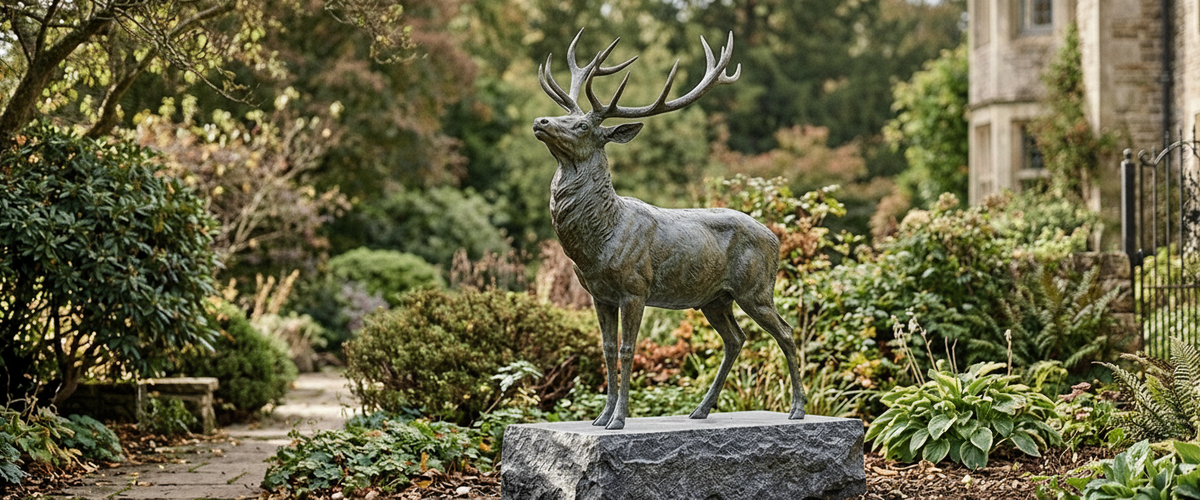

Nobody maintains a garden sculpture as often as they promise to at the point of purchase. That single fact should shape how you choose the best finish for outdoor statues, because the surface that photographs beautifully in a studio and the surface that still holds up after two unsupervised winters are frequently not the same thing. Most inquiries reach us framed the same way: what is the best finish for outdoor statues, bronze or granite? We have shipped pieces to Napa hillsides, Hamptons lawns and Manhattan rooftop terraces, and the pattern repeats: the owner waxes it once, life gets busy, and the weather takes over from there.
Looking for the full range in this category? Browse our Bronze Garden Statues collection for every available finish, size, and configuration.

At a Glance: The Short Version
Ranked by how much neglect each surface tolerates, the best finish for outdoor statues comes down to five lines:
Highest neglect tolerance: silicon bronze with a chemically applied patina, or unpolished granite. Both weather rather than fail.
Best for sharp, graphic form: mirror-polished or brushed stainless steel, provided you accept visible water spotting between cleans.
Highest maintenance for the look you bought: polished granite and dark waxed bronze. Both need attention to stay as delivered.
Shortest realistic life outdoors: stone-effect sprays and gel coats over composite. Fine indoors, unconvincing after a couple of freeze cycles.
Site beats preference: coastal salt air, city particulates and tree drip lines will override your finish choice every time.
Patinated silicon bronze after three winters with no waxing: changed, but not damaged.
The Test That Matters: 24 Months With Nobody Touching It
Ask any supplier how a finish performs and you will get the maintained answer. Ask how it performs unmaintained and the conversation gets more useful. A finish either weathers gracefully, meaning it changes into something still worth looking at, or it degrades, meaning it chalks, streaks, flakes or blooms into a mess you have to strip back.
That distinction is the whole argument. Bronze and stone weather. Coatings degrade. A patinated bronze heron that has gone three shades greener is still a good sculpture; a powder-coated figure with a chalky south face and a rust bloom at the weld line is a repair job. When we talk clients through finish options, we are really asking how much change they can live with, and in which direction.

Bronze Patina at Year One, Year Three and Year Ten
Cast bronze is the most forgiving outdoor surface we work with, because corrosion on bronze is largely self-limiting. The metal reacts, forms a stable layer of copper compounds, and then slows down. Year one is the most active period: a fresh liver-of-sulfur brown or a green nitrate patina will shift noticeably in the first few months as rain and UV work on it. By year three the movement is subtler, mostly the deepening of recesses and the lightening of raised areas where rain sheets off. Somewhere around year ten, on most inland sites, the surface has settled into a weathered face that changes very little from then on.
Two things ruin that arc. The first is uneven water, which we will come back to. The second is wax applied inconsistently, which locks in patina in some areas and lets it run in others. The National Park Service guidance on outdoor bronze care makes the point plainly: consistent, gentle washing does more good than occasional heroic intervention. If a client tells us they will not wax, we specify a patina we are happy to let go feral, and we say so at the quoting stage. Browse the bronze sculptures collection and you will see both approaches, tight dark patinas for sheltered courtyards and looser green-brown patinas built for open weather.
Polished, Honed and Flamed Granite Under the Same Rainfall
Granite is chemically stubborn, which is why headstones outlast the people who commissioned them. The treatment, not the stone, decides how it ages, and in stone the best finish for outdoor statues is almost always the least reflective one. Polished granite disappoints owners fastest outdoors. Rain, hard water and airborne dust dull the reflective surface within a couple of seasons, and the dulling is rarely even; the top surfaces go flat while the vertical faces keep their shine. Honed granite starts matte and therefore has nothing to lose, which makes it the quiet winner over 24 months of neglect. Flamed granite, thermally textured to open the surface, holds dirt in its topography but reads as intentional texture rather than grime.
Freeze-thaw is the granite risk worth naming. Water sitting in a shallow carved detail or an unsealed base joint expands when it freezes, and repeated cycles work at the stone. The Natural Stone Institute publishes technical guidance on stone selection and exterior installation detailing, and the drainage detail at the plinth matters more than most buyers expect. Marble is a different animal again: beautiful, softer, and prone to sugaring in acidic rain, which is why our marble sculptures are more often specified for sheltered terraces than for open lawn.
Honed granite starts matte, so rainfall and hard water have nothing to dull.

Powder Coat, Gel Coat and Stone-Effect Spray: Real Lifespans
Coatings are where the argument about the best finish for outdoor statues usually goes wrong. Architectural-grade powder coating on steel or aluminum is genuinely durable, and on a large abstract form it can hold color for many years. What brochures skip is the edge condition. Coatings thin over sharp arrises and weld seams, and that is where the first failures show. Gel coat over composite performs reasonably in shade and poorly in full sun, where UV chalks the surface. Stone-effect sprays over resin are the weakest option we see coming into the studio for refinishing; they look convincing at 20 feet (6 m) on day one and unconvincing at 3 feet (1 m) after eighteen months.
If you want a coated look with long-term behavior closer to bronze, consider uncoated metals that self-protect. Corten develops a stable oxide skin and then largely stops. Marine-grade stainless holds its own in salt air. Our stainless steel sculptures get specified for coastal and poolside sites for exactly that reason, with the caveat that mirror polish shows every water spot.
Site Conditions That Overrule Every Preference
For wider placement ideas, Bronze Electroplated Bear Sculpture: Where the Finish Wins and Where It Wears is useful companion reading before finalizing the setting and sightlines.
Three site factors outrank any preference about the best finish for outdoor statues. Coastal salt accelerates everything, so 316 stainless, silicon bronze and dense granite become the shortlist and mild steel drops off it. City grime is mostly carbon and sulfur compounds that settle in recesses, which favors mid-tone patinas and honed stone over polished anything. Drip lines are the sleeper problem. A client in Connecticut sited a bronze figure under a mature oak, and within a season the piece had a pale vertical stripe down one shoulder where tannin-heavy runoff hit the same spot after every rain. The sculpture was fine. The symmetry of the patina was not.
Before finalizing a specification, walk the site during rain if you can. Look for where water concentrates rather than where it sheets. That five-minute observation prevents most of the aging problems we get asked to correct.
The Ranking: Best Finish for Outdoor Statues, Bronze or Granite
Judged purely on neglect tolerance over 24 months and beyond, here is how we rank them:
Patinated silicon bronze. Changes, but always toward something acceptable. Repairable, re-patinable, effectively permanent.
Honed or flamed granite. Almost inert. Only fails through bad detailing at the base, not through surface breakdown.
Corten and marine-grade stainless. Self-stabilizing, low intervention, strong on contemporary forms.
Polished granite. Structurally faultless, visually compromised by season three unless cleaned.
Architectural powder coat. Good for years, then edge-critical.
Gel coat and stone-effect spray. Short-term surfaces on long-term objects.
So on the specific question of the best finish for outdoor statues, bronze or granite: bronze wins on character and repairability, granite wins on sheer indifference to weather. Pick bronze if you want a surface with a life of its own. Pick honed granite if you want the piece to look much the same in a decade.

Finish Checklist Before You Sign Off a Commission
State honestly how often the piece will be cleaned. Once a year is a real answer; specify to it.
Confirm the substrate metal, not just the finish name. Silicon bronze, 316 stainless and mild steel age very differently under the same coating.
Ask for the patina recipe or coating spec in writing so it can be matched years later.
Check drainage at the base and inside hollow castings. Trapped water causes more damage than any surface choice.
Ask where water will pool or run on the form itself, and whether the finish will streak there.
Request a weathered sample or reference image of a piece at three or more years old, not a studio shot.
Agree who handles refinishing and what that involves before installation, not after.
Getting the Finish Right on a Bespoke Piece
On commissions, this is a design decision made early, not a coat applied at the end. Wall thickness, weld placement, internal drainage and mounting all interact with how a surface ages. At Giant Sculptures we match the best finish for outdoor statues to the actual site: its exposure, prevailing weather and realistic maintenance appetite. We would rather talk a client out of a mirror polish than deliver something that disappoints in two years. Cost follows material, scale, engineering complexity, finishing time and installation, so the sensible next step is a tailored quote against your site. Start with the garden sculptures collection to see how different surfaces read at scale outdoors.