





































































































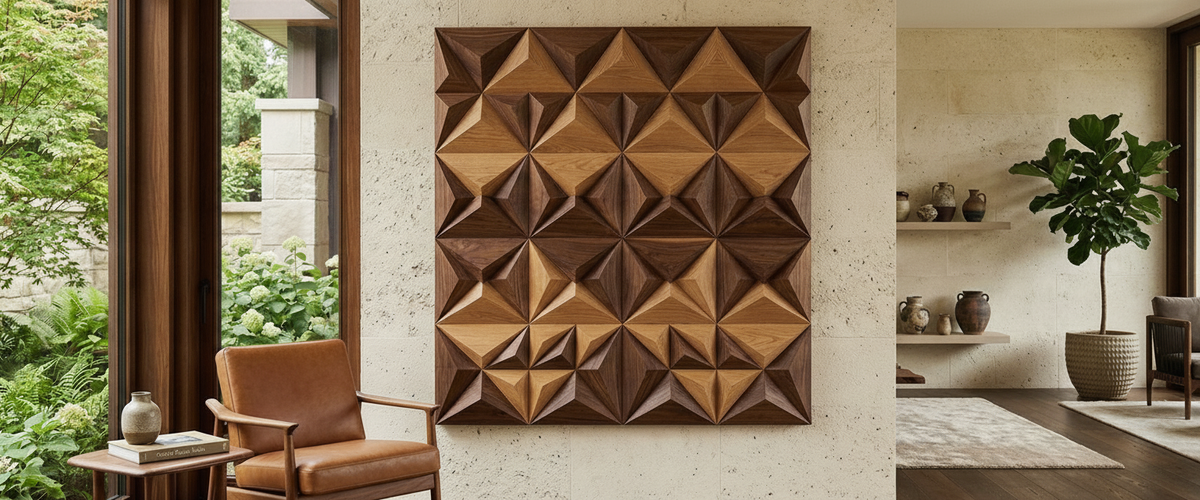

Almost every complaint we hear about wood wall art geometric panels lands in the same six-week window: mid-January, heating running hard, and a hairline crack walking straight across a faceted panel that looked perfect in October. Nothing was dropped. Nobody cleaned it wrong. The room dried out, the wood shrank, and a rigidly glued pattern had nowhere to go. Understanding that single mechanism tells you more about buying geometric wooden wall art than any style guide will.

Key Takeaways Before You Buy
Movement is the whole story. Wood shrinks and swells across the grain with indoor humidity, and a repeating pattern multiplies every millimeter of that change.
Slatted and modular builds outperform glued tessellations in heated rooms, because each element moves on its own.
Species matters. Ash works harder than walnut; quarter-sawn oak behaves better than plain-sawn oak across a wide panel.
Fixing method matters as much as joinery. Floating cleats and deliberate expansion gaps absorb what glue cannot.
Wax and oil feed the surface, not the structure. Once a joint has opened, finish will not close it.
If the room is genuinely dry, a bespoke panel engineered for that environment, or a metal or acrylic relief, is the honest answer.
Why a Glued Tessellation Splits in January While a Slatted Panel Shrugs It Off
Picture a tight honeycomb of hardwood facets, edge-glued into one continuous field. It is beautiful, and it is a single rigid body. When the room drops from a humid summer to a heated winter, that whole body wants to shrink across its width. A 4 ft (1.2 m) wide hardwood field can want to give up something close to a quarter inch (6 mm) of width across a seasonal swing. There is nowhere for that quarter inch to go, so the panel finds the weakest short-grain joint and splits there. The USDA Forest Products Laboratory Wood Handbook documents these shrinkage coefficients species by species, and they are not small numbers.
A slatted or modular geometric panel handles the same conditions differently. Each slat, chevron or block moves independently, and the gaps between them widen or close by a fraction of a millimeter each. Nothing accumulates. That construction logic, separated and individually mounted elements rather than one bonded field, as in the Wenlock White & Burgundy Wood Relief 3D Wall Art, is what allows wood wall art geometric reliefs of that footprint to sit in a real, centrally heated room without opening a seam.
Separated slats let each element move on its own, so seasonal shrinkage never accumulates into a crack.

Radiators, Wood Burners, and the Moisture Drop That Opens Every Seam at Once
Heat itself is not the villain. Dryness is. A wood burner in a Colorado living room or forced-air heating in a Texas great room can pull interior relative humidity from a comfortable 50 percent down into the twenties within days. Conservation guidance from the Canadian Conservation Institute is blunt about the risk: it is the speed and size of the swing, not the absolute number, that cracks joined wood objects.
We shipped a large faceted oak commission to an Aspen chalet a few winters ago and asked the client to hang it on the interior wall opposite the fireplace rather than the chimney breast itself. They followed the advice. The identical panel style, installed by another owner directly above a wood burner in a similar house, developed two visible seams in its first heating season. Same wood, same build, different microclimate. Keep wood wall art geometric panels out of the rising air column from a stove, off the wall above a radiator, and away from south-facing glass that bakes one half of the pattern each afternoon.
Oak, Walnut, and Ash: How Each Species Moves Across a Repeating Pattern
Species choice for wood wall art geometric patterns is a design decision and a durability decision at once.
White oak: hard, strong, visually assertive, and the biggest mover of the three. Quarter-sawn stock shrinks noticeably less across the width than plain-sawn, which is why we specify it for wide continuous fields.
Walnut: the calmest of the three in service and the most forgiving in a dry room. It also holds crisp arrises on small facets, so chevrons and pyramids stay sharp.
Ash: lively, pale, excellent for high-contrast geometry, but it works harder with humidity than walnut does. Ash rewards a slatted layout and punishes a rigid tessellation.
Grain direction inside the pattern matters too. Alternating grain across a repeating geometry looks lively but sets neighboring pieces pulling against each other. Where the cuts all rake the same way, as they do across the Barwick Mocha Angled Abstract 3D Carving Wall Art, movement stays predictable and directional instead of fighting itself facet by facet.
Walnut chevrons cut with consistent grain direction, with deliberate reveals absorbing seasonal change.

Floating Cleats and Expansion Gaps: The Build Details That Absorb the Movement
Good wood wall art geometric joinery is engineered on the back as carefully as it is composed on the front. Ask about three things.
Floating fixings. Elongated slots or shouldered screws let the panel breathe across its width while staying flat and level. Screwing tight through fixed holes at both edges guarantees a crack.
A French cleat or continuous batten. This spreads load, keeps the piece off the plaster, and lets air circulate behind so both faces reach the same moisture content. A panel sealed flat against a cold wall cups.
Designed gaps. Deliberate reveals between facets or slats, typically a couple of millimeters, become part of the visual rhythm and quietly absorb seasonal change.
The Month Three Inspection
Three months after installation, through one heating cycle, is when a panel tells you the truth. Run this check:
Raking light along the surface from one side. Hairline seams show as shadow lines long before they show face-on.
A straight edge across the widest dimension. Any cupped slat will lift the edge off the reference.
Fingertip along the perimeter facets. Corners and edges lift first because they lose moisture fastest.
Rock test at the cleat. Movement here means fixings, not wood.
A hygrometer on the same wall. Readings that sit in the twenties for weeks, or swing hard between seasons, are a room problem before they are a panel problem.
Photograph anything you find. A seam that stays the same width for two winters is stable. A seam that grows each January is a build problem worth raising.
What Re-Waxing Genuinely Fixes, and What It Cannot
Wax and hard oil restore color depth, even out sheen, and slow surface moisture exchange slightly. That is the honest limit. Finish is not a vapor barrier and it will not pull an opened joint back together. Re-wax annually with a soft cloth, thin coats, always finishing with the grain, and never with silicone sprays that later block refinishing. If a joint has actually opened, the repair is mechanical: release the fixing, re-glue with a flexible adhesive, or in some cases accept the reveal as a legitimate feature and let it stabilize.

When a Bespoke Panel Is the Honest Answer to a Dry, Heated Room
Some interiors are simply hostile to solid wood. Double-height rooms with big stoves, desert climates, unoccupied holiday houses that swing from sealed and damp to blasted with heat on arrival day. For those spaces we either engineer the wood wall art geometric design around the environment (stable substrate, veneered faces, generous expansion allowance, species chosen for low movement) or steer clients toward a different material entirely. Where a room will never hold steady humidity, a crisp geometry in metal or acrylic such as the Alverton Multicolour Geometric Stripe Acrylic 3D Wall Art is closer to the right specification than any hardwood, and it holds its lines regardless of what the heating does.
Scale changes the calculation too. Above roughly 6 ft (1.8 m) in either direction, we almost always break a design into modules rather than fight the physics of one continuous field. Giant Sculptures builds bespoke wall pieces at architectural scale, and a commission conversation starts with the room, not the pattern: wall construction, heat sources, glazing, humidity history, and how the piece will be seen. Browse the wood wall art range for finished directions, compare against geometric art across materials, or look at metal wall art if your room runs dry. What a bespoke panel costs depends on species, scale, geometry, engineering and finish, so send us the room and ask for a quote against it rather than a guess.
For wider placement ideas, Large Wood Wall Art That Survives Its First Winter is useful companion reading before finalising the setting and sightlines.