






































































































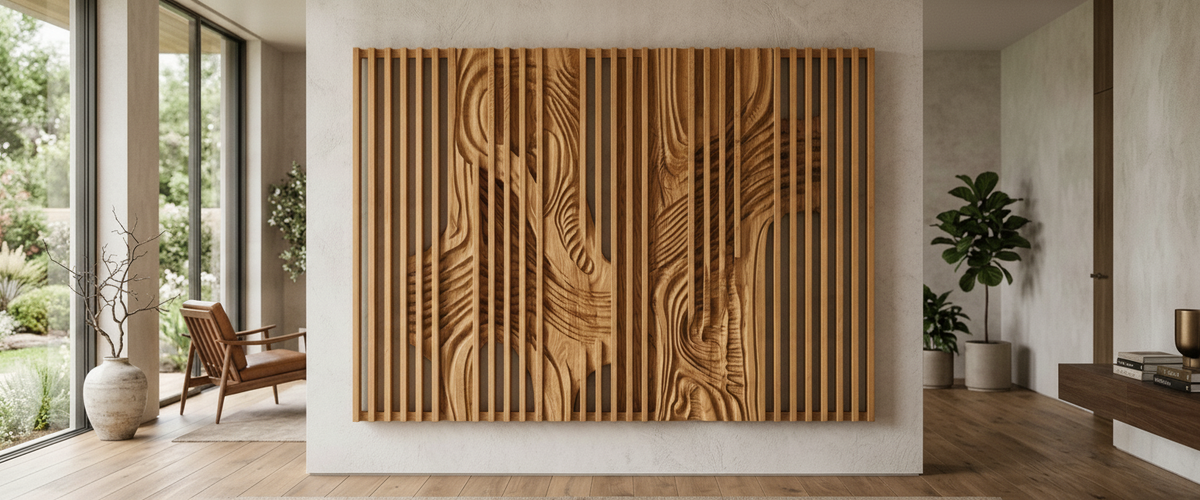

Hang a six-foot oak panel above a log burner in November and by February it will tell you exactly what it thinks of the decision. Cupped edges. A hairline split running with the grain. A joint that has quietly opened by the width of a credit card. Large wood wall art is the only wall piece we sell that keeps working after installation, because timber never fully stops responding to the air around it. Steel of the same size does not twitch. Wood breathes, shrinks, swells and settles, and the whole craft of building a big panel is deciding where that movement is allowed to go.

Key Takeaways Before You Buy
Movement is normal. A 6 ft (1.8 m) wide solid panel can gain and lose a meaningful fraction of an inch across the grain between a humid August and a dry January.
Drying method decides behavior. Kiln-dried, air-dried and reclaimed timber all react differently in their first year indoors.
Slats and segments are engineering. Gaps and floating joins give movement somewhere to go instead of forcing a split.
Three walls cause most failures: above radiators, above wood burners, and directly facing unshaded south glazing.
Finish choice matters more than most buyers think. Penetrating oils and waxes let a panel breathe; heavy film sealers can trap moisture unevenly.
Size to the wall, not the sofa. The wall plane sets the proportion; furniture just sits under it.
Why a Wood Panel Breathes and a Steel Panel Never Does
Timber is hygroscopic. It exchanges moisture with the air until it reaches equilibrium, and that equilibrium shifts every time your HVAC kicks in, a fire is lit, or a humid summer gives way to a heated, dry winter indoors. The USDA Forest Products Laboratory has documented this dimensional behavior for decades: wood moves substantially across the grain and almost not at all along it. That single fact explains nearly every design decision in a well-made panel.
Compare that to the metalwork we fabricate for exterior commissions. A stainless or Corten wall piece expands and contracts thermally, but the numbers are tiny and predictable, and the fixings absorb it. With large wood wall art you are buying a material that will look slightly different in February than it did in August. Good makers plan for that. Poor ones glue everything rigid and hope.

Kiln-Dried, Air-Dried, Reclaimed: Three Very Different First Februaries
Kiln-dried stock is brought down to a low, controlled moisture content and is the safest starting point for heated interiors. It is stable, consistent, and it behaves in a way we can predict when we build large wood wall art for a client in Aspen, where indoor humidity drops hard in winter.
Air-dried timber often carries more moisture and more character. It can be beautiful, and for some species the color is richer, but it needs weeks of acclimation in the space where it will live. Reclaimed beams and barn boards are the wildcard: already old, already moved, sometimes already relieved of internal stress, sometimes still holding enough of it to twist the moment the board is resawn. We have opened reclaimed oak in the studio that behaved perfectly for eight days and then bowed on the ninth. Species matters too; the American Hardwood Export Council publishes movement characteristics that separate the calm woods from the temperamental ones.
Slats, Segments and Floating Joins Are Movement Engineering
The slatted look is fashionable, but it started as a fix. Narrow members move less than wide ones, and the gaps between them swallow seasonal change. Segmented panels do the same job on a larger canvas: many small pieces, each moving a fraction, instead of one wide board fighting itself. Almost every piece of large wood wall art that reaches its tenth winter flat owes it to one of those two strategies.
Narrow slats and open gaps absorb seasonal movement that a single wide board would turn into a split.
Floating joins matter just as much. A panel fixed rigidly at every point across its width has nowhere to go. Slotted fixings, sliding cleats and a back frame that lets the face move independently are the difference between a piece that ages well and one that cracks in year two. Splitting the composition in two is the same logic applied to the whole wall: a pair like the Kansora Woodland & Floral Nature 2-Set Framed Wall Art covers the width a single wide panel would, while halving the span any one frame has to manage across the grain.

The Three Walls We Argue Against
Nearly every service call we take about large wood wall art traces back to one of three positions. Over a radiator: a rising column of dry air hits the panel unevenly, drying the lower half faster than the top. Cupping follows. Above a log burner or fireplace with a shallow mantel: the same problem, harder and hotter, plus soot. Facing unshaded south glazing: UV bleaches one side of the grain and heat cycles the surface daily.
None of these walls are permanently off limits. A deep mantel shelf, a heat shield, solar-control film, or simply moving the piece to a return wall usually solves it. We had a Napa client set on a chimney breast install; we shifted the panel to the perpendicular wall, gained better raking light on the carved relief, and removed the heat risk in one move.
Oils and Waxes Versus Sealers That Trap Moisture
Penetrating finishes such as hardwax oils soak into the fibers, leave a thin breathable layer, and can be refreshed in place with a cloth. Film-forming polyurethanes and heavy lacquers build a shell. On a big panel that shell rarely covers the back and edges as thoroughly as the face, so moisture enters and leaves unevenly, which is exactly the condition that warps a board.
Edges take as much oil as the face. A panel finished only where it shows will move unevenly behind the scenes.
Our rule for large wood wall art is simple: finish every surface, including the back and all four edges, with the same product and the same number of coats. Balanced finishing is boring, invisible, and it prevents more problems than any other single step.
Character or Fault? Reading Cupping, Checking and Open Joins
Character: fine surface checking on reclaimed or textured timber; a seasonal join gap that closes again in summer; gentle color shift as the wood ambers.
Character: slight relief across a wide board that you can only see in raking light.
Fault: a through-split that runs off the end of a member; a glue line failing along its length; a panel pulling away from its back frame; visible fastener heads lifting.
Most complaints about large wood wall art are really complaints about character, and that line is where guarantees live. Ask any supplier which category their warranty covers before you buy. A serious maker will answer without flinching.
Sizing Large Wood Wall Art for a Living Room
Most buyers size to the sofa. We size to the wall, and scale is where large wood wall art for a living room is usually won or lost. Measure the uninterrupted wall plane, then let the piece occupy roughly two thirds to three quarters of that clear width, with the visual center around eye level for a standing adult rather than centered on the furniture. Double-height rooms need vertical emphasis; a 4 ft (1.2 m) square panel that reads well in a standard room disappears under a 20 ft (6 m) ceiling.
Weight drives the fixing plan. A dense hardwood piece can run well over 60 lb (27 kg), which means locating studs or specifying a hidden French cleat rail bolted through to structure. Where the wall build-up will not carry that load, typically a stud-free partition in a child's room, a lighter framed format such as the Cuddiloft Panda Plush Display 3D Wall Art answers the fixing question before it becomes a structural one. Browse the full wood wall art range for scale reference, or the broader wall art and wall decor collection if you are still weighing timber against metal.
Depth is the other lever. When a room needs shadow rather than mass, a relief-led pair such as the Artelis 2-Set Fox & Panda Animal Framed Wall Art holds a wall through raking light instead of sheer square footage, and the wider 3D wall art selection works the same way.

Commissioning a Bespoke Panel
Bespoke is where large wood wall art gets genuinely interesting: species chosen for grain and color, dimensions cut to your wall rather than a catalog, carved or engineered relief, and a hanging system designed for your actual construction. Tell us the room's heating type, the glazing orientation, the wall build-up and the ceiling height, and we will spec the drying, joinery and finish around those conditions. Budget depends on species, scale, complexity of the relief, structural backing and finishing, so ask for a tailored quote rather than working from an assumption. Giant Sculptures builds at scale for a living, and the same discipline that keeps a bronze stable outdoors for fifty years is what keeps a timber panel flat indoors.
For wider placement ideas, Large Indoor Wall Art: Measure the Wall, Not the Furniture is useful companion reading before finalising the setting and sightlines.