




































































































Hang a panel with a quarter inch of surface movement and it will photograph beautifully, then disappoint everyone standing in the room. That is the quiet failure mode of most 3D textured wall art sold online: the relief is designed for a product shot lit by a raking studio lamp, not for a Dallas hallway lit by two downlights at four in the afternoon. Depth is the variable that decides whether a panel behaves like sculpture or like costly wallpaper, and almost nobody publishes it.

Key Takeaways
Relief under about an inch (roughly 25mm) usually reads flat once you step back six feet (1.8m).
Real shadow lines start around 1.5 to 2.5 inches (roughly 40mm to 60mm) of depth.
Material changes how the same depth behaves: carved timber softens it, welded steel sharpens it, cast composite sits in between.
Deep relief needs viewing distance. In a narrow corridor, deep panels turn into shins and dust ledges.
A gloss seal can erase the shadow you paid for. Matte and satin protect the read.
Always request a sample tile before a bespoke panel goes into mold or onto the CNC bed.
The One-Inch Ceiling: Where Texture Stops Being Sculpture
Under an inch of relief, a surface is decorative rather than dimensional. Light skims it, gives you a faint ripple, and stops. Walk to normal viewing distance in a living room, around eight to twelve feet (2.4m to 3.7m), and the shadow collapses into a pattern. Buyers then blame the color or the frame when the real problem was depth.
This is why so much mass-produced 3D textured wall art underwhelms on arrival. Shallow relief is cheaper to press, lighter to ship, and much safer to pack. It also survives exactly one lighting condition: the one it was photographed under. Relief carving has always depended on controlled shadow, and the low-relief work held by the Metropolitan Museum of Art was cut for specific sight lines and specific light, not for a room with recessed cans.
Same lamp, same angle, two relief depths. The shallow panel gives a highlight; the deeper one gives a shadow.
Where 3D Textured Wall Art Starts Casting Its Own Shadow
Somewhere between 1.5 and 2.5 inches (about 40mm to 60mm), a panel stops receiving light and starts making its own. Ridges throw a defined dark edge onto the face beneath them. That shadow moves through the day, which is the whole point: the piece changes at 9am and 6pm without anyone touching a dimmer.
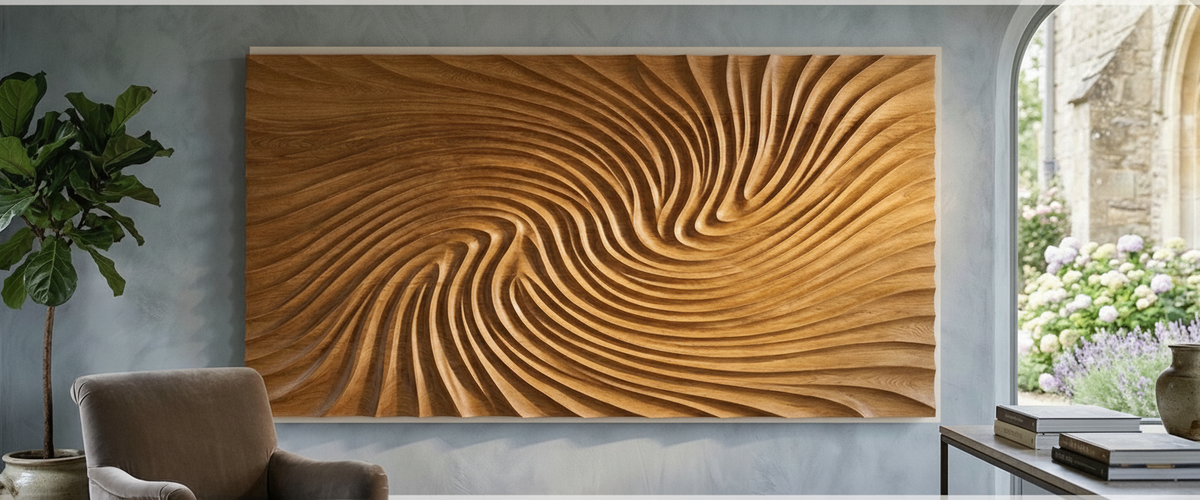
Carved timber pieces in this depth band are where 3D textured wood wall art earns its keep. A tightly cut abstract relief such as Barwick Mocha Tangle Abstract 3D Carving Wall Art holds a shadow at the bottom of each channel rather than only a highlight on top, which is the difference between depth you can see and depth you can only measure. Set a printed faux-texture board beside it and the gap is obvious from the doorway.

Same Depth, Three Materials, Three Results
Depth is only half the answer. Two pieces of 3D textured wall art cut to an identical 50mm profile can behave completely differently depending on what they are made from. We once laid carved oak, cast composite and welded steel samples at identical relief depth on the studio floor under one lamp and photographed them from the same spot. The results were not close.
Matching depth, three materials: timber softens the shadow edge, composite neutralizes it, steel cuts it hard.
Carved Timber
Grain scatters light, so shadow edges look soft and warm. Timber flatters organic and gradient work. Where the grain would otherwise soften the read, a color shift across the relief does the work instead, which is the logic behind pieces like Wenlock White & Burgundy Wood Relief 3D Wall Art, where the tonal gradient reinforces what the carving is already doing. Best in living rooms, bedrooms and hospitality suites where you want warmth rather than drama.
Cast Composite
For wider placement ideas, 3d Wall Art for Office Spaces: The Two Distances That Decide Everything is useful companion reading before finalising the setting and sightlines.
Consistent, repeatable and neutral under light. Useful for repeat panels across multiple guest rooms. It also has the least character of the three, so for a signature wall we steer clients toward timber or metal.
Welded and Formed Steel
The sharpest read by a wide margin. Metal holds a hard edge, so the shadow line is a crisp black stroke rather than a gradient. Stainless and Corten panels also handle covered terraces and pool houses, which timber only manages with constant upkeep. Our metal wall art range is the right starting point when the wall is large, the light is strong, or the space is commercial.

Deep Relief Needs Distance
A 2.5 inch (60mm) panel in a four-foot-wide (1.2m) corridor is a mistake we have talked clients out of more than once. Deep relief needs a minimum standoff of roughly eight to ten feet (2.4m to 3m) to be read as a whole composition. Closer than that and the eye only sees the nearest ridge, sleeves catch on edges, and the top faces collect dust in a way nobody enjoys.
For tight spaces, go wider and shallower rather than deeper. Angular, faceted carving helps here too, because a flat plane tilted against the light still throws a defined edge at close range: in a hallway or stair return, something like Barwick Mocha Angled Abstract 3D Carving Wall Art reads better than a deeply channelled panel you have to stand back from. For a double-height entry or a hotel lobby, push the depth as far as engineering allows; at thirty feet (9m) of viewing distance, shallow 3D textured wall art disappears entirely.
The Gloss Trap in 3D Textured Wood Wall Art
Seal a carved panel in high gloss and you fill every valley with reflection. Specular highlights land inside the shadow zones and the relief flattens visually, even though not a millimeter of depth was lost. Matte and satin finishes absorb rather than bounce, keeping the dark side dark.
Finish also does real protective work. Timber moves with humidity, and the USDA Forest Products Laboratory Wood Handbook is the standard reference on how moisture cycling drives dimensional change across the grain. In practice that means a carved panel destined for a dry Aspen winter and a humid summer wants a stable, breathable finish and a wall it can acclimatize against for a few days before hanging.
Demand a Sample Tile Before Anything Goes into Mold
For any bespoke commission, insist on a physical sample tile carrying the actual relief profile, the actual species or alloy, and the actual finish. Photographs of samples are not enough. Take the tile home, tape it to the target wall, and look at it at breakfast and again at dusk.
The sample answers questions no render can: whether the shadow survives your ambient light, whether the color reads warm or muddy against your plaster, and whether the depth is right for the room's traffic. Once a mold is cut or a large carving program is committed, changes get expensive. Fifteen minutes with a tile prevents most of it.

Depth Versus Weight: What Your Wall Can Actually Carry
More depth means more material, and more material means more load. Before specifying, confirm what sits behind the plaster.
Stud wall: Fix into studs or add blocking. Drywall anchors alone are a poor bet for a large carved or metal panel.
Masonry or concrete: The easiest case, but you need the right fixings and a drill that can handle it.
Hollow partition in a fit-out: Coordinate blocking with the contractor while the wall is still open.
French cleat or standoff mount: Spreads load and lets deep panels sit level. Ask for the mounting method in writing.
Multi-panel installs: Confirm the tolerance between sections and who sets the datum line on site.
Budget for 3D textured wall art follows the same logic as depth: material, scale, carving or fabrication complexity, finish and installation all move the number. We quote each commission individually rather than publishing a band that would be meaningless across timber, stainless and stone.
Commissioning a Panel That Holds Up
Giant Sculptures builds large-format 3D textured wall art the same way we build freestanding sculpture: specify the depth for the room, choose the material for the light and the climate, then engineer the fixing before anything is cut. Start with the 3D wall art collection to calibrate what depth looks like at scale, or look through wood wall art if warmth is the priority. Bring us a wall dimension, a photo at two times of day, and a note on viewing distance, and we can usually tell you in one conversation whether your idea needs 40mm or 60mm.