





































































































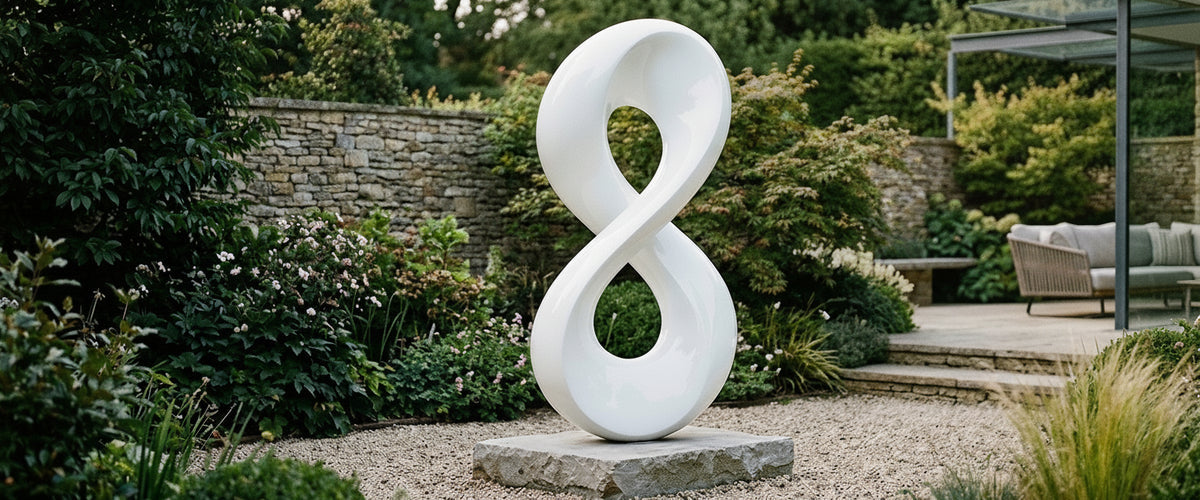

A client in Napa once chalked out a 9 ft (2.7 m) abstract form on his gravel courtyard, stood back, and told us it looked small. It was not small. The surrounding oaks were 40 ft (12 m) tall and the house had a 20 ft (6 m) roofline, so the chalk outline read as a puddle. That single afternoon explains more about why people commission composite work than any material spec sheet: when you want to make fiberglass sculpture at genuine scale, you get volume and presence without the weight, foundation work and casting costs that a solid stone or bronze equivalent would demand.
Fiberglass (glass-reinforced plastic, or GRP) is a hollow-shell material. Skin thickness carries the strength, an internal armature carries the load, and everything in between is air. That is the whole trick, and it is why studios make fiberglass sculpture rather than cast metal when the brief calls for the largest forms in shopping centers, hotel lobbies and themed attractions.
Key Takeaways
- Fiberglass sculptures are built as thin laminated shells over a mold, not carved or poured solid.
- Anyone who makes fiberglass sculpture at real size casts it in sections, bolts it to an internal steel or aluminum frame, then seam-fills and refinishes on site.
- Paint quality decides how the piece ages. Automotive-grade 2K polyurethane with UV clear coat outperforms decorative paint by years.
- Outdoors, fiberglass wins on scale and color; bronze, stone and Corten win on multi-decade permanence.
- Get the pedestal height and viewing distance right before you approve the maquette. It changes the piece more than the finish does.
How to Make Fiberglass Sculpture: The Honest Version
Every studio has its own habits, but the sequence for a serious piece is consistent. Learning how to make fiberglass sculpture means accepting that the casting is the quick part and the finishing is the slow part.
- Maquette. A scale model, usually 1:10 or 1:5, in clay or 3D-printed resin. This is where proportion gets argued out. Fix it here, not later.
- Full-size pattern. Oil clay over an armature for figurative work, or CNC-milled high-density foam for geometric and abstract forms. The pattern is sealed and refined to the exact surface you want to reproduce.
- Mold making. Silicone rubber backed by a rigid GRP jacket for detailed organic surfaces; a straight GRP tooling mold for cleaner shapes. Complex forms get split into multiple mold pieces with registration keys.
- Gelcoat. A pigmented resin layer brushed or sprayed into the mold face. This becomes the outer skin and holds the finest surface detail.
- Lay-up. Chopped strand mat and woven roving, wetted out with polyester or vinyl ester resin, built in layers. Corners, flanges and load points get extra laminate.
- Demold and assembly. Sections come out of the mold, get trimmed, then bond together over internal ribs and a steel armature.
- Finishing. Seams filled, faired, sanded through progressively finer grits, primed, then painted. On a gloss finish this stage alone can take longer than everything before it.
The resin you use to make fiberglass sculpture matters more than most buyers realize. Polyester is the workhorse. Vinyl ester costs more and resists water ingress better, which is the sensible call for a fiberglass resin sculpture that will live near a pool, a fountain or coastal air. Styrene fumes during lay-up are a real occupational hazard, and any competent workshop runs extraction and respiratory protection as standard rather than as an afterthought; the OSHA guidance on styrene exposure sets out why.
How to Make a Large Fiberglass Sculpture
Above roughly 8 ft (2.4 m), the questions change. You stop asking what the piece looks like and start asking how it gets out of the workshop, onto a truck, through a gate, and up onto its base. To make fiberglass sculpture at that size you engineer around three constraints: mold size, transport envelope and lifting points. We build sectionally, with bolted internal flanges so the joints fall along design lines rather than across a face. A welded steel spine carries wind load and self-weight down to a base plate, and that base plate needs a real foundation calculated for the exposed area, not four masonry anchors and optimism. Anyone asking how to make large fiberglass sculptures without an internal structural frame is describing a prop, not a permanent installation.
How to Paint Fiberglass Sculpture So It Survives Sunlight
Pigmented gelcoat gives good color straight from the mold, but it chalks under prolonged UV. If you make fiberglass sculpture for an exposed site, treat the surface like a car body: epoxy primer, high-build filler primer, block sanding, then a two-pack polyurethane or acrylic urethane topcoat with a UV-stable clear over the top. Metallics, pearls, deep gloss blacks and saturated reds all sit better in this system than in single-pack decorative paint.
Interior pieces have more freedom. Matte lacquers, soft textured finishes and faux bronze or verdigris effects all work beautifully indoors and cost less to apply because there is no weather package. It is also cheaper to make fiberglass sculpture for an interior, which is a large part of why custom fiberglass sculptures dominate retail and hospitality spaces, where a color has to match a brand palette exactly. Polymers and their coatings do change with age, and the Smithsonian's Museum Conservation Institute publishes useful background on how plastics behave over time.
What Fiberglass Sculptures Look Like in Different Settings
In a double-height Manhattan lobby, a glossy white or mirror-lacquered form reads as architecture. The material disappears and the silhouette does the work. That is the territory an Anish Kapoor fiberglass sculpture occupies: pure geometry, saturated pigment, and no visible evidence of how it was built. Fiberglass sculpture artists have worked this way since the 1960s precisely because you can make fiberglass sculpture that holds a perfect curve at a size no carver could reach.
In a Texas ranch garden, the same material behaves differently. If you make fiberglass sculpture for hard sun with dry grass behind it, a matte or lightly textured surface holds up better than high gloss, which throws hot spots and shows every fingerprint of dust. In a Hamptons courtyard with salt in the air, the coating spec matters more than the color.
Seasonal work is its own category, and it is one of the strongest reasons to make fiberglass sculpture rather than cast metal. Fiberglass Christmas sculptures for retail centers and hotel forecourts get specified for exactly the reasons above: a 12 ft (3.7 m) figure that two people can move on a pallet truck, store in a warehouse for eleven months, and reinstall without a crane. Browse our fiberglass sculptures collection and you can see the range this material covers, from restrained abstracts to full character pieces.
Scale, Sightlines and Pedestal Height
Scale decisions matter as much as the decision to make fiberglass sculpture in the first place. Here is the rule we work to: a sculpture should read clearly from the point where people first see it, not from arm's length. Walk to the front door, the gate, the top of the stairs. That is your true viewing distance.
- Viewing distance to height: for a piece seen from 30 to 50 ft (9 to 15 m), you generally need 6 to 10 ft (1.8 to 3 m) of height before it registers as an object rather than an ornament.
- Pedestal height: lifting a figurative piece so the visual center sits near standing eye level, roughly 5 ft (1.5 m), makes it feel considered. Lift an abstract form too high and it looks stranded.
- Ceiling clearance indoors: leave at least 18 in (45 cm) of air above the highest point, more in a tall atrium, or the piece looks jammed in.
- Negative space: a large form needs clear ground around it. Crowding it with planters kills the silhouette.
Mock it up before you sign off, whether you make fiberglass sculpture or cast in metal. Cardboard, plywood, scaffold poles, anything. Ten minutes with a real outline in the real space beats a rendering every time.
Indoor Versus Outdoor: When Each Material Wins
Fiberglass wins indoors almost outright. It is light enough for a mezzanine floor, easy to color-match, and simple to remove if the space changes hands. Clients also make fiberglass sculpture the answer outdoors when the brief calls for extreme scale, bold color, or a piece that may be relocated later.
For a permanent garden centerpiece that should outlive the owner, we usually steer clients toward bronze sculptures or Corten steel, both of which weather into something better than they started. A polished stainless steel sculpture holds mirror-bright reflections outdoors in a way painted composite simply cannot match over decades. You make fiberglass sculpture when the form itself is only achievable as a molded shell, or when weight limits rule metal out.
Placement Mistakes We See in Commissions
These come up on almost every project where we make fiberglass sculpture for a specific site. For wider placement ideas, How to Place Work From Contemporary Sculpture Artists so It Actually Lands is useful companion reading before finalising the setting and sightlines.
- Buying to fill a gap. The gap dictates the size and the piece ends up serving the architecture instead of leading it.
- Ignoring the sun path. A form that looks sculptural at noon can flatten to a black cut-out at 6pm if it is backlit.
- Busy backdrops. Patterned stone, dense mixed planting or a glazed facade will eat a silhouette. Plain hedge, sky, water or a single-tone wall gives the piece something to sit against.
- Under-specifying the base. Wind load on a large hollow form is significant. Anchoring gets designed, not improvised.
- Skipping the lighting plan. Two ground-recessed uplights at 45 degrees do more for a sculpture after dark than any amount of extra height.
- Assuming zero maintenance. Wash twice a year with mild detergent, check the coating annually, refresh the clear coat when it dulls.
Commissioning Custom Fiberglass Sculptures
When clients come to Giant Sculptures wanting to make fiberglass sculpture as a one-off, the useful conversation starts with three things: the exact spot, the viewing distance, and whether the piece is permanent or seasonal. From there we work through maquette, material choice, engineering and finish. Budget depends on scale, form complexity, mold count, structural engineering, coating specification and installation access, so we quote each commission rather than publishing a figure that would be meaningless. Ask for a tailored quote with photographs of the site and we will tell you honestly whether composite, metal or stone is the right answer for what you want.
Plenty of projects that begin as a fiberglass enquiry end up in bronze, and a few go the other way once the client sees what a molded shell can do at 15 ft (4.6 m). Either result is a good one, whether we make fiberglass sculpture for you or point you toward metal. Start with the full Giant Sculptures range if you are still shaping the idea, and bring us the site photos when you are ready to get specific.