
































































































A reclaimed wood panel almost never fails on the day it goes up. It fails around month three, once the heating has run for a full cycle and the boards start doing what old timber always does. That is the honest problem with reclaimed wood wall art: the piece you approve in a photograph is a piece at one moisture content, in one climate, and your wall is a different climate entirely. Get the preparation right and reclaimed wood wall art will outlive most of the furniture in the room. Get it wrong and you will be looking at a half-inch gap by February.

Key Takeaways Before You Buy Reclaimed Wood Wall Art
Ask for a moisture meter reading. For heated US interiors you want timber around 8 percent, not "air dried in a barn".
Barn oak, salvaged pine and reclaimed teak move at very different rates. Teak settles fastest, pine cups soonest.
The fixing method matters as much as the wood. A panel screwed rigidly to a substrate has nowhere to go but apart.
Radiators, range hoods and south-facing glass are the three placements that cause most callbacks.
Finish the back and the edges, or the front will cup toward the room.
Barn Oak, Salvaged Pine and Reclaimed Teak: Which One Keeps Moving Longest Indoors
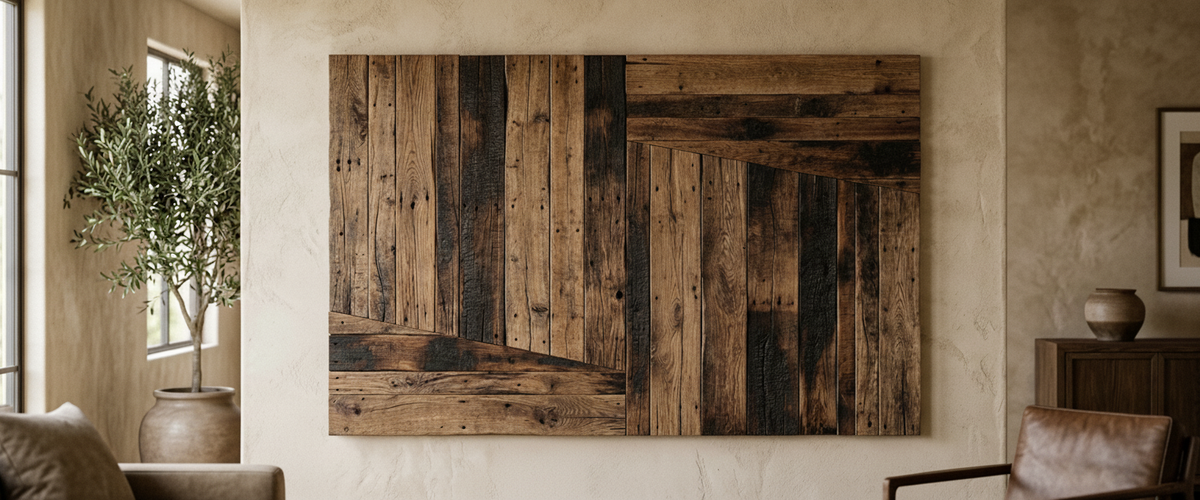
Barn oak is the romantic choice and the most temperamental. It is dense, tannin-heavy, and it has spent decades cycling between damp and dry in an unheated building, which people mistake for stability. It has been seasoned, certainly, but never to the 30 percent relative humidity of a Colorado winter. Oak moves most across the grain, so wide boards are the ones that check.
Salvaged pine from joists and decking is softer and more forgiving. It cups faster than oak but splits less dramatically, and it takes a repair well. Reclaimed teak sits at the calm end of the scale thanks to its natural oil content, which is why it earns its keep in kitchens, pool houses and coastal properties where humidity swings hardest. When we build reclaimed wood wall art with metal inlay or a bronze relief element, teak or quartersawn oak is usually the substrate, because metal does not move and the timber has to do all the compromising. Species is the first decision in any reclaimed wood wall art commission, and it is the one most buyers skip.
Barn oak boards conditioned and metered in our workshop before they become a finished panel.

Moisture Content Is the Whole Story, and 8 Percent Is the Number to Ask For
Timber does not have a fixed size. It reaches equilibrium with the air around it, and the USDA Forest Products Laboratory's Wood Handbook puts the equilibrium moisture content of wood in heated interiors in the range of roughly 6 to 9 percent for most of the year. Reclaimed stock straight out of a barn or a demolition yard often sits well above that.
So ask the question plainly: what is the meter reading on this panel, and was the stock re-dried before machining? A supplier who cannot answer is a supplier who has not measured. Every piece of reclaimed wood wall art we ship leaves with a recorded reading, and we acclimate finished panels in a heated space before crating. We also ask clients to leave a large piece flat in the room for a week or two before hanging. That waiting period feels fussy. It is cheaper than a remake.
Month Three Splits: What a Dry Winter Does to a Panel Above a Radiator
The worst wall in any house is the one directly above a heat source. A good share of the callbacks we get trace back to one. We had a client fit a wide salvaged oak panel over a cast iron radiator in a mountain house near Aspen, and by the third month the lower two boards had opened up like a fan. Nothing was wrong with the wood. The air six inches (150 mm) above that radiator was drier and hotter than anywhere else in the building, so the bottom edge shrank while the top edge did not.
The Canadian Conservation Institute's guidance on incorrect relative humidity is worth reading if you own anything organic, because the damage comes from the swing rather than the number. A house that runs at 30 percent RH all winter is survivable. A house that jumps between 25 and 55 percent every few days is not.

Reclaimed Wood Dining Room Wall Art: Steam, Heat Spikes and the Walls to Avoid
Dining rooms are usually the safest room in the house for reclaimed wood wall art, which is why reclaimed wood dining room wall art has become such a staple in open-plan homes from Napa to the Hudson Valley. The risk arrives when the dining wall is really a kitchen wall. Read the room honestly: if the panel sits within a few feet of a range, a dishwasher vent or an espresso machine, it will take repeated steam hits on one face only.
Dining walls are kind to timber, provided the panel sits clear of the range and the dishwasher vent.
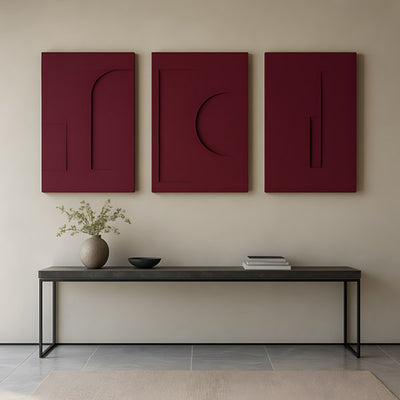
On those walls, framed and sealed work behaves better than open slatted timber, and splitting the wall into two pieces beats asking one oversized panel to absorb all the movement. A framed pair such as Kansora Woodland & Floral Nature 2-Set Framed Wall Art carries the natural subject a reclaimed panel would have given you, in a construction that copes with a busier atmosphere. Where the humidity is genuinely relentless and timber becomes a liability, Panthra Emerald Green Acrylic Stripe 3D Wall Art is closer to the right answer, holding a strong graphic line in a steam-heavy corner without any seasonal movement at all.
Cupping, Twist and the Fixing Method That Lets a Panel Breathe
Most cracked panels were killed by their fixings. Hanging reclaimed wood wall art is a structural decision rather than a decorative one, because timber has to be allowed to expand and contract across its width. The mounting system needs to hold the piece securely in one axis and loosely in the other.
Use a cleat, not a glue line. A French cleat in hardwood or aluminum carries weight cleanly and leaves the boards free.
Slot the screw holes. Oversized or slotted holes in the battens let each board slide a few millimeters without tearing.
Keep an air gap. Around half an inch (12 mm) behind the panel equalizes both faces and stops the back from staying damp.
Fix the center, float the edges. Anchor the middle of a wide panel and let it grow outward evenly.
Check the wall first. An exterior masonry wall in a cold climate can run several degrees colder and noticeably damper than a stud wall.

Hardwax Oil, Wax or Char and Seal: How Each Finish Handles Seasonal Swing
Hardwax oil is our default for interior reclaimed wood wall art. It penetrates rather than sitting on top, it slows moisture exchange without sealing the timber into a plastic shell, and a scuff can be spot-repaired without stripping the whole piece. Soft wax looks beautiful on aged oak and offers almost no moisture control, so treat it as a decorative layer for a stable, climate-controlled room and expect to refresh it.
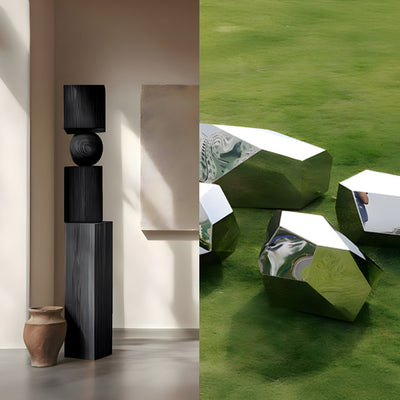
Charring and sealing, the yakisugi approach, does something different: burning the surface stabilizes the outer fibers and gives you a matte black relief that reads powerfully at scale. In a double-height great room, a charred panel next to a stainless or bronze sculpture is one of the strongest pairings we build. Whatever finish you choose, insist that the back and all four edges are finished to the same standard as the face. Uneven sealing is the single most common cause of cupping we see on pieces made elsewhere.
Year Five: What Settled Reclaimed Wood Wall Art Looks Like
A panel that was built right does not look untouched at year five. It looks settled. You will see a few hairline checks in the end grain, a deeper tone where daylight has worked on the oil, and joints that have closed and opened by a hair without ever opening into a gap you can see from across the room. No cupping. No twist at the corners. The cleat still tight.
That is the standard we build to, and it is the same thinking we apply to bronze, Corten and stone: material behavior first, then design. If you are weighing bespoke reclaimed wood wall art against a sculptural relief in metal, browse the wood wall art collection alongside our 3D wall art range and tell us the wall, the heat source and the ceiling height. Cost on a commission depends on species, scale, engineering and finishing, so we quote each piece individually rather than guessing from a photo. Send us the room and we will tell you honestly whether timber is the right answer for that wall.
For wider placement ideas, Large Wood Wall Art That Survives Its First Winter is useful companion reading before finalising the setting and sightlines.