































































































Three years after a coastal install, a client sent us photographs of pale orange streaks running down her render wall from the bottom edge of a large panel. The metal itself was sound. The stainless steel wall art had been made from the wrong grade, fixed with the wrong hardware, and mounted flat against a wall that never dried out. Every one of those decisions was made at the quote stage, and every one of them was cheap to get right.
Stainless steel wall art is one of the most requested categories we work on, and also the category where the gap between a good maker and a bad one shows up fastest. Indoors, almost anything survives. Outdoors, the wall tells the truth within two winters.

Key Takeaways Before You Buy
Six decisions determine whether stainless steel wall art still looks right in a decade.
Grade first: 316 for coastal, pool and de-icing-salt sites. 304 is fine inland and sheltered.
Finish second: brushed and bead-blasted hide handling marks and water spotting. Mirror shows everything.
Fixings matter more than the panel: mixed metals at the standoff corrode long before the sheet does.
Leave a shadow gap: air behind the piece keeps water moving instead of sitting.
Gauge and welds predict the decade: thin sheet ripples, poorly ground welds rust at the seam.
Maintenance is a rinse, not a chemical program: clean water, a soft cloth, and no chloride cleaners.
Tea-Staining: Why 304 Goes Orange Within Sight of the Sea
Stainless steel does not resist corrosion because it is inert. It resists corrosion because chromium forms a thin passive oxide layer that repairs itself when oxygen is present. Chlorides break that layer down locally. Salt spray, pool chemistry and road salt all deliver chlorides, and once they sit on a surface in a damp, sheltered spot, you get the shallow brown discoloration the industry calls tea-staining. It is cosmetic rather than structural, but on a feature wall it is ruinous to look at. The Australasian Stainless Steel Development Association has documented the causes in detail, and the short version is that grade, finish and cleaning frequency drive almost all of it. Nothing about stainless steel wall art is maintenance-free; it is maintenance-light, and only when the specification is right.
Grade 316 contains molybdenum, which substantially improves pitting resistance in chloride environments. That is why marine hardware, coastal handrails and architectural facades within a few miles of the ocean are specified in 316 as standard; the International Molybdenum Association keeps a useful library of architectural case studies on exactly this point. For a Malibu terrace, a Hamptons pool house or a Gulf Coast courtyard, 316 is not an upgrade, it is the baseline. Inland, on a Napa hillside or a Dallas courtyard with no de-icing salt nearby, 304 performs perfectly well and the money is better spent on gauge and fabrication quality.

Brushed Hides Marks, Mirror Shows Every One
Surface finish changes both how a piece reads and how forgiving it is. A smoother, tighter finish gives chlorides less to cling to, which is why a well-polished panel genuinely outperforms a rough one in the same location. The trade-off is visual: a mirror-polished panel records fingerprints, irrigation overspray, mineral spotting from hard water, and every pollen season.
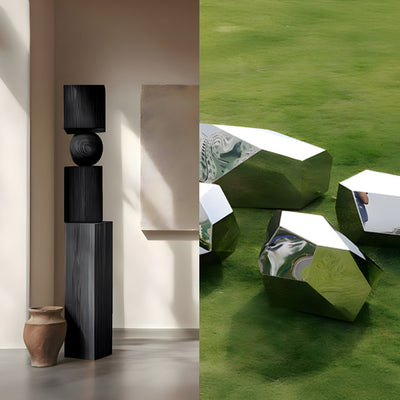
Brushed (a directional satin grain) is our default recommendation for stainless steel outdoor wall art on residential sites. It reads warm in low sun, hides handling marks, and can be re-grained locally if something scratches it. Bead-blasted gives a soft pewter tone that sits beautifully against gray render and weathered timber, though it holds water film slightly longer and wants a more regular rinse. Mirror belongs where people are not touching it and where a maintenance crew already exists: hotel forecourts, corporate lobbies, gated motor courts. If you want reflection at a distance and calm up close, ask for stainless steel wall art with a brushed field and mirror-polished accent elements.
A brushed 316 face keeps handling marks and water spotting off the surface on exposed coastal sites.
The Fixings Fail Before the Panel Does
We have inspected more failures at the standoff than in the metal itself. Put a mild steel anchor, a zinc-plated screw or an aluminum bracket in direct contact with stainless in a wet location and you have built a galvanic cell. The less noble metal corrodes, the joint stains, and eventually the panel moves. The fix is unglamorous: matched stainless fixings, isolating washers or sleeves where dissimilar metals meet, and anchors rated for the actual substrate rather than whatever was in the van.
Weight is the other half of this. Large-scale stainless steel wall art in a heavier gauge is not a picture frame. On render over block, on cavity brick, or on timber cladding with battens behind, the load path has to reach something structural. The same discipline applies across materials, and the numbers change fast: a carved stone panel at comparable width, such as the Six Galloping Horses Marble Relief Wall Panel - 180cm, carries many times the mass per square foot of a steel sheet, so the bracket schedule and the wall behind it have to be specified accordingly. For commissions over roughly 6 ft (1.8 m) wide in any material, we work from a fixing drawing rather than a list of screws, and we would rather ask your builder three questions early than diagnose a sagging panel later.

Why a Shadow Gap Keeps Water Moving
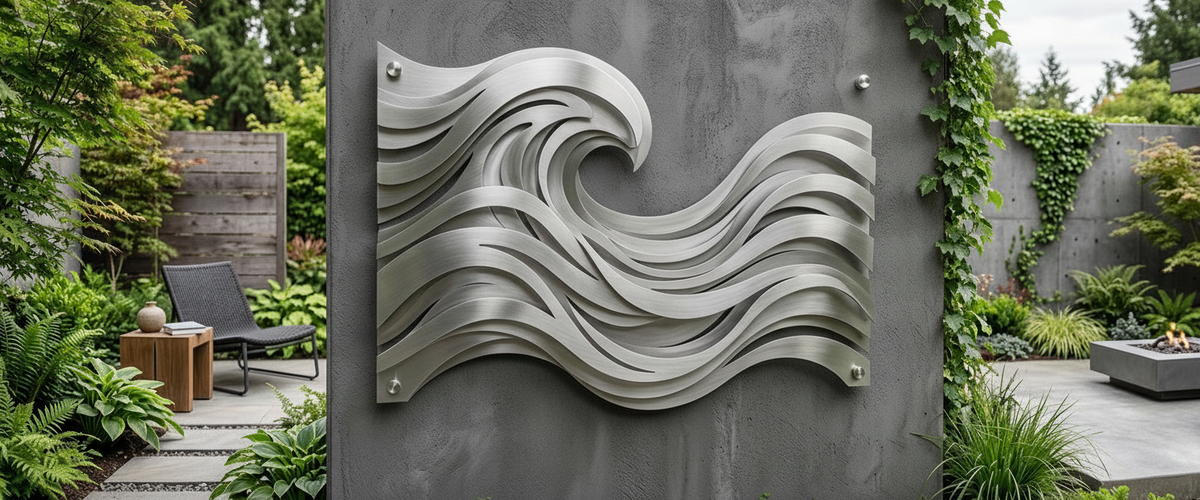
Flush-mounted stainless steel wall art traps a wet film between the panel and the wall. That film holds chlorides, dries slowly, and produces exactly the streaking that ruined the install described at the top of this article. Standoffs that push the panel 1 to 2 inches (25 to 50 mm) off the face let air circulate, let rain wash through, and throw a shadow line that makes the work look considered rather than stuck on.
Standoffs set the panel 25 to 50 mm off the face so air moves behind it and rain washes through.
The backing wall changes the outcome too. Smooth painted render shows runoff staining most clearly and benefits from the biggest gap. Brick hides streaking well but is rarely flat, so fixings need shimming. Timber cladding moves seasonally and can leach tannins onto lower fixings, which is why we prefer to bridge to the structure behind rather than sit hardware in the boards themselves. If you are still comparing textures for a large exterior elevation, browsing our outdoor wall art and decor range alongside metal options will tell you quickly whether you want reflection or relief.
The Tells That Predict a Bad Decade
Some warning signs in stainless steel wall art are visible in photographs before you ever place an order.
Sheet ripple: thin gauge oil-cans in sunlight and looks like a cheap appliance panel. Ask what thickness the face sheet is and whether it is stiffened or folded at the edges.
Ground-back welds with no re-passivation: grinding removes the passive layer. If it has not been pickled or passivated afterward, the seam is where rust begins.
Carbon contamination: steel fabricated in a shop that also grinds mild steel picks up embedded iron particles that bloom orange in weeks.
Unsealed edges and pockets: any detail that collects standing water will stain the wall below it.
No fixing detail supplied: a maker who will not tell you how the piece hangs has not thought about the next decade.
Choosing Between Steel and Relief Work
Not every exterior wall wants metal. Stainless steel wall art gives you light, movement and a contemporary line; carved and cast relief gives you depth, shadow and narrative. On a long render elevation in strong western sun, where reflection would only add to the glare, a marble relief at architectural scale such as the World Icons Cabinet Marble Relief Wall Art - 300cm (nearly 10 ft) works with carved shadow instead, and holds a long wall without lighting it up. Where a sheltered courtyard or stable-yard wall needs motion at closer range rather than a mirrored surface, the patinated depth of the Galloping Herd Bronze Relief Wall Art - 120cm (around 4 ft) is closer to the right design language. Our metal wall art and 3D wall art collections are worth viewing side by side before you commit to a material.

Commissioning Stainless Steel Wall Art at Scale
Bespoke work is where stainless earns its keep, because the panel can be sized to the wall instead of the wall being decorated around a stock size. When clients come to Giant Sculptures for commissioned stainless steel wall art, we start with site conditions: distance to salt water, irrigation layout, sun path, substrate, and who will clean it. Those answers set the grade, the gauge, the finish and the fixing system. Budget follows material, scale, complexity, engineering and installation, so the honest answer on cost is always a tailored quote rather than a number pulled from the air.
One lesson worth passing on: a client in Arizona had sprinkler heads throwing hard water across the base of a new panel twice a day. No grade of steel fixes that. We moved two heads, and the mineral spotting stopped.
The Maintenance That Actually Resets the Surface
Stainless wants water, not chemistry. Rinse with clean fresh water, wipe in the direction of the grain with a soft cloth or microfiber, and dry off if your water is hard. Coastal sites benefit from a rinse every month or two; inland sites can go seasonally. Mild detergent handles greasy marks near kitchens and grills.
What to avoid is short: no chloride-based or bleach cleaners, no steel wool, no wire brushes, no abrasive pads that cross the grain. Light tea-staining that has already appeared can usually be removed with a proprietary stainless cleaner and, in stubborn cases, professional re-passivation. Catch it early and the surface genuinely resets. Leave it for five years and you are looking at refinishing. For inspiration on how stainless steel wall art sits alongside other pieces across a property, our wider wall art and wall decor collection shows the range of scale we work at.
For wider placement ideas, 3d Wall Art for Office Spaces: The Two Distances That Decide Everything is useful companion reading before finalizing the setting and sightlines.