



































































































Granite will outlive your house, but a bad finish can make it look tired within a year. Most buyers choose an outdoor granite sculpture by subject and stone color, then treat the granite finish as a detail for the workshop to sort out. That gets the order wrong. Outdoors, the finish decides how the piece handles rain, sprinkler spray, frost and lichen, and it even changes the color you see from across the lawn.
Looking for the full range in this category? Browse our Granite Headstones collection for every available finish, size, and configuration.

At a Glance
High polish looks sharpest on day one and shows water marks, mineral streaks and organic growth fastest.
Flamed and bush-hammered faces hide weathering and suit wet climates, lawns and irrigated beds.
Split and pitched surfaces read best at true garden scale, where the raw quarry character carries over distance.
Finish shifts color. Polish deepens dark stone; textured faces lighten and gray it.
Granite's weak points are existing fissures, de-icing salt and poor footings, not the stone itself.
Why a High Polish Struggles Outdoors
A mirror polish closes the surface and bounces light back like glass. Indoors that is exactly the point. Outside, polished granite shows every hard-water droplet as a pale ring once it dries, and lichen spores and algae settle into the faint film that builds up in shade. Within a season, a north-facing polished piece can look speckled rather than lustrous.
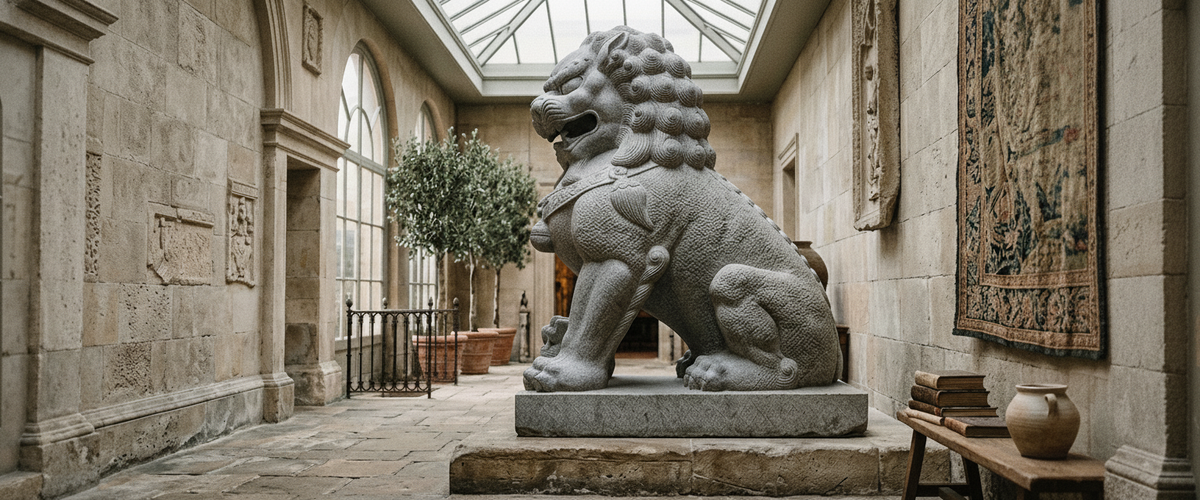
Polish can work on an outdoor granite sculpture; careless placement is the real problem. On a covered terrace or a sunny, well-drained courtyard in Scottsdale or Palm Springs, where stone dries quickly and stays clear of irrigation heads, a polished black piece such as the Roaring Lion Polished Black Granite Statue - 120cm, at around 4 feet (120 cm), keeps its depth of color with very little upkeep. Put the same lion under dripping oaks in a humid Southern garden and you will be wiping it every week. We once had a client on Long Island move a polished piece three times in its first summer, purely to escape the sprinkler arc. Map your irrigation before you map your sightlines.
The same stone, two finishes: polish deepens color, flaming softens it and hides water marks.

Flamed and Bush-Hammered Finishes Forgive the Weather
To make flamed granite, the workshop blasts the surface with a torch so the crystals spall off, leaving a slightly glittering, rough face. A bush-hammered finish comes from a toothed head that pits the stone evenly. Both break up reflection, so water marks and mineral deposits simply disappear into the texture. For damp climates, whether British rain or a Pacific Northwest winter, these are the finishes we steer most outdoor granite sculpture commissions toward.
They also add grip. On a granite garden statue that doubles as a seat, a plinth people lean against, or anything near a pool deck, a textured face is safer than a polished one when wet. The trade-off is fine detail: aggressive flaming can soften crisp carved edges, so many commissions combine a textured field with honed or lightly polished highlights on the face, mane or lettering.
Split and Pitched Faces: Letting the Quarry Show
A split face is the stone as it breaks along its grain; a pitched face is chiseled back to a rough, rock-like edge. At tabletop size these can look unfinished. At 6 feet (about 2 m) and beyond, set at the end of a long axis in a Napa vineyard or an Aspen meadow, they give granite its natural weight and read clearly from 100 feet away.
Where a garden calls for a broad panel rather than a figure, a 200 cm piece such as the Blessing Character Grey Granite Garden Screen - 200cm lets a refined carved motif sit within stone that still feels honest and solid, without tipping into fussiness. Screens and monoliths are where raw faces earn their place, because the eye takes in the whole mass before any detail.
Raw split faces carry best at garden scale, where the whole mass reads before the detail.
How Finish Changes the Color You See
Here is the part of choosing an outdoor granite sculpture that catches designers out. The same granite can look like two different stones depending on finish. Polish saturates color, so black granite reads jet black and red granite reads deep rust. Flaming and bush-hammering scatter light, turning black to charcoal and red to a dusty terracotta.
Context compounds this. Dark granite against a yew or boxwood hedge can disappear into a single shadow unless it is polished or honed enough to catch light. Pale gray granite on pale gravel can vanish the other way. Our studio rule is simple: choose contrast with the backdrop first, then choose the finish that delivers it. On a pale gravel forecourt, a deeply carved figure such as the Ornate Throne Guardian Lion Granite Statue - 200cm, at around 6.5 feet (200 cm), is a safer choice than a smooth form in the same gray, because its relief casts its own shadows and separates the sculpture from the ground.

Where Outdoor Granite Sculpture Finally Fails
Granite is dense and has low porosity, but it is not invincible. Freeze-thaw cycles exploit any natural vein or fissure; water gets in, expands as ice and slowly opens the crack. De-icing salt is worse. Keep rock salt away from stone plinths on Chicago or Denver driveways, because salt crystallization attacks joints, mortar beds and any softer inclusions. The National Park Service's Preservation Brief 1 on cleaning and water-repellent treatment of masonry is a useful caution against sealing stone reflexively, since trapped moisture can do more harm than good.
The most common failure we see has nothing to do with the stone. A heavy granite piece on an undersized or uncompacted footing will settle unevenly, tilt and stress the joint between sculpture and base. Any large outdoor granite sculpture needs a reinforced concrete pad sized by an engineer or experienced installer, with drainage so water does not pool at the base.
What to Demand From a Sample Block
Never sign off the finish on an outdoor granite sculpture from a photograph. Ask for a physical sample block in the exact quarry lot, not just the same named stone. Then test it properly:
View it wet and dry. Some granites darken dramatically when wet, and your garden will be wet often.
Look at it outdoors at the distance people will actually see the sculpture.
Place it against your hedge, gravel or paving, not on a white studio table.
Ask to see more than one finish on the same block, side by side.
Check for visible veins or fissures, and ask how the finished piece will be oriented relative to the grain.
Confirm how carved details will be finished if the field is textured.
A Buyer's Checklist Before You Commission
Map sun, shade, drip lines and irrigation for the exact spot.
Decide the viewing distance, which dictates how much texture the piece can carry.
Choose contrast with the backdrop, then the finish that achieves it.
Plan the footing and drainage before the carving starts.
Agree the sample block in writing as the reference for the finished work.
Budget depends on stone, scale, carving complexity, finishing, engineering, crating and installation, so the most reliable figure comes from a tailored quote. Giant Sculptures makes bespoke granite pieces to your site and ships them worldwide; share your location, photos and intended viewing distance, and we will recommend a finish that still looks right after its tenth winter.
For wider placement ideas, Recumbent Beats Rampant: How to Site Sleeping Lion Garden Statues is useful companion reading before finalizing the setting and sightlines.