






































































































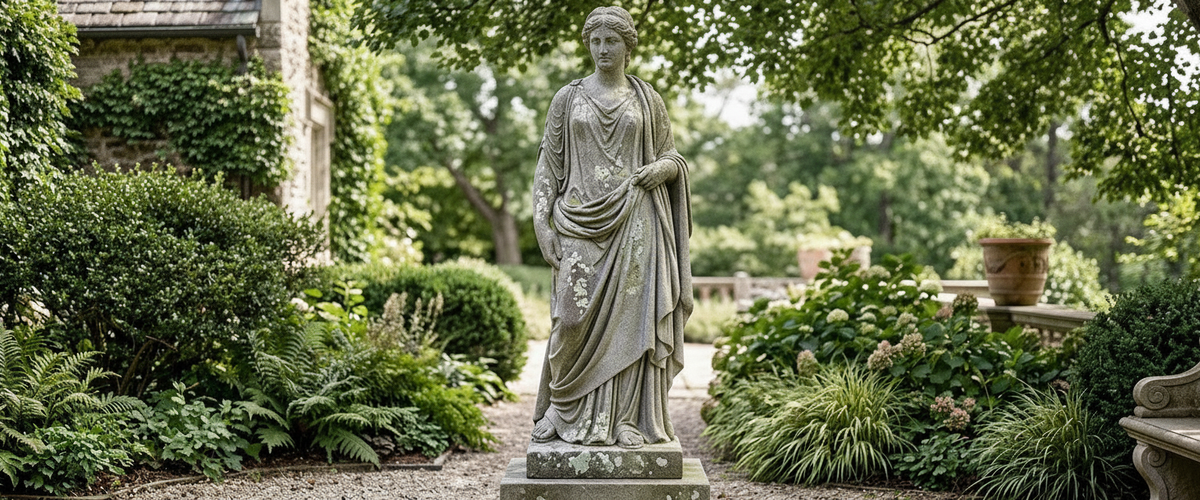

Walk through any garden center from Long Island to Austin and you will find "stone" statues that weigh less than the bag of mulch beside them. The label is doing a lot of work. The phrase outdoor stone garden sculptures covers three very different products, and the one you buy decides how the piece ages, how it survives a hard freeze, and whether your lawn can even hold it. This is the conversation we have with clients at Giant Sculptures before anyone mentions pose or size.

At a Glance
Hand-carved natural stone (marble, granite, limestone, sandstone) is solid all the way through, heavy, and ages with character.
Reconstituted stone is crushed stone bound with cement and cast in a mold. Detail can be crisp; winter performance depends on the mix.
Cast concrete is sand, gravel and cement with a surface tint. It is the most widely sold and the quickest to show wear.
Granite and dense marble shed water. Limestone and sandstone absorb it.
Solid stone needs a footing plan and lifting access before delivery day.
Hand-Carved, Reconstituted and Cast Concrete: Three Products Under One Word
Hand-carved means a quarried block reduced by chisel, pneumatic tools and, increasingly, machine roughing, then finished by hand. Chip it and you find the same stone underneath. Reconstituted stone, often sold as "cast stone," is crushed limestone or similar aggregate mixed with cement and poured into a mold. Made well, it is dense and honest. Cast concrete is the general-purpose version, frequently hollow, with a wash on the surface to suggest stone.
Carved marble is solid throughout; cast concrete is often hollow beneath a tinted surface.
Two questions sort them fast: is it solid or hollow, and what is under the surface? A seller who cannot answer either is telling you something.

How Outdoor Stone Garden Sculptures Handle Rain
Limestone and sandstone are sedimentary rocks, laid down in layers and full of tiny pores. They drink rain slowly, which gives them that soft, chalky warmth and a gentle gray patina over time. Granite is the opposite: interlocking crystals, very little pore space, and a habit of shrugging water off. There is a reason it ends up as curbs and monuments.
Marble sits between the two. It is dense and absorbs little, but its calcite reacts with acidic rain, so a high polish softens to satin after a few seasons outdoors. On a terrace wall, a carved white marble head such as the Graceful Horse Head White Marble Outdoor Sculpture will keep its form for generations; if you want the gleam to last, set it under a loggia or porch roof rather than in open rain.
Where Each Type Fails First in a Hard Winter
A Seattle winter is wet more than it is cold. A winter in Connecticut or Colorado freezes that water solid, again and again. Both punish the same weakness in outdoor stone garden sculptures: water inside the material expanding as ice.
Limestone and sandstone: spalling, where the face flakes away in thin sheets, worst when the stone was carved against its natural bed.
Reconstituted stone: crazing, a fine web of cracks across the surface skin that lets frost in deeper each year.
Cast concrete: crumbling edges on ears, noses, fingers and rims, sometimes with rust bleeding from internal rebar.
Granite and dense marble: rarely the stone itself. Failures usually start at the base, where water pools in a plinth joint.
We regularly see the same story: a pair of reconstituted lions bought elsewhere, and after two winters the manes have crazed and the plinth corners have sheared clean off. The design was fine. The mix was never made for repeated freeze-thaw.
Lichen and Moss: Flattering on Stone, Grubby on Concrete
Real stone has variation in grain and tone, so lichen reads as age, part of the surface. Colonies also arrive slowly; the British Lichen Society notes that many species grow only a few millimeters a year. Concrete is uniform, so the same growth reads as dirt, and it tends to collect patchy green algae before anything attractive takes hold.
Resist the pressure washer. Conservation guidance from the National Park Service Technical Preservation Services consistently favors the gentlest effective method for masonry: water and a soft brush.
Placement matters too, because dark stone forgives more than pale. In a damp, shaded corner where white stone would streak, a black marble piece such as the Black Marble Veiled Figure Bust keeps a crisp silhouette season after season. Busts at this scale also suit covered terraces and niches, and the wider range of marble busts and torsos is a useful place to compare tones and finishes.

The Weight Gap: Plan the Footing Before the Crane Arrives
Marble weighs roughly 168 pounds per cubic foot (about 2,700 kg per cubic meter), and a carved figure is solid throughout. Many cast concrete pieces sold as outdoor stone garden sculptures are hollow-cored to save shipping. Two statues of the same height can differ in weight several times over.
That changes the install. At full life size, a solid carved horse such as the Majestic Horse Black Marble Outdoor Sculpture is a lifting job, not a delivery. It wants a compacted gravel and concrete pad, set below the frost line in cold states, with a stainless pin fixing. On estate jobs, a gravel drive often cannot take a crane's outrigger loads, which can leave the crane standing on the public road. That is why we confirm gate widths, ground conditions and truck position before a crate is closed.
A life-size carved horse needs a frost-depth footing and confirmed crane access.
A Buyer's Checklist for Outdoor Stone Garden Sculptures
Ask exactly what it is: carved natural stone, reconstituted stone or cast concrete. Get the stone type by name.
Ask the weight. It tells you more than any product photo.
Match stone to climate: granite or dense marble for freeze-thaw; limestone and sandstone for mild, well-drained sites.
Choose the finish for the position: polished under cover, honed or matte in open weather.
Plan the base: footing depth, drainage and fixing.
Confirm lifting access and ground protection for lawns and paving.
Budget depends on material, scale, complexity, engineering, installation and finishing, so request a tailored quote rather than comparing sticker heights.

When a Carved Commission Is Worth the Wait
An off-the-shelf cast piece makes sense for a rental, a short-term styling job or an event. A carved commission earns its lead time, usually measured in months rather than weeks, when the sculpture is a focal point you plan to keep for decades, when proportion must suit one specific view (the end of an allée in the Hamptons, a courtyard in Aspen), or when the stone needs to match your home's cladding or survive a harsh mountain winter.
In our studio the sequence is block selection, a clay or digital maquette for sign-off, then carving and finishing. Start with our large garden statues or the wider garden statues collection, then talk to us about scale. The best outdoor stone garden sculptures are bought once and left alone for a lifetime, which is exactly why the material question comes first.
For wider placement ideas, Marble and Granite Statues: Which Stone Belongs Where in Your Garden is useful companion reading before finalising the setting and sightlines.