

























































































The most expensive part of a marble horse is the part you can circle with two fingers. Everything above the knee is confident work with a big margin for error; the fetlock is where a carver slows down, changes tools, and starts breathing carefully. Buyers of marble animal statues tend to price a piece by its height, and tend to guess wrong, because stone carving is priced by risk and by hours at the fragile end, not by the tonnage sitting on the pallet.

At a Glance: What Actually Drives the Price
Before the detail, here is the short version of what makes marble animal statues expensive:
Pose beats size. A crouching animal with legs tucked under the body can cost roughly half what a leaping version of the same subject costs at the same height.
Thin sections carry the risk. Legs, tails, antlers, ears and wingtips are where blocks are lost and where breakages happen after delivery.
Crystal size caps the detail. Coarse-grained marble will not hold fine fur; that is a material limit, not a skill limit.
Struts are engineering, not laziness. Stumps, drapery and rock bases exist to keep legs attached for the next hundred years.
Frost attacks the extremities first. A slender limb freezes and thaws far faster than the mass behind it.
Your reference photos move the quote. Sharp, well-lit, multi-angle references shorten modeling time and reduce revision rounds.
A Fetlock Costs More to Carve Than the Whole Body Above It
Rough out a horse's barrel and shoulder and you are removing waste stone at speed. Reach the lower leg and the work inverts. The carver is now supporting a narrow column of marble while removing stone from three sides of it, with every strike transmitting through the section they are trying to protect. Hours per pound go up sharply, and so does the chance of restarting on a fresh block. When a quote for marble animal statues looks high relative to the height, look at how much of the silhouette is unsupported.
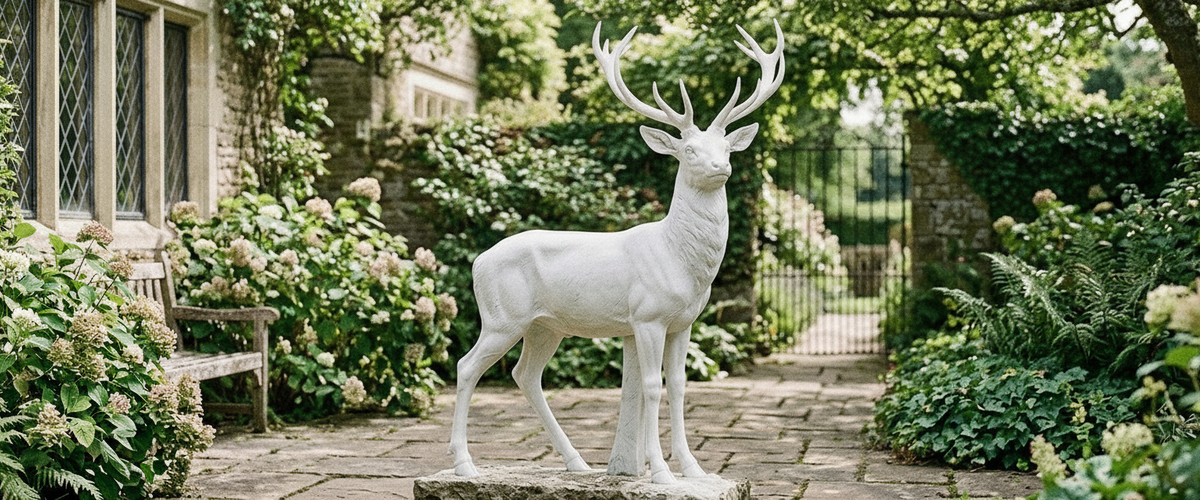
Subject matters here as much as scale when you are pricing marble animal statues. An elephant is largely mass with a few vulnerable points at the tusks and trunk tip, which is why something like the Grey Marble Elephant With Pale Tusks, 180cm reads as generous and imposing at close to six feet without demanding acrobatic carving. A deer at the same height is a different proposition entirely: four pencil-thin legs, a slender neck, and antlers that branch into air.
Mass-led subjects carry their own weight: an elephant has few unsupported sections to protect.

Thin Sections, Undercuts, and the Breakages That Happen After the Invoice Clears
Marble has excellent compressive strength and poor tensile strength. Push down on it and it shrugs; lever sideways on a projecting limb and it snaps, usually along a vein or bedding plane. Deep undercuts, where the carver cuts behind a form to create shadow and separation, are where that weakness gets tested. They look magnificent. They also create use points.
Most damage to marble animal statues that we hear about does not happen in the studio or in transit; it happens a year or two after installation, when a landscaper's trailer clips an antler or a gardener leans a ladder against a foreleg. Stags lose tines to hose reels. Dogs lose tail tips to strimmers. The repairs are usually straightforward, pinned and toned, but the lesson holds: pieces with delicate extremities need a placement plan with real clearance, not just a nice sightline.
Crystal Size Against Fur Detail: Where Marble Gives Up
Not all white stone destined for marble animal statues behaves the same under a fine chisel. Fine-grained statuary marbles hold crisp edges and can take a soft translucency at the surface; coarse, sugary marbles fracture between crystals and blur anything smaller than the grain. That is why a carver will render a lion's mane as sculpted mass and rhythm rather than as thousands of individual hairs. On a piece such as the Standing Lion With a Tousled Mane White Marble Statue - 120cm, the mane is cut to stone logic: deep grooves, strong shadow, no hair-by-hair fussing.
Grain size sets the limit: the mane is cut for shadow and rhythm, not hair-by-hair realism.
When a client genuinely wants dense pelt texture or wire-fine whiskers, marble is the wrong answer. Granite is tougher and stands up better to abrasion, but its coarse crystal structure blunts fine detail even further, while cast bronze will pick up every mark a sculptor makes in clay. Our bronze animal sculptures exist partly for exactly this reason. Choosing the right material at the sketch stage is cheaper than discovering the limit halfway through carving. The Natural Stone Institute publishes useful background on how stone type governs finish and weathering behavior.
The Crouching Hound Is Half the Price of the Leaping One
Two dogs, same breed, same height, wildly different marble animal statue cost. The crouching hound sits inside a compact block, with legs folded against the body and almost no unsupported stone. The leaping hound needs a much larger block to contain the extended limbs, wastes most of it, demands slower work at every projection, and needs structural thinking to stay standing. Pose is the single biggest lever on the price of marble animal statues, and the same arithmetic governs any mid-air subject: on the Leaping Dolphin White Marble Garden Statue - 120cm, the wave form under the body is doing quiet structural work while reading as pure decoration.
Dynamic poses need hidden engineering: the wave here is structure disguised as decoration.
If budget is tight and presence matters more than drama, buy the seated or standing pose at a larger scale rather than the dynamic pose at a smaller one. Scale reads across a lawn. Fine detail does not.

Struts, Stumps, and Drapery: The Supports That Keep Legs Attached
Roman copyists solved this problem two thousand years ago and the solutions have barely changed: a tree stump beside a hound, a fold of drapery running to the ground, a rock outcrop under a raised hoof, a discreet stone strut between two legs. These are not compromises. They are the reason surviving classical animal sculpture still has its legs, and the reason antique marble animal statues are still standing at all.
A good carver hides the support in the story. A rock under a stag's forefoot looks like terrain. Ask, at commission stage, exactly where supports will sit and how they will be justified visually. If a supplier promises a fully unsupported four-legged animal in marble at life size, ask what happens the first time someone bumps it.
Frost Finds a Thin Limb Long Before It Touches the Mass
Freeze-thaw damage is a water problem. Marble is slightly porous, water enters, it expands as it freezes, and micro-cracks widen every cycle. A thick torso has thermal inertia and rides out a cold snap; a slender leg or a thin ear cycles fully with every night. Add road salt or a sprinkler head that soaks one flank every morning and you accelerate the process considerably. Guidance from the American Institute for Conservation is worth reading before you commit a fragile carved piece to a hard-winter site.
Practical steps for marble animal statues in cold climates: set the piece on a drained plinth so it never stands in standing water, keep irrigation spray off the stone, avoid de-icing salt within splash distance, and consider a breathable cover for the worst weeks. For an exposed Aspen or Hudson Valley site, a compact, mass-led silhouette will outlast a spindly figure, however elegant that figure looks on a summer afternoon.
Reference Photographs That Move the Quote Up or Down
For bespoke marble animal statues, the quality of your references directly affects both price and outcome. Send us the following and the modeling stage gets shorter:
Side, front, rear and three-quarter views, camera held level with the animal's chest.
Daylight, no flash, no heavy shadow across the head.
Close-ups of the head, feet and any markings that matter to you.
A scale reference in at least one frame, plus the animal's real height and weight if known.
One image of the intended site, with approximate footprint dimensions.
A note on which pose you want and whether the piece will be viewed from one side or in the round.
Vague references mean assumptions, assumptions mean revisions, and revisions in stone are expensive. Budget for marble animal statues depends on material grade, scale, pose complexity, engineering, finishing and installation, so we quote each commission individually rather than publishing a figure that would mislead you.

Buying Checklist Before You Commit
Before you commission marble animal statues at scale, work through this list:
Confirm the marble type and grain, not just "white marble."
Ask where the supports are and how they are disguised.
Check the base: doweled, pinned, or free-standing on gravel?
Confirm access at the site, including gate widths and crane or gantry requirements for anything over about 300 lb (140 kg).
Plan clearance from paths, driveways, hose reels and mower routes.
Agree the finish: polished, honed or slightly weathered, since each ages differently outdoors.
Browse our marble sculptures to see how pose and mass play out at different heights, or start with the wider animal sculptures range if you are still deciding between stone and metal. Giant Sculptures carves and commissions large-scale marble animal statues to order, and we would rather talk you out of a fragile pose than sell you one that loses a leg in its third winter.
For wider placement ideas, What Nobody Tells You About Commissioning Custom Bronze Animal Sculptures is useful companion reading before finalising the setting and sightlines.