






































































































Most oversized wall pieces fail for a boring reason: someone measured the sofa. Large indoor wall art lives or dies on the empty space around it, and nothing exposes a bad measurement faster than a masted ship, where the entire appeal is rigging read against a clean surface. Get the proportion wrong and a beautiful piece looks beached above the console table.
We talk clients through this before anything reaches fabrication, because the fix is almost never the artwork. It is the wall.

Key Takeaways Before You Measure Anything
Measure the uninterrupted wall, from trim to ceiling and corner to corner, then subtract what furniture and door swings actually block.
Aim for the piece to fill roughly 60 to 75 percent of the usable wall width. Below that it floats; above that it crowds.
Fretwork needs negative space. Open rigging, cut metal and layered relief only read when the background is quiet.
Set the visual center for the seated viewer in a living room, not the person walking past.
Weight drives the fixing plan. Large indoor wall art at this scale needs blocking, cleats and masonry anchors decided at survey stage, not on delivery day.
Budget follows material, scale, complexity and installation. Ask for a tailored quote on your large indoor wall art rather than guessing from a photo.
Rigging Detail Needs Breathing Room, So Measure the Empty Wall
A masted ship is mostly air. The hull gives you mass, but the mainmast, yards and standing rigging are thin lines that only exist visually because there is a flat plane behind them. Crowd those lines with a picture rail, a wall sconce, a thermostat or the top edge of a tall bookcase and the ship stops reading as a ship. It becomes texture, which is the fastest way to waste large indoor wall art.
So measure the empty wall. Tape out the full footprint on the plaster in low-tack painter's tape, then live with it for two days. You will notice things a tape measure hides: the way a lamp cord crosses the lower hull, the doorway that clips the bowsprit, the return air grille sitting exactly where the stern should be. Every large indoor wall art project we ship starts with that tape outline, and it has saved more commissions than any drawing.
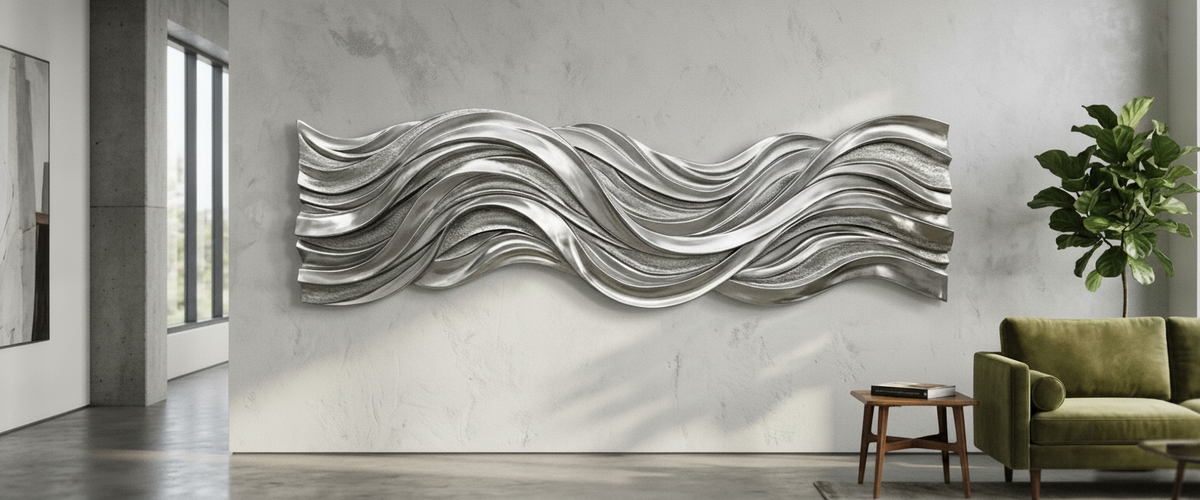
One more note from the studio: large indoor wall art needs clearance in front, too. Deep relief and three-dimensional metalwork can project several inches from the wall, which matters in a hallway where shoulders and luggage pass. Something like the Lumineris Silver Melted Wave Metal 3D Wall Art earns its drama from exactly that projection and the shadow it throws, so it belongs on a stretch of wall nobody brushes against.

Hull Length Versus Wall Width: The Ratio That Stops a Ship Looking Beached
Here is the rule we keep coming back to when we size large indoor wall art. Take your usable wall width, then size the hull so the whole composition, masts included, occupies about two thirds of it. On a 12 ft (3.7 m) wall behind a sectional, that gives you a piece around 8 ft (2.4 m) wide with roughly 2 ft (0.6 m) of clear plaster at each side.
Go wider than 75 percent and the masts start colliding with corners, which reads as a framing error rather than a bold choice. Go narrower than about half and the ship looks like a model of a ship, which is precisely the trap with large indoor masted ship wall art. Scale is what separates a serious sculptural statement from a nautical souvenir.
Height matters just as much, and this is where ships differ from most large indoor wall art. A full three-masted rig is close to as tall as it is long, so that 8 ft piece wants a room with real height, not a standard 8 ft (2.4 m) ceiling. Without headroom above the topmasts the whole rig looks compressed against the ceiling line. If you have the height, use it. If you do not, scale down or choose a horizontal composition instead.
Stairwells and Double-Height Walls Where a Masted Ship Finally Gets Its Horizon
The best home we have found for a masted ship, and for large indoor wall art generally, is a double-height stair wall. You get 16 to 20 ft (4.9 to 6.1 m) of vertical plane, a viewer who moves past it slowly, and two distinct viewing distances: the long view from the entry floor and the close view from the landing. Rigging rewards both. From below you read silhouette; from the landing you read joinery, blocks and the tension of the lines.
We shipped a large masted ship piece to a Napa property last year where the client had spent months trying to make it work over a dining sideboard. It never sat right. Moved to the double-height wall opposite the stair, the same piece finally had a horizon, and the shadow line across the plaster in late afternoon did half the work for us. That is the most common rescue we run: same artwork, better wall.
Historic builder's and dockyard models were made to be studied closely, which is why their rigging is so precise; the ship model collections at Royal Museums Greenwich show how much information those lines were meant to carry. Hang a modern sculptural version somewhere a viewer can approach it and that inheritance pays off. Hang it at 14 ft (4.3 m) with no close approach and you have bought silhouette only.
Sightline Height for a Piece Meant to Be Read From a Sofa
Gallery convention puts the visual center of a work around 57 to 60 in (145 to 152 cm) from the floor, which suits a standing viewer. Living rooms do not work that way. Seated eye level drops to roughly 40 to 46 in (102 to 117 cm), so large indoor wall art hung to gallery height will always feel like it is leaning away from you when you are actually using the room.
Decide who the primary viewer is. Over a sofa, drop the center and keep the bottom edge 8 to 12 in (20 to 30 cm) above the backrest so the two shapes do not fuse. In an entry hall or a corridor, hold gallery height, because everyone is standing. In a dining room, split the difference and check it while sitting in a chair, not standing behind one.
Reliefs are the most forgiving large indoor wall art you can hang, because they read as a single mass at any height. Above a fireplace, an 80 cm (about 31 in) cast piece such as the Traditional Horse Head Bronze Relief - 80cm holds a soot-darkened chimney breast where open rigging would simply disappear, and bronze copes with heat and shifting light far better than paper or thin veneer.

Why Open-Fretwork Ships Die Against Busy Wallpaper
Patterned wallpaper and fretwork compete for the same job: drawing the eye with fine repeated lines. Put them together and both lose. Grasscloth, damask, wide stripes and any print with strong figure-ground contrast will swallow rigging entirely from more than a few feet away, and that is where a lot of large indoor wall art quietly vanishes.
Quiet backgrounds win. Limewash, flat plaster, a single deep color, wide-plank paneling with generous flat areas. If you already have a patterned wall and you still want depth on it, choose something that fights back with mass rather than line; a solid cast silhouette like the Classical Bull Head Bronze Relief, 70cm cuts straight through pattern because its own shadow becomes the strongest line in the composition.
Lighting is the other half of this, and it makes or breaks large indoor wall art. Fretwork wants raking light from one side, ideally an adjustable narrow-beam fitting set close to the wall so shadows exaggerate the lines. Flat frontal downlighting kills a ship stone dead. For deep relief and carved timber, a warmer beam brings out grain and tool marks, and the character of a layered wood wall panel shifts noticeably with beam angle, so it is worth aiming the fitting before you commit to fixings.
Rooms That Reject Large Indoor Wall Art of This Kind
Not every big wall is a candidate, and part of our job is saying so.
Bathrooms and pool rooms. Humidity swings and chlorine vapor are hostile to timber, adhesives and unsealed metals. Choose stainless steel or a sealed cast piece instead, sized modestly.
Kitchens near the range. Airborne grease settles in every crevice of fretwork and never fully leaves. A smooth bronze or stone relief is far easier to wipe down.
Walls under skylights or west-facing glass. Sustained direct sun fades finishes and stresses joints in wood. Museum ship model collections such as those at Mystic Seaport Museum are kept out of raking sunlight for the same reason: rigged models suffer badly under strong light and dry heat.
Narrow corridors. Large indoor wall art needs stand-back distance, so if nobody can retreat 8 to 10 ft (2.4 to 3 m), they will never see the composition. Hang a series of smaller reliefs at intervals instead.
Partition walls with no structure. Hollow stud walls with nothing to fix into are solvable, but only with blocking added before installation, so raise it early.
Pre-Purchase Checklist
Measure wall width and height, then subtract obstructions to get the usable plane.
Tape the full footprint, including mast height and any projection, and leave it up for 48 hours.
Confirm the primary viewing position and set the visual center for that eye level.
Identify the wall build-up: studs, masonry, plaster over block, or hollow partition.
Check the access route. Doorway widths, stair turns and elevator dimensions decide whether a piece ships in one section or several.
Plan lighting angle before installation, not after the piece is on the wall.
Assess the background. Pattern, color depth and sheen all change how fretwork reads.
Ask about mounting hardware, panel splits, weight distribution and finish care for your large indoor wall art as part of the quote.

Commissioning Large Indoor Wall Art That Fits the Wall You Actually Have
When stock sizes miss, commissioning is the sensible route. Bespoke work lets us set hull length to your wall, adjust mast height to your ceiling, split a large composition into sections that clear a stairwell turn, and choose a finish that suits your light. Bronze, stainless steel, engineered metalwork and carved timber all behave differently indoors, and material choice should follow the room rather than a mood board.
Pricing for large indoor wall art depends on material, overall scale, structural complexity, engineering of the mounting system, finishing work and installation, which is why we quote per project rather than publishing a figure. Send wall photographs, dimensions and a note on sightlines, and we will come back with options.
For browsing by material, our bronze wall art and metal wall art ranges are the best starting points, and the wider wall art and wall decor collection shows how the same wall can be handled with relief, fretwork or layered panels. Whichever direction your large indoor wall art takes, measure the plaster first. The furniture can move.
For wider placement ideas, Why Most Large Metal Wall Art Is Hung Too High is useful companion reading before finalizing the setting and sightlines.