

























































































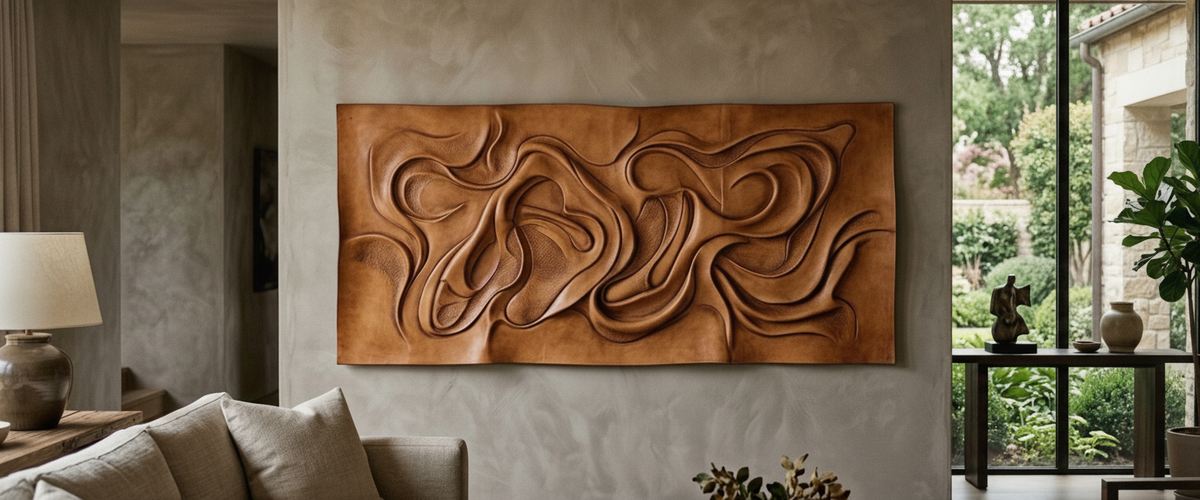

The saddest thing we see in leather wall panels is not a scratch or a scuff. It is a wave. A six-foot (1.8 m) hide that looked taut on install day, slumped in the middle three summers later like a sail with no wind. Large leather wall art is one of the few wall formats that genuinely improves with age, but only when the tanning, the substrate and the wall behind it have been chosen with a decade in mind rather than a photoshoot.

At a Glance: What Decides Whether a Leather Panel Ages Well
Tannage: vegetable-tanned hide darkens and deepens; chrome-tanned hide tends to hold its color and then look inert.
Substrate: a rigid bonded panel stays flat. A stretcher frame invites movement at the center.
Relief depth: shallow embossing softens over years; sculpted relief still reads at viewing distance a decade on.
Wall conditions: dry heat, direct sun and damp masonry are the three real enemies.
Care: infrequent, minimal conditioning. Most darkening damage is self-inflicted with the wrong product.
Year One to Year Ten: How a Hide Darkens, Tightens and Settles
Year one is the honeymoon and the risk window for large leather wall art. A fresh hide is still giving up moisture and settling onto its support, and any tension error in the build will show now. Expect a slight tightening and a first shift in tone, warmer and a little deeper, especially anywhere light lands.
Years two to four are where character arrives. Vegetable-tanned leather oxidizes into a richer, more varied color, and tooled lines gain contrast because the compressed fibers darken faster than the open grain around them. By year five, a well-built panel has stopped moving. What you see then is roughly what you keep.
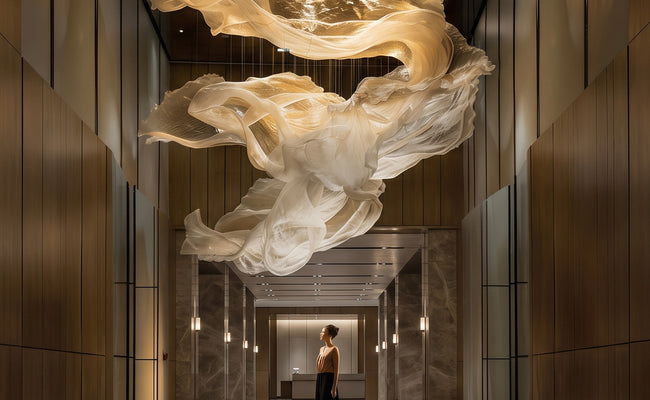
Years six to ten belong to surface, not structure. Highlights burnish where hands and sleeves pass, and edges pick up a polish no finisher can fake. One hotel corridor we paneled has been brushed by luggage for years, and the lower band now carries a sheen the designer calls the best thing about the job.

Vegetable-Tanned Versus Chrome-Tanned: One Ages, the Other Goes Flat
Vegetable tanning uses plant tannins and produces a firmer, more sculptable hide that patinates. It is the right specification for any large leather wall art you expect to own for decades, and it takes tooling and wet-forming far better. Chrome tanning gives softer, more color-stable, more water-tolerant leather, which suits upholstery beautifully and wall art less well. Chrome-tanned panels rarely deteriorate dramatically. They just refuse to develop, and after five years they read like vinyl at a distance.
Ask the maker which tannage they use and why. If the answer is vague, that tells you how much thought went into longevity. Tannage and finish chemistry drive how leather behaves over decades, which is why conservators identify both before deciding on any treatment at all, the approach taken by the Leather Conservation Centre.
Why a Stretcher Frame Guarantees a Wave and a Rigid Substrate Doesn't
Canvas tolerates a stretcher because it is thin, light and stable in tension. Hide is none of those things. It is hygroscopic, it creeps under its own weight, and an unsupported span will eventually bow toward the floor. On a big panel the center is entirely unsupported air.
Our studio bonds hide to a rigid engineered substrate with a sealed reverse and a concealed cleat or batten hanging system. The leather then has nowhere to go. The other benefit is flatness discipline for big formats: an 8 foot (2.4 m) panel installed on a slightly bowed drywall run will telegraph that bow unless the substrate is stiff enough to override it. If a supplier offers stretched large leather wall art at scale with no rear support, walk.

The Radiator Wall, the South Window and the Damp Barn Conversion
Three placements cause most of the large leather wall art failures we get asked to assess. A wall above a radiator or a hard-working baseboard heater bakes the hide from below, and dry leather stiffens and cracks along tooled lines first. A south-facing window wall fades and hardens the exposed half while the shaded half stays put, which creates a two-tone panel that no conditioning will even out. Then there is the damp stone wall in a converted barn or basement gallery, where moisture migrating through masonry reaches the panel reverse and brings mold with it.
Practical fixes are simple. Keep panels off walls with heat sources directly beneath, use UV-filtering glazing or shading on strong exposures, and furr any panel off masonry so air can move behind it. The V&A's guidance on caring for leather is blunt about the same fundamentals: stable humidity, no direct heat, no strong light.
Tooled, Embossed or Sculpted Relief: What Still Throws Shadow at Six Feet
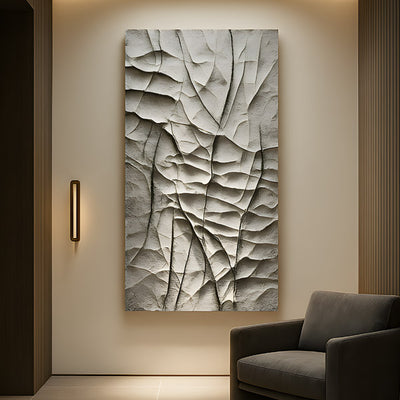
Embossing presses pattern into the surface with a plate. It looks crisp in a close-up and disappears from across a room, and it relaxes over years as the fibers recover. Hand tooling cuts and compresses, so the lines darken with age and hold. Sculpted relief, where the hide is wet-formed over a built-up ground, is the only version that still casts real shadow from six feet (1.8 m) away after a decade.
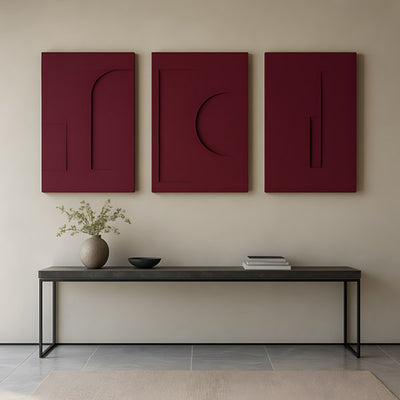
If your brief is about depth rather than material romance, compare honestly across media before committing. A faceted timber piece such as the Wenlock White & Burgundy Wood Relief 3D Wall Art holds its geometry indefinitely because timber sections do not creep, and where the wall needs figurative depth that will outlive the building, a carved panel like the Striding Winged Figure Marble Relief Wall Art, 180cm is the more durable answer. Hide earns its place when you want warmth and touch alongside relief. Set the leather art and 3D wall art collections side by side and the trade-off is obvious.
Conditioning Without Darkening
Most large leather wall art is over-treated, not under-treated. Oils and heavy creams sink in, saturate the fibers and darken the hide permanently, usually unevenly.
Dust with a dry, soft brush or lint-free cloth every few weeks.
Condition sparingly and only when the surface feels dry to the touch, typically once every year or two indoors.
Test any product on the reverse or a hidden edge and wait 48 hours before judging color.
Never use neatsfoot oil, mink oil, silicone polish, saddle soap or household cleaning spray on a finished art panel.
Keep relative humidity broadly between 45 and 55 percent; swings matter more than the number.
Ask your supplier which conditioner matches the finish. We specify by panel, because a waxed surface and an aniline-dyed surface want different things.

Rooms That Keep a Hide Stable
Paneled studies and libraries are close to ideal: steady temperature, controlled light, and surrounding timber that shares the same humidity preferences. Where that kind of room calls for a period register rather than contemporary relief, a gilded framed piece such as the Aristo Romantic Swing Painting Gold Frame Hanging Wall Art sits more comfortably against dark joinery than a modern sculpted hide. Hotel corridors suit large leather wall art because they are internal, conditioned and rarely sunlit, and the scale of a long corridor takes a big horizontal panel. Boardrooms are the other reliable setting, and a large hide panel takes some of the hard edge off the acoustics in a glass-heavy room.
Where we steer clients away: bathrooms, pool houses, enclosed sunrooms and any exterior wall. For covered outdoor terraces, a metal panel is the correct answer, and the metal wall art range handles those conditions without argument.
Commissioning Large Leather Wall Art That Lasts
Bring three things to a commission conversation: the wall dimensions and construction, the light conditions across a full day, and the viewing distance. Those decide hide thickness, relief depth, panel segmentation and fixing method. Budget follows material, scale, relief complexity, substrate engineering, finishing and installation, so ask for a tailored quote rather than working from a headline figure.
Giant Sculptures builds bespoke wall work to commission across leather, metal, timber and stone. Tell us the wall and the decade you intend to keep it, and we will specify backward from there. The wider wall art and wall decor collection is a good place to calibrate scale before you brief us.
For wider placement ideas, Large Abstract Wall Art for Hallways: Bold Lines Win at Walking Speed is useful companion reading before finalising the setting and sightlines.