

























































































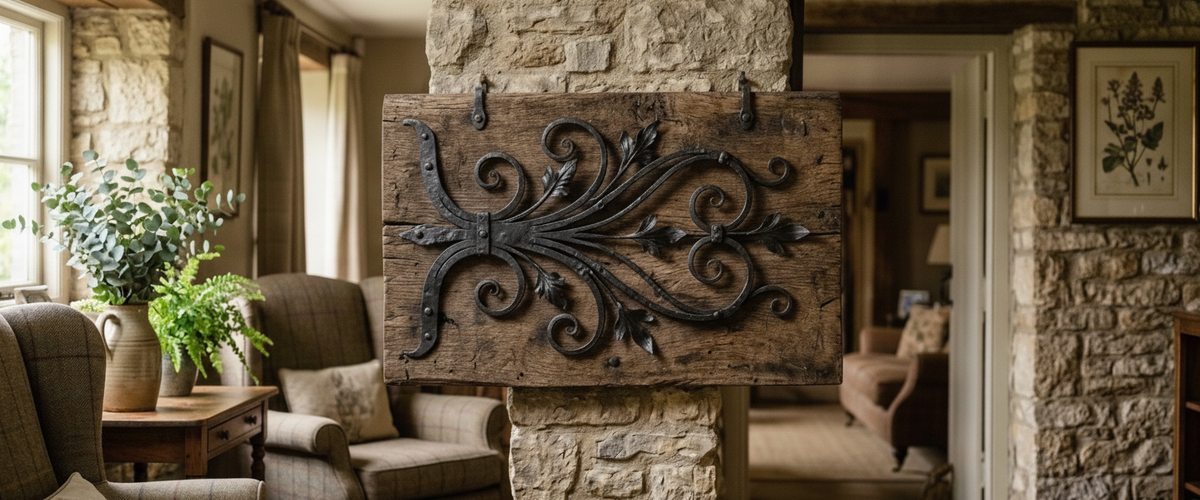

Most of what sells as wrought iron wall art has never been near a forge. True wrought iron, the fibrous, low-carbon metal that was puddled by hand in the nineteenth century, stopped being made commercially long ago. The label now covers almost anything black, scrolled and hung on a wall. That works as shorthand. It stops working when a laser-cut sheet is priced and described as blacksmith work. Here is how we read a piece before we recommend it to a client.
Quick Answer
Modern wrought iron wall art is usually forged mild steel, so the process matters more than the name.
Tapered scroll ends and irregular hammer texture point to hand forging.
Dead-straight edges and identical repeats point to laser or plasma cutting.
A genuinely forged panel is heavy and needs fixings into studs or masonry.
Wax or oil finishes leave the metalwork on show. A thick powder coat can hide weak welds.

Forged, Cast or Laser-Cut: Three Processes Sold Under One Label
Forged work is heated and shaped with a hammer, an anvil and bending jigs. Cast iron is poured into a mold. That gives crisp, repeatable ornament, but the metal is granular and brittle and snaps rather than bends if it takes a knock. Laser- and plasma-cut pieces start as flat steel sheet cut to a digital file. Some are then bent or welded into relief. Most stay flat.
All three processes turn up as wrought iron wall art, and all three can look good on a wall. They differ in price, in weight and in how they age, so ask any seller which one you are looking at. The iron art and wrought iron wall decor collection puts these finishes and forms side by side, which makes the differences easier to see.
Read the Scroll Ends First
A smith draws out the end of a bar under the hammer, so a forged scroll thins toward its tip and often finishes in a small flattened fishtail or a curled button. The cross-section changes along its length. A scroll bent from flat strip keeps the same width and thickness from start to finish and ends in a square cut.
A forged scroll thins toward its tip. Bent strip keeps the same width to a square cut.
Run a finger along the curl. If the metal stays the same size right up to a blunt stop, it was bent from strip. Plenty of bent scrollwork is honest, well-made wrought iron wall art. It just shouldn't carry a forged price.
Hammer Marks, Forge Scale and the Edges a CNC Table Can't Fake
Look at the piece under low, raking light. Forged surfaces carry faint facets where the hammer landed, and forge scale (the dark blue-gray oxide skin) clings in the recesses. Edges soften, and they swell slightly wherever the bar was upset or bent hot. A CNC table leaves a clean, uniform kerf, sometimes with fine striations or a slight bevel from the beam, and every repeat of a motif matches its neighbor exactly.
Under raking light, a cut edge stays uniform while a forged edge shows facets and swelling.
Some factories stamp a hammered texture onto cut wrought iron wall art. The tell is a pattern that repeats at regular intervals, which no hand can manage. If you want to train your eye, the Artist-Blacksmith's Association of North America is a good starting point for traditional forging technique. Machine-cut work is a legitimate style in its own right, and much of our metal wall art is cut that way on purpose. The point is to know which one you are paying for.

Wrought Iron and Wood Wall Art: The Join Reveals Who Built It
Wrought iron and wood wall art is where shortcuts show fastest. A smith usually fixes iron to timber mechanically, with forged straps wrapped around a board, hand-set rivets with domed heads, or tenons passed through the wood and peened over. The iron is shaped to fit the wood. Factory pieces tend to screw or glue a flat-cut silhouette onto a board, with Phillips heads on show or staples hidden behind. Turn the piece over before you buy.
Sometimes the better answer is to hang the two materials side by side rather than combine them in one object. Where a forged panel needs a lighter neighbor, a pale carved relief such as Selene V White Sandstone Textured 3D Wood Relief Wall Art sets matte, stone-like texture against dark metal without asking one piece to do both jobs. Designers we work with in Austin and Santa Fe often lay out long hallways this way.
In a darker room, a deeper palette holds together better. The black and green of Nocturna Black & Green Modular Wooden Hand-Painted 3D Wall Art sits closer to iron's tones, so the wall reads as one scheme rather than a patchwork. The wider wood wall art collection has more tones to test against a metal piece.
Heft as Evidence: Plan the Fixing Before the Panel Arrives
Solid bar is heavy, so weight is a quick honesty check on any wrought iron wall art. If a 5-foot (1.5 m) panel sold as hand-forged lifts easily in one hand, it is probably thin sheet or hollow tube.
The flip side is that real forged work needs real fixings. A designer in Dallas once sent us photos of a scroll panel that had pulled two plastic anchors out of drywall within a week of hanging. Plasterboard alone will not hold a genuine forged piece. Fix into studs, use a steel French cleat or ledger spanning at least two studs, or anchor into masonry. Ask the maker for the actual weight and a fixing recommendation before delivery. On exterior walls, use stainless or galvanized fixings to avoid rust staining. Our outdoor wall art is specified with that in mind.
Powder Coat Can Hide Shortcuts; Wax Leaves Nothing Hidden
Powder coat is tough, and for outdoor pieces in Florida humidity or coastal California salt air it is often the right call. A thick, glossy coat also fills hammer texture, rounds off edges and can bury rough welds and filler. Wax, oil or a clear lacquer over bare metal shows every mark, mistakes included. That is why smiths who are confident in their work often choose it, and why open-rust finishes read the same way.
For indoor wrought iron wall art, a beeswax-based finish renewed every year or two is usually enough. For older or architectural ironwork, the National Park Service Preservation Briefs cover how historic metal is assessed, repaired and recoated.

A Buyer's Checklist for Wrought Iron Wall Art
Process: ask directly whether the piece is forged, cast or cut, and get the answer in writing.
Scroll ends: look for tapered tips rather than square-cut strip.
Repeats: small variations between motifs mean hand work; exact copies mean a machine.
The back: check for rivets, collars and peened tenons rather than screws and glue.
Weight and wall: confirm the weight and what your wall is built from before ordering.
Finish for location: wax indoors, and a sealed or coated finish on exposed exterior walls.
Budget: cost depends on process, scale, design complexity, finishing and installation, so request a tailored quote rather than comparing listings line by line.
When a Commission Makes More Sense
Stock pieces rarely fit an awkward chimney breast, a double-height stair void or a long restaurant banquette. That is where commissioning pays off. Giant Sculptures works with metalworkers on bespoke wall pieces sized to the space. Send us wall dimensions, photos, the wall construction and whether the piece will live indoors or out, and we will advise on process, finish and fixing before anything is made. It takes longer than buying off the shelf. You also end up with a piece built for that wall, one that will still hang true in twenty years.
For wider placement ideas, Wrought Iron Garden Sculptures: Why Backlight Beats Backdrop is useful companion reading before finalising the setting and sightlines.