


















































































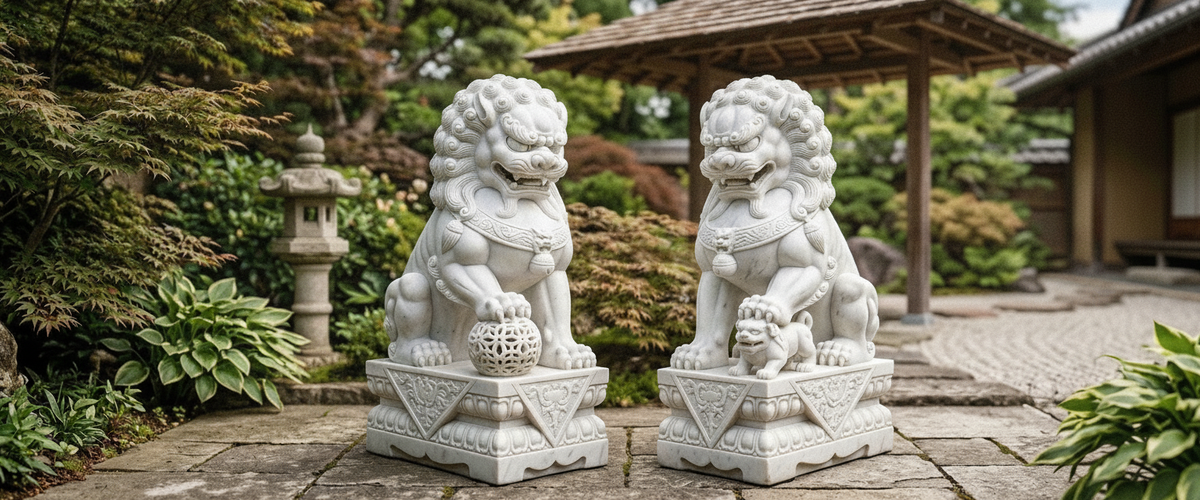

Stand ten feet back from a pair of guardian lions and almost all of them look convincing. Walk up, put your thumb into the mane, and the story changes in seconds. A hand-carved foo dog marble statue has curls you can hook a fingertip behind, with shadow living inside the undercut. A machine-roughed copy has shallow scoops that read as texture from the driveway and turn to porridge at arm's length. Once you know where to look, you stop buying photographs and start buying stone.

Quick Answer: What Separates a Good Pair from a Cheap One
These are the checks we run before any foo dog marble statue leaves the workshop, and they work just as well on someone else's showroom floor.
Undercut mane curls. Real depth casts real shadow. Shallow grooves mean fast production.
Teeth, claws and the pierced ball. These are the hardest passages to fake, so this is where machine roughing gives up.
Marble choice. Dense, low-porosity stone holds crisp detail outdoors. Soft, sugary stone loses edges after a couple of hard winters.
Matched as a pair, not paired after the fact. Mane rhythm, jaw angle and body mass should mirror.
Fixing. Stainless pins, dowels and a level plinth stop a heavy stone pair from creeping out of alignment.
Mane Curls, Undercut and Drill Chatter: The Three-Second Check
Guardian lions, known in China as shishi and popularly called foo dogs in the West, were traditionally carved in mirrored pairs to flank an entrance, a tradition visible across centuries of Chinese architectural stonework in collections such as the Metropolitan Museum of Art. The mane is the signature. On a hand-finished foo dog marble statue, each curl is worked from more than one direction, so the base of the spiral is narrower than its crown and the shadow line is crisp.
Undercut curls hold shadow inside the spiral; machine-roughed manes flatten out at arm's length.
Run a fingertip along the inside of a curl. If you feel a regular ripple, like a fine washboard, that is drill chatter: the vibration signature of a rotary bit taken through stone too quickly and never dressed back by hand. One or two chatter marks in a hidden recess are normal workshop reality. Chatter everywhere, including on visible faces, tells you nobody finished the piece properly. We have refused shipments over exactly this, and the giveaway is always the same: a mane that photographs beautifully and feels like corrugated cardboard.
Teeth, Claws and the Pierced Ball: Where Machine Work Gives Up
Automated roughing handles the broad forms of a foo dog marble statue well. It struggles at every point where the carving turns back on itself. Look inside the mouth: individual teeth should have space between them, with the tongue sitting free of the palate rather than fused into a solid ridge. Claws should read as separate digits with a defined nail bed, not as a webbed paw with lines scratched in.
Then there is the ball. On the male lion, the paw rests on an openwork sphere, and the pierced lattice is the single hardest passage on the whole figure. Hold a light behind it. If the perforations pass fully through the ball and the internal edges are dressed, a carver spent real hours there. If the holes are shallow dimples or blocked at the back, you are looking at a production shortcut that no amount of polish will fix.

Which Marbles Hold Detail Outdoors and Which Sugar Off
Not every white stone behaves the same way in a Chicago winter or a Napa summer. Marble is a calcite stone, and calcite is prone to granular disintegration, the effect conservators call sugaring, where repeated thermal cycling and freeze-thaw action loosen the crystal bond and the surface starts shedding like damp sugar. Historic England's technical guidance on building stone is a useful primer on why exposure matters as much as material.
Practical rules we work to: dense, tight-grained marbles with low water absorption stay crisp far longer in freeze-thaw climates. Softer, more open stones are better suited to covered porticos, courtyards in mild coastal zones, or interior placement. A foo dog marble statue sited under a Texas colonnade will age very differently to the same carving on an exposed Aspen driveway. If your site takes hard frost, ask which specific stone is proposed and how it performs in wet-freeze conditions before you sign off. Where a client wants marble character without accepting the weather risk, the honest answer is often to keep the stone indoors entirely; a polished interior piece such as the Snail Marble Sculpture - 60cm stays glassy for decades precisely because it never sees a frost cycle.
Ball or Cub: Reading Whether a Foo Dog Pair Marble Statue Was Carved Together
Traditionally the male guards the ball and the female shelters a cub beneath her paw. That symbolism is easy to buy; a genuinely matched pair is not. A foo dog pair marble statue carved as a set will share mane rhythm, the same jaw opening, the same shoulder mass and, crucially, the same stone batch. Stand them side by side and mirror the poses. Mismatched pairs betray themselves in the small stuff: one head sits a touch higher, one tail curls tighter, one body is a half shade warmer in tone.
Colour is the fastest tell of all. Two pieces cut from different blocks will almost never agree under daylight, however close they look in a studio photograph. If you are buying to flank a gate or a lobby entrance, insist on stone from one block and ask for a photo of both pieces together outdoors, not lit on a turntable.

Veining That Works with the Carving, Not Against It
A good carver reads the block before the first cut. Veining that runs lengthwise down the body follows the muscle and makes the animal look alive. Veining that cuts across the neck or slices diagonally through the face fights the form and, worse, often marks a weaker plane in the stone. Heavy vein lines through a slender element such as a tail or a raised paw are a structural question, not just a visual one.
For interiors where you want pattern and contrast without the structural risk of carved stone, lighter materials are a legitimate route. Where the room needs a pale-and-gilt palette more than it needs solid marble, the Melham White & Gold Dog Sculpture - 90cm is closer to the right design language, and its lighter build matters on upper floors where loading limits rule stone out.
Tool Marks, Wax Fills and the Repairs a Good Finisher Hides
Honest tool marks are not a defect. Claw chisel tracks in recessed areas are evidence of hand work. What you are hunting for is filler. Angle the foo dog marble statue toward raking daylight and look for patches that stay matte while the surrounding stone throws a soft sheen, or areas that feel slightly warmer and waxier under the palm. Small fills around a repaired ear or a chipped tooth are common and acceptable in stone of any age, as long as they are declared.
Ask the seller directly: has anything been broken and reattached, and where? A reputable supplier will tell you and show you. Silence, or a stock reply about the stone being flawless, is a signal in itself.
Pinning, Dowels and Plinths That Keep a Heavy Pair in Line
Marble guardian lions at entrance scale are seriously heavy, easily running into several hundred pounds (over 150 kg) per figure once you get above roughly 3 feet (about 90 cm). Weight is not the problem. Movement is. Set a stone pair on soft ground or an unlevel step and within two seasons one will have settled a fraction. Mismatched guardians read wrong at a glance.
Stainless dowels and matched plinth heights keep a heavy carved pair reading as one set.
Bed onto a compacted, level base with a concrete or engineered pad sized for the load, not a paving slab on sand.
Pin with stainless steel dowels, never mild steel. Ferrous pins rust, expand and split stone from the inside.
Use a lime-based or non-staining bedding mortar so mineral salts do not bloom through pale marble.
Match plinth heights exactly and check with a laser level, not by eye.
Plan the lift. Slings, spreader bars and protection padding, agreed with the installer before delivery day.

Commissioning a Bespoke Pair
Off-the-shelf guardian lions come in a narrow band of sizes, which is why so many entrances end up with a pair that is slightly too small for the doorway. Commissioning fixes proportion. At Giant Sculptures we scale bespoke work to the architecture: gate width, step height, sightline from the street. We also talk clients through material alternatives where marble is not the right answer, whether that is bronze for coastal exposure or a patinated alloy for high-traffic commercial entrances. Not every brief calls for classical weight either; on a narrow contemporary threshold, a compact sculptural pair in the spirit of the Bramford Red Bulldog Sculpture - 65cm holds the guardian idea at 65cm without crowding the door or demanding an engineered pad. Browse the marble sculptures collection for stone character, or the bronze dog statues if you want a canine guardian that shrugs off salt air.
Budget for a bespoke foo dog marble statue depends on the stone selected, finished size, carving complexity, structural engineering, plinth work and installation, so we quote each commission individually rather than working from a list. Send us the site photographs and the entrance dimensions, and we will tell you honestly whether stone or metal serves the location better.
For wider placement ideas, Balloon Dog Sculpture: Get the Twist Right and the Rest Follows is useful companion reading before finalising the setting and sightlines.