




































































































Stand in front of a "Greek" statue in almost any major museum and there is a good chance you are looking at a Roman's second opinion, carved in stone after a lost bronze original. That matters to anyone buying Greek Roman statues. In Greek Roman statues marble was a deliberate Roman choice, as were the finish and the supports, and those same decisions still decide whether a classical figure looks right in a modern home. This guide covers what counts for more than the myth: the stone (Carrara, Pentelic or Parian), the finish (polished, honed or tooled) and the placement. Get them right and a classical figure suits your hallway for generations. Get them wrong and it looks tired in your garden within a few winters.
Looking for the full range in this category? Browse our Marble Headstones collection for every available finish, size, and configuration.

At a Glance
Most famous "Greek" marbles are Roman copies of lost bronze originals, which explains the tree stumps and struts.
Carrara, Pentelic and Parian each read differently on skin, drapery and shadow.
Finish sets the age: polished looks new, honed looks timeless, tooled looks excavated.
Veining is a design decision the carver makes before the first cut.
Outdoors, density and drainage matter more than whiteness; for Greek Roman statues marble grain beats marble color every time.
Why Most Greek and Roman Marble Statues Are Roman Copies
Many of the celebrated Greek originals were cast in bronze, and most of that bronze was later melted down for its metal value. The Greek and Roman marble statues that survived were mostly carved for Roman villas, baths and gardens, often centuries after the originals. Smarthistory's overview of Roman copies is a useful primer on how that trade worked.
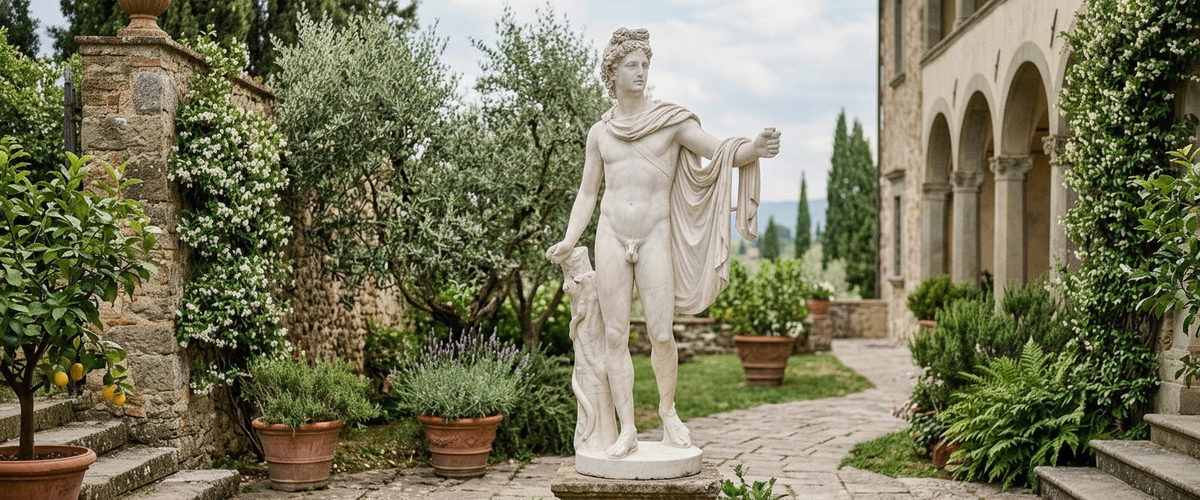
Copying in stone forced an engineering change. In Greek Roman statues marble had to carry poses designed for another material: bronze is hollow and strong in tension; marble is heavy and brittle. So Roman carvers added tree trunks beside legs and discreet struts under outstretched arms. When you weigh up a standing god at near life size, such as the Apollo Marble Sculpture - 180cm, look at how the weight is carried behind the leg. A support there is a Roman solution to a Greek pose, and a faithful carver keeps it rather than hiding it.
The tree-trunk support behind Apollo's leg is a Roman fix for carrying a bronze pose in stone.

Carrara, Pentelic and Parian: Three Stones, Three Skins
Carrara, quarried in the Apuan Alps and used by Rome from the time of Augustus, is the stone most buyers picture. For Greek Roman statues marble from Carrara is the default: white to soft gray, fine-grained, dependable to carve. It gives crisp drapery edges and even, cool shadows.
Pentelic, from Mount Pentelicus near Athens, is the marble of the Parthenon (the Acropolis Museum holds much of its surviving sculpture). Traces of iron let it mellow toward a warm honey tone over time, which flatters skin more than drapery.
Parian, from the island of Paros, has larger crystals that let light sink a fraction below the surface. On Greek Roman statues marble from Paros makes flesh seem to glow. The trade-off is that coarse crystal is more vulnerable to weathering outdoors, a point we return to below.
Polished, Honed or Tooled: The Surface Decides the Age
A high polish deepens veining and throws reflections, which suits a contemporary interior but can make Greek and Roman marble statues look like showroom pieces. A honed, satin surface is closer to how well-kept antiquities read in a gallery. A tooled or lightly abraded finish, with rasp and claw marks left visible, reads as excavated.
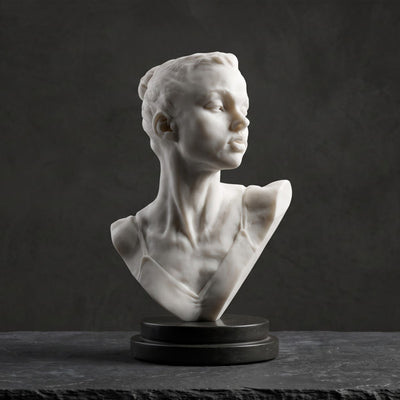
Fragment forms carry that last finish best. At stair-hall or garden-niche scale, a torso such as the Classical Male Marble Torso Sculpture - 130cm, given a honed body and softened break lines, feels found rather than manufactured. For a smaller dose of the same effect, our marble busts and torsos suit a library shelf or stair landing.

The Gray Vein Problem
Every block carries veins, and in Greek Roman statues marble veining does not care where the face will be. A gray thread across a cheek or through an eye socket reads as a bruise or a scar, and no amount of finishing removes it.
This is where good carving starts long before the chisel. On a bust we made for a Dallas client, the first roughing pass exposed a vein running exactly along the line of the cheekbone. We set that block aside and started again. It cost time, but a flawed face sits in someone's entrance hall for decades. Experienced carvers orient the figure so veining runs with drapery folds or down the back, where it adds movement instead of damage.
Hallway or Open Garden: Which Marbles Shrug Off Weather
In Greek and Roman statues marble choice outdoors comes down to chemistry. Marble is calcium carbonate, so it reacts slowly with acidic rain, and freeze-thaw cycles exploit any water that gets into the grain. Indoors, almost any sound block is fine. Outdoors, choose dense, fine-grained stone, favor honed over polished (rain dulls a polish anyway), and give the base a plinth that sheds water.
Green algae is a placement issue more than a stone issue. North-facing spots, dripping tree canopies and irrigation spray cause most of it. An intertwined two-figure group like Cupid And Psyche Angel Marble Outdoor Sculpture - 160cm, with its deep recesses between wings and limbs, is happiest in an open lawn in Napa or a gravel court in the Hamptons, clear of sprinklers and with sun reaching into the carving. In Aspen or other freezing climates, a breathable winter cover is worth budgeting for from day one, because on outdoor Greek Roman statues marble recesses trap snow and meltwater.
Open sun and a draining plinth keep deep recesses like these free of algae.

What We Fix on a Classical Marble Commission Before Carving
With bespoke Greek Roman statues marble rewards decisions made early. Before a block is cut, we agree on:
Setting: indoor, covered terrace or open garden, which drives stone choice.
Viewing distance and height: a figure seen from 30 feet (about 9 m) needs bolder drapery than one seen from a sofa.
Stone and color: cool white, warm cream, or gray-veined.
Finish: polished, honed or tooled, and whether it differs between skin and drapery.
Supports: historically faithful struts, or a reworked pose that avoids them.
Base and fixing: plinth height, drainage and anchoring for the site.
Access and installation: doorways, floor loading, crane or lifting route.
Budget depends on material, scale, complexity of carving, engineering, installation and finishing. In Greek Roman statues marble grade and block size often move the number most, so we quote each commission individually rather than guess. Our range of Greek and Roman marble statues is a good place to find starting points, and the wider marble sculptures collection covers subjects beyond the classical canon. From there, ask Giant Sculptures for a tailored quote.
In Greek Roman statues marble rewards the buyer who decides early. Pick the stone for where the statue will live, the finish for how old you want it to feel, and a carver who respects the vein. Get those right and a classical marble will look better in twenty years than on the day it arrives.
For wider placement ideas, Greek and Roman Statues: What the Pose, Drapery and Struts Are Telling You is useful companion reading before you finalize the setting and sightlines for your Greek and Roman marble statues.