

























































































Greek Roman statues fall into two working traditions, and the difference is physical rather than decorative: Greek figures were carved to be walked around, while Roman civic figures were built to face you down a single axis. Put one of each in the same courtyard and they will not behave the same way. Most buyers choose on subject alone, then wonder why the piece looks slightly wrong on site. Stance, drapery, material and strut work all tell you where a figure belongs. The clues were there in the carving all along.

At a Glance: Reading Greek Roman Statues Before You Place Them
For wider placement ideas, Collecting Bronze Greek God Statues Without Ending Up with Three Different Browns is useful companion reading before finalising the setting and sightlines.
Stance tells you the sightlines. Contrapposto figures need 360 degree access; frontal civic figures work against a wall or hedge.
Struts and tree trunks are structural leftovers from marble copies of lost Greek bronzes, not decoration.
Drapery reveals origin. Soft, clinging Greek folds read differently from the crisper, drilled Roman cut.
Portrait heads and ideal heads have different jobs. One records a face, the other sells an idea.
Intended viewing height beats room size. Get the plinth wrong and the head disappears against the sky.
Material choice is a climate decision before it is an aesthetic one.
A figure carved or cast in the round needs open access on every side to earn its keep.
Carved for a Niche or Carved for the Open Air
The original brief still shows. A figure cut for a temple pediment or an open sanctuary was finished all the way around, with weight in the back muscles and a base wide enough to sit on stone in wind. A figure made for a wall niche in a Roman villa was often left thinner at the back, with detail concentrated on the three-quarter view the owner would actually see.
That distinction matters the moment you choose a site. A niche-minded piece against an open lawn looks hollow from behind. An in-the-round piece pushed flat against a boundary wall wastes half of what you paid for. When clients send us a site plan, the first question our studio asks is how many sides will ever be seen. It changes the sculpture we recommend and sometimes the material.

Contrapposto Versus Civic Frontality
Classical Greek sculptors solved standing. Weight drops onto one leg, the hip lifts, the shoulders counter-rotate, and the spine takes a soft S-curve. That is contrapposto, and it only pays off in motion. Walk around a well-carved contrapposto figure and the silhouette changes every few steps.
Roman public sculpture often pulled back toward frontality, because the statue had a civic job: address the forum, the road, the crowd. A commander in armor with an outstretched arm is speaking to people arriving from one direction. Where the approach is controlled by walls or a single axis, a frontal figure such as the Life-Size Classical Roman Commander Bronze Statue - 150cm sits more comfortably than a dancing Greek athlete, which would lose most of its geometry in the same spot.
Roman Copies of Greek Bronzes and Those Awkward Tree Trunks
Most of the famous Greek bronze originals are gone, melted for metal centuries ago. What survives is largely Roman marble versions, and marble cannot do what bronze does. Bronze holds a raised arm or a free-standing ankle because the alloy has tensile strength. Marble snaps. So copyists added struts between wrist and thigh, and propped ankles against a carved tree stump or a drapery pile. That is why so many Greek Roman statues in museum galleries appear to be leaning on scenery. The Metropolitan Museum of Art's overview of Roman copies of Greek statues is a useful primer on how that copying industry worked.
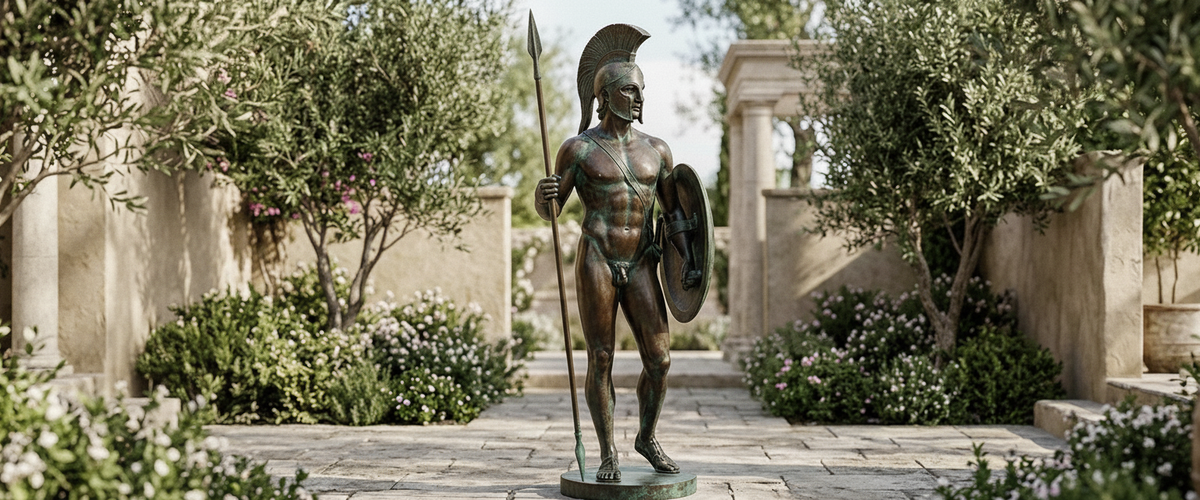
For buyers this is genuinely practical information. If you want a figure with an extended spear arm, a raised laurel, or real air under the limbs, cast bronze is the honest answer. At monumental height the difference is stark: a Life-Size Classical Greek Warrior Bronze Statue - 300cm can hold a fighting pose with no visible prop because the metal carries the load internally. Ask for the same silhouette in marble and you will get struts, or a redesign.
Drapery as Evidence
Look at the cloth. High Classical and Hellenistic Greek carving gave us the wet-cloth effect: fabric pressed against the body so the anatomy reads through it, folds pooling in long diagonal runs. Roman carvers, working faster and often with running drill work, tended toward harder edges, deeper shadow channels and more repetitive fold rhythms.
Soft Greek folds need raking light; drilled Roman folds carry their own shadow.
Neither is better. They read differently outdoors, which is the point. Soft Greek drapery needs raking light to come alive, so it does well on an east or west facing terrace where morning and evening sun crosses the surface. Crisper Roman folds hold their own under flat overcast light and in shaded loggias, because the shadow is cut into the stone rather than borrowed from the sun. On grey, wet, north-facing sites the harder cut almost always wins.

Portrait Busts Told the Truth, Idealized Heads Told a Story
Republican Roman portraiture is startlingly blunt: pouches under the eyes, thin lips, a bald skull mapped honestly. Age signaled authority. Greek ideal heads went the other way, smoothing a face into a type rather than a person. Later imperial portraits blended the two, borrowing Classical body proportions and attaching a recognizable head.
If you are buying a head or bust for an interior, decide which effect you want in the room. A specific, lined portrait face invites people to lean in and study it, so it belongs at close quarters on a console or a library plinth. An idealized head works better at a distance, at the end of a hallway or above a stair return, where it functions as a shape more than a character.
Workshop Copy, 19th Century Cast or Modern Reproduction
Three very different things get sold as Greek Roman statues under the same photograph. Here is how they separate:
Ancient workshop copies show hand tool evidence: claw chisel tracks in unfinished zones, drill channels in hair and drapery, weathering that follows bedding planes rather than an even wash of dirt. These belong to the antiquities market, with all the provenance paperwork that implies.
19th century casts and carvings came out of the Grand Tour trade and the souvenir workshops that followed it. Look for foundry stamps, sand-cast texture, plaster piece-mold seams, and old iron pins that have rusted and stained the surrounding stone.
Modern reproductions are lost-wax bronze or newly carved marble made today. Chasing is cleaner, welds are TIG welded and dressed, internal armatures are stainless, and patina is applied rather than accumulated.
We make the third category, openly. That is the right choice for outdoor installation, because a new bronze is engineered for a fixing plate, a specified wall thickness and a patina that can be maintained. Just be certain which of the three you are actually buying before money moves, because the gap in price and paperwork between them is enormous.
Reading Intended Viewing Height
Ancient sculptors adjusted proportion for the eye level of the viewer. Figures destined for pediments and high bases were given longer legs, tilted heads and exaggerated upper detail because nobody would see them straight on. Copy that logic when you site a piece.
A lesson that cost a client time: an 8 foot 2 inch (250 cm) warrior went onto a 3 foot (91 cm) plinth at a vineyard entrance, which put the head against bright sky from the only approach road. The silhouette vanished. We rebuilt the base lower and shifted the piece 12 feet (3.7 m) forward so the head landed against dark cypress. Same sculpture, completely different presence. Test the sightline with a pole and a cardboard cutout before you pour any concrete.

A Buyer's Checklist for Greek Roman Statues
Confirm how many sides are visible, and from how far away.
Check what sits behind the head from the main approach: sky, hedge, masonry or water.
Match material to climate. Marble suffers in freeze-thaw and acid rain; bronze handles coastal salt with regular waxing.
Ask for the fixing detail, the weight, and the base plate dimensions before the foundation goes in.
Plan the access route. Gate widths, soft ground and overhead cable heights sink more installations than crane cost does.
Agree a maintenance rhythm: wash and wax bronze, rinse and inspect stone joints, check pins and anchors annually.
Commissioning Greek Roman Statues at the Right Scale
Off-the-shelf works when the site is forgiving. Bespoke earns its place when the site is not. Our studio regularly adjusts height, plinth design, arm position and patina color so a piece answers one specific approach, and we cast pairs and groups when an axis needs balancing. A gateway usually wants a threshold guardian rather than a figure, and a piece like the Winged Lion on a Greek Key Plinth Marble Statue - 220cm carries its own viewing height in the base; a long estate drive may need something with far more mass and movement to hold the distance.
Greek and Roman Statues for Sale: Australia and Worldwide Delivery
Budget follows material, scale, complexity, engineering, installation and finishing, so the only honest number is a tailored quote against your drawings. We ship worldwide, and we handle a steady stream of enquiries from buyers searching for Greek and Roman statues for sale Australia wide, where crating, timber treatment certification and port handling all need building into the schedule. Sydney courtyards, Melbourne gardens and Queensland coastal sites each push the material choice in a different direction, so send climate notes with your plans. Start with the Greek Roman statues collection, then send us the site photographs and the sightlines. The statue will tell you where it wants to stand.