






































































































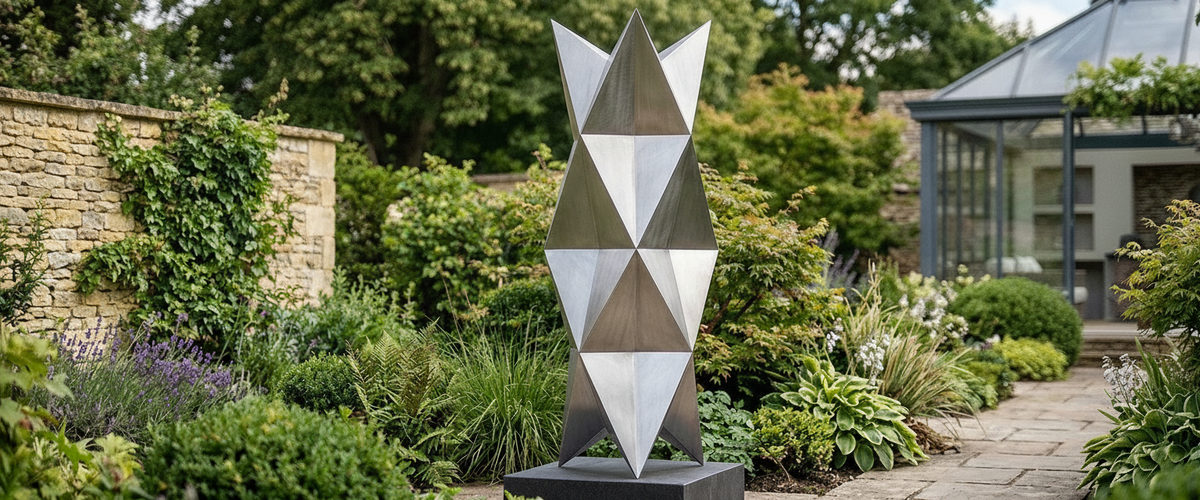

A geometric abstract sculpture has nowhere to hide. A figurative bronze can carry a soft shoulder or a slightly heavy hand and still read as a person. A cube with one lazy corner just reads as a badly made cube. That unforgiving quality is why buyers love the genre, and why so many pieces disappoint once they leave the showroom and meet real light, real weather and real viewing distances.
We make and ship large-scale geometric abstract sculpture for gardens, lobbies and private collections. The questions that decide success are rarely about style. They are about edges, seams, material movement and where the sun sits at four in the afternoon.

At a Glance
Edges are the artwork. A crisp arris (the line where two planes meet) separates intention from accident.
Metal is the safest outdoor choice. Bronze, stainless steel and Corten hold a facet for decades when seams are properly dressed.
Ceramic belongs indoors in most climates, because freeze-thaw cycles and glaze pooling work against hard geometry.
Wood moves. Expect outdoor edges to soften within a few seasons.
Light placement matters as much as the object. A facet that never catches light effectively does not exist.
Why a Rounded Corner Reads as a Mistake
Geometric work borrows its authority from mathematics and from the Minimalist sculptors who stripped form back to planes, volumes and repetition. MoMA's overview of Minimalism is a useful primer on that lineage. The viewer's eye assumes precision, so when a corner arrives rounded, nobody thinks "softness." They assume the fabricator ran out of patience.
Organic abstraction plays by different rules. It wants undulation, with ridges that are meant to wander and surfaces that swell and recede. A geometric abstract sculpture asks for the opposite discipline. Every edge is either crisp or chamfered at one consistent angle, with nothing in between. When we review a design, we ask the client one question early: is any curve in this piece a choice? If the answer is no, it comes out of the drawing.
Faceted Metal: What a Properly Dressed Weld Seam Looks Like
Most geometric metal sculpture at scale is fabricated from sheet or plate, which means seams. A properly dressed seam is invisible from 3 feet (about 1 m) and close to invisible from 12 inches (30 cm). The weld is ground flush, the brushed grain runs continuously across the join, and the corner stays a single clean line. Our studio test is low-tech: a flashlight held flat against the plane and swept across the seam. Any dip, bump or shift in the grain throws an instant shadow.
Poorly dressed seams are the most common flaw we see in imported faceted work. They show as faint scars in raking light, and on outdoor stainless steel, trapped weld contamination can tea-stain within a season near the coast. Bronze is more forgiving because patina unifies the surface. Corten will rust happily across a seam but punishes any grinding that leaves a thin, weak corner. Organic metalwork is gentler still: on a flowing form such as this Black and Gold Abstract Scholar's Rock Metal Sculpture - 163cm, at 163 cm (about 5 ft 4 in), the gold catches on wandering ridges and a join can disappear into the movement. A flat facet offers no such cover. When browsing geometric sculptures, zoom in on the corners in the photography. Seams tell you more about a geometric abstract sculpture than the hero shot.

Geometric Ceramic Sculpture: Kiln Warp, Pooled Glaze and Indoor Life
Geometric ceramic sculpture is beautiful and stubborn. Clay shrinks as it dries and fires, and flat slabs rarely shrink evenly, so long planes bow and corners pull. Glaze adds a second problem by running toward edges and pooling in internal angles, softening the very lines the design depends on. Good ceramicists fight back with thick, slowly dried slabs, internal bracing and thin or matte glazes, and the results can be exquisite on a console or plinth.
Outdoors is another matter. Porous bodies absorb water, and in winter-freeze climates such as Aspen, upstate New York or much of the Midwest, that water expands and spalls corners. That is why we steer buyers toward bronze or stainless steel for an exterior geometric abstract sculpture and keep ceramic for interiors.
Wooden Geometry Softens Faster Than You Think
A geometric wooden sculpture looks razor sharp on delivery day. Wood swells and shrinks with humidity, though, and it moves far more across the grain than along it. A cube in oak can drift out of square through a single dry Napa summer and wet winter, while sun-bleached end grain checks and rounds over at the corners. Indoors, in a stable climate, the change is slow and can be lovely. Outside, either welcome a piece that grows more organic every year or choose a material that will not.
Placing Geometric Abstract Sculpture: Garden Sun versus Lobby Downlights
Light decides which facets exist. Low morning and late-afternoon sun throws each plane into a different value, so a faceted form reads as a crisp, shifting drawing. Midday sun flattens it. Lobby downlights are harsher still: they light top surfaces and leave vertical faces a near-uniform gray, which can collapse a complex geometric abstract sculpture into a silhouette.
One commission we shipped to a hillside garden above Malibu was nearly sited in the wrong place. On plan, the spot beside the pool looked ideal. On site, the piece would have been backlit by ocean glare all afternoon. Moving it roughly 20 feet (6 m) out of the glare line and turning it on its base put the main facets square to the evening sun. Indoors, a polished element earns its place under ceiling spots: in a 100 cm (about 3 ft 3 in) piece such as the Silver Abstract Leaf Cluster with Orb Sculpture - 100cm, the mirrored orb gathers downlight and sends it back, keeping the form lively where matte vertical faces would fade to gray. For hard-edged lobby work, ask your lighting designer for an angled accent rather than relying on the grid.

Why Geometric Sculpture Artists Lock the Maquette Before Scaling
Serious geometric sculpture artists fix every angle at maquette stage and record them as numbers, never impressions. Errors multiply with scale. A 2-degree drift invisible on a 12-inch (30 cm) model becomes a visibly twisted face at 10 feet (3 m). Every bespoke geometric abstract sculpture we fabricate follows the same discipline: maquette sign-off, fabrication drawings taken from it, and every panel checked against those angles before welding. Slower at the start, far cheaper than recutting plate later.
Buyer Checklist Before You Commission
Site first: photograph the location at morning, noon and late afternoon.
Material for climate: bronze, stainless steel or Corten outside; ceramic indoors; wood indoors unless you welcome change.
Edge spec: agree whether corners are sharp or chamfered, and at what angle.
Seam finish: ask how welds are dressed and request close-up photos before shipping.
Engineering: confirm base fixing, wind loading and foundation needs for anything above head height.
Budget: cost depends on material, scale, complexity, engineering, installation and finishing, so request a tailored quote rather than comparing headline figures.
Giant Sculptures builds bespoke geometric pieces in metal and stone for gardens, hotels and collections worldwide. Start with our abstract sculptures or bronze abstract sculptures, then talk to us about scale, site and the angles you want held for decades.
For wider placement ideas, Extra Large Abstract Sculptures: Why What Holds Them up Matters Most is useful companion reading before finalising the setting and sightlines.