






































































































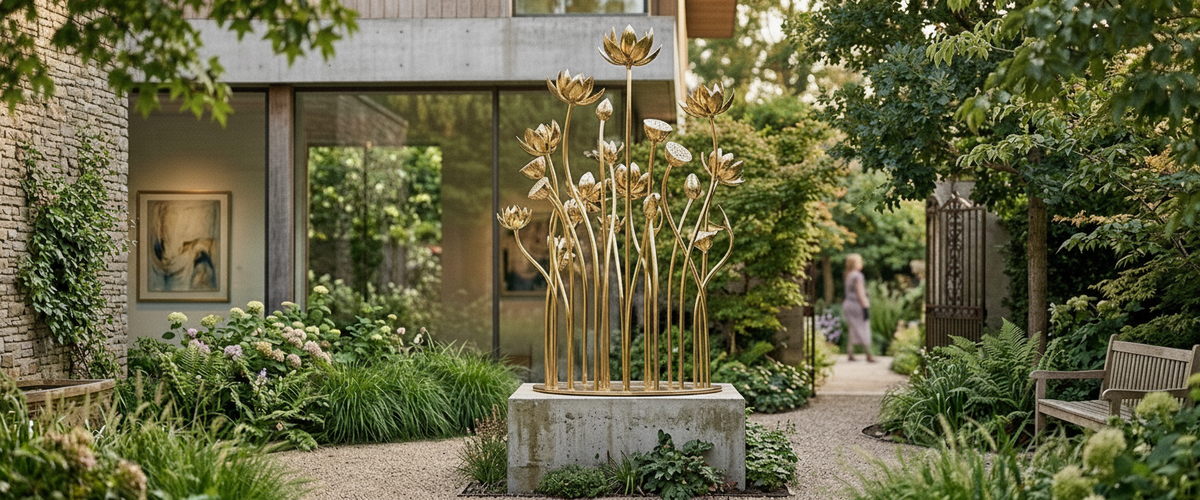

Our most nervous install had nothing to do with the sculpture. A client in Napa poured the footing for a tall abstract piece four days before delivery, and the concrete was still too green to take an anchor bolt. We waited, the crane cost an extra day, and nobody minded once the piece was standing. That is the lesson with extra large abstract sculptures: once a form climbs past head height, the parts you never see decide whether it stands for three decades or starts leaning by its second winter.
At a Glance
Above roughly 6 feet (1.8 m), wind load usually drives the engineering more than the silhouette does.
Resin is light, so anchorage becomes the priority.
Zinc is heavy, so its weight sets the size of the footing.
The internal steel armature determines the real lifespan.
Concrete footings need weeks to cure. Pour first, deliver later.
Survey crane reach, gate width and ground conditions before you order.

Past Head Height, Wind Load Matters More Than Form
A sculpture at waist height barely notices a storm. At 8 or 10 feet (2.4 to 3 m), broad flat planes behave like sails, and the overturning force on the base climbs steeply with every extra foot of height. In the US, engineers size these forces against the wind maps in ASCE 7, the same standard used for signs and canopies. A ridge-top lot in Aspen or a Gulf Coast garden in Texas will need a very different base from a sheltered Manhattan courtyard.
Open forms help. On an exposed site, a composition of separated, slender stems such as the Gold Abstract Lotus Stems Sculpture - 190cm, at 190cm (about 6 feet 3 inches), lets air pass between its elements, while a solid disc of the same height catches every gust. When we review designs for extra large abstract sculptures, perforation and gaps are often the first conversation, well before color or finish.
Gaps between elements let wind pass through instead of loading the base.
Resin Is Light, so Anchor It Harder Than You Think
Fiberglass-reinforced resin weighs a fraction of cast metal, which makes it easy to ship and gentle on a roof terrace. That same lightness means gravity does almost nothing to hold it down. In the studio we rock-test every tall resin base by hand before crating, and the difference between a properly bonded threaded rod and a surface-fixed plate is obvious within seconds.
Buyers comparing extra large resin or zinc garden abstract sculptures are really weighing lightness against mass. For resin outdoors, expect stainless anchor rods set into the footing, concealed ballast in the base, or both. Where the setting is a covered terrace or an interior atrium and wind is not a factor, a mid-height form like the Gold Abstract Lily Stems Sculpture - 150cm, at 150cm (about 4 feet 11 inches), asks far less of its fixings than the same design would on an open lawn.
Zinc's Blue-Gray Patina and the Weight That Comes With It
Cast zinc develops a soft blue-gray carbonate patina that protects the surface beneath, a behavior the International Zinc Association documents in detail. It flatters overcast British light and reads beautifully in a Hamptons winter or a Pacific Northwest garden. It is also dense, around 445 pounds per cubic foot (7.1 g/cm³), so even a hollow casting sets the dimensions of the footing.
Zinc is softer than bronze and can slowly creep under its own load. Many nineteenth-century zinc monuments slumped for exactly this reason. If you want the gray tone with more structural forgiveness, our bronze abstract sculptures can be patinated toward similar cool tones.

The Armature Decides Whether Extra Large Abstract Sculptures Last Thirty Years
Inside every tall casting or resin shell sits a steel skeleton. Specify grade 316 stainless for outdoor work, and insist on isolation between dissimilar metals. Zinc touching stainless steel in rain corrodes galvanically, and a mild-steel frame inside resin will rust, swell and crack the skin from within. Cantilevered elements depend entirely on rods you will never see. Even at 100cm, the outstretched leaves of a form like the Silver Abstract Leaf Cluster with Orb Sculpture - 100cm are only as secure as the steel running through them, and that load grows quickly as reach and height increase. Ask your maker for armature drawings. A reputable studio will have them.
The hidden steel skeleton carries every cantilevered element.
Pour the Footing Weeks Ahead
Standard structural concrete reaches its design strength at around 28 days. Pour too close to delivery and the anchors sit in material that cannot yet resist uplift. For extra large abstract sculptures in Colorado or New England, the footing must also reach below the frost line. On most installs the plinth is cosmetic cladding. The reinforced slab beneath it does the actual work, so spend your structural budget there.
Rehearse Delivery Day on Paper
When we deliver extra large abstract sculptures, the crane is usually the tightest constraint. Lifting capacity drops sharply as reach extends, so a truck parked 40 feet (12 m) from the footing may need a much larger machine than one parked at 15 feet. In the Hamptons we once found a client's gate a few inches narrower than the crate and had to re-pack the piece on the driveway. Now we ask for measured photos of every gate, overhead cable and slope before booking. Soft lawns need ground-protection mats, and irrigation lines need marking.

Buyer Checklist Before You Commission
Confirm the site's exposure and request a wind-load assessment for anything over head height.
Choose resin for lightness and color, zinc or bronze for mass and patina.
Request armature drawings showing grade and metal isolation.
Have a local engineer design the footing and pour it at least four weeks early.
Measure access routes, gates and crane positions, with photos.
Ask for a tailored quote. Budget depends on material, scale, complexity, engineering, installation and finishing.
Giant Sculptures builds and ships bespoke extra large abstract sculptures and other large-scale work worldwide, and we treat the structure as seriously as the surface. Explore our abstract sculptures for forms to start from, or look at life-size and large statues if your site calls for real presence. Then talk to us early, before the concrete is poured.
For wider placement ideas, Why Large Resin Garden Sculptures Blow Over, and How to Anchor Them is useful companion reading before finalising the setting and sightlines.