





































































































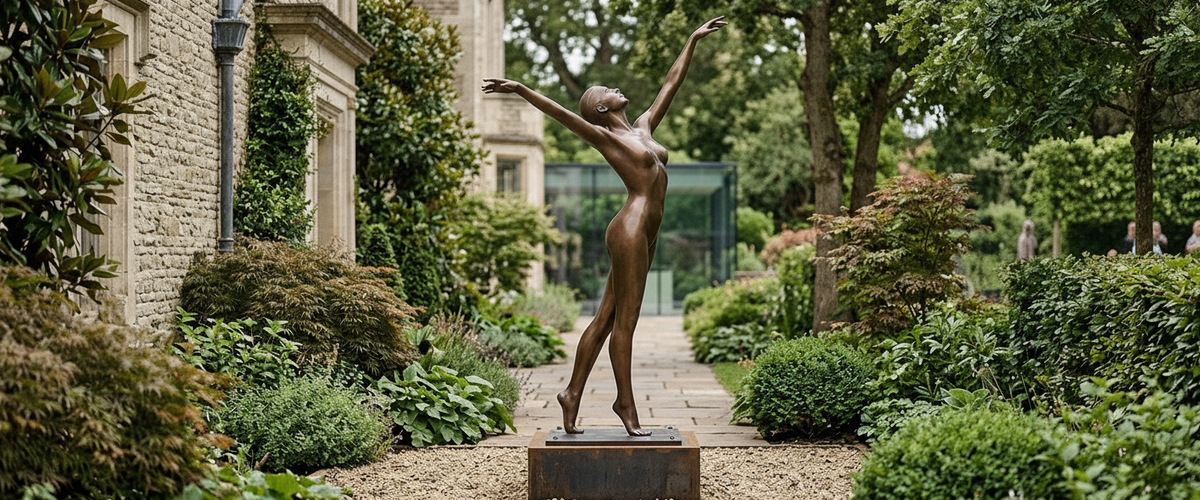

The fastest way to kill a sculpture project is a structural report. A roof terrace signed off for planters and lounge chairs will not accept a solid bronze figure on a small footprint, and no amount of design enthusiasm rewrites the load calculation. That is the moment a fiberglass outdoor sculpture stops being a compromise and starts being the only route to real scale: a hollow laminated shell can give you a commanding piece at a fraction of the deadweight of cast metal or carved stone.
Looking for the full range in this category? Browse our Fiberglass Sculptures collection for every available finish, size, and configuration.
The lightness is genuinely useful. It also comes with a bill, and the bill arrives at hand height, on south-facing elevations, and about three feet from the viewer's eye.

Quick Answer: When Fiberglass Is the Right Call
Choose it for load-limited sites: roof terraces, timber decks, suspended slabs, upper-floor atriums, event installations that travel.
Choose it for scale on a tighter budget: a 10 ft (3 m) fiberglass outdoor sculpture costs far less to make, crate and install than the same form in bronze.
Anchor it properly: a hollow shell behaves like a sail. Ballast and fixings matter more here than with heavy metal.
Keep it out of the contact zone: gel coat does not forgive knuckles, luggage carts or valet trolleys.
Go metal instead if: the piece sits in coastal salt spray at eye level, in a high-traffic plaza, or is expected to outlive the building.
The Weight Argument: Terraces That Will Never Take Bronze
We shipped a figurative commission to a Manhattan penthouse terrace where the engineer had capped point loading so tightly that even the plinth had to be redesigned as a spread-load steel frame. Bronze was out before the first sketch. A laminated composite shell with an internal armature, ballasted from below, got the client the height and presence they wanted without a single line item for structural strengthening.
That pattern repeats constantly across US projects: Napa pool decks over habitable space, Aspen cantilevered viewing platforms, Texas hotel mezzanines, Hamptons boardwalks built on sand and timber. In each case the question is not which material looks best in isolation, but which one the building will physically tolerate. A fiberglass outdoor sculpture is often the answer, and a good one, provided everybody understands the trade.
A hollow laminated shell delivers full height on a terrace that could never carry cast metal.

What the Trade Actually Costs You
Lightness is bought with a thin skin. Cast bronze is the same material 3 mm down as it is at the surface; a composite piece is a pigmented gel coat film over laminate. Damage a bronze and you dent it. Damage a gel coat and you expose the layer underneath, which is where water ingress and chalking begin.
You also give up the optical depth of metal. Patinated bronze shifts through the day as raking light picks up high points and shadow settles into recesses, one of the reasons our bronze sculpture collection still dominates commissions intended to stand for generations. The painted or metal-effect surface of a fiberglass outdoor sculpture reads flatter by comparison, particularly in the strong overhead sun you get in Arizona or Southern California.
Budget is the honest attraction, and it deserves an honest framing: cost tracks material, scale, structural engineering, finishing system, crating and install access, so the only useful number is a quote built against your actual site. Composite keeps the total lower, especially on freight and rigging, because you are not paying to lift and crane a multi-ton object.
Wind Loading on a Hollow Form
Wind is the most under-specified part of almost every fiberglass outdoor sculpture we are asked to review. A 10 ft (3 m) figure with an outstretched arm presents a large sail area and weighs a fraction of its metal equivalent, so wind does the arithmetic for you. Exposure category, height above grade and gust speeds all feed into the fixing design, and US projects should be checked against the wind provisions in ASCE 7 rather than a rule of thumb.
Practical fixes we use: a welded internal steel armature carried down into a base flange; a concealed ballast chamber filled on site with sand or concrete; stainless chemical anchors into a slab, sized by an engineer rather than by the crate; and for deck-mounted work, a spread-load steel sub-base that spans joists instead of loading one board. Undersized bolts through a decorative plate is the failure mode we see most often, and it usually presents after the first serious storm.

Where the Gel Coat Gives Up First
Every fiberglass outdoor sculpture ages, but it ages predictably, which makes the process manageable. South and west elevations go first, because UV plus heat cycling breaks down the resin surface into fine chalking and loss of gloss. Salt air accelerates everything, and glazed facades are an underrated hazard: reflected heat off a curtain wall can push surface temperatures well above ambient, degrading a dark finish in one specific band. Conservation guidance on polymer-based objects consistently points to UV, heat and pollutants as the main aging drivers, and the Canadian Conservation Institute's notes on plastics care are a good technical primer.
Care Checklist for Composite Pieces Outdoors
For wider placement ideas, An Outdoor Stainless Steel Sculpture Reflects Everything You Put Near It is useful companion reading before finalising the setting and sightlines.
Wash quarterly with pH-neutral soap and soft water; grit is what scratches, not dirt.
Apply a UV-stable automotive-grade wax or polish on sun-facing surfaces twice a year.
Inspect seams, arms and ground contact points for hairline crazing each spring.
Repair chips promptly. Exposed laminate wicks water and delaminates slowly.
Plan a refinish cycle rather than waiting for failure. Exposed elevations need a full recoat sooner than sheltered ones, and coastal sites sooner still.
Rinse salt off after storms if you are within sight of the ocean.
Chalking and loss of gloss start on south and west elevations, which is where the care schedule should focus.

Hand Height Is the Enemy
Lobbies teach this lesson quickly. Anything between roughly 2 and 5 ft (0.6 to 1.5 m) off the floor gets touched, leaned on, wheeled into and rapped with a knuckle. People really do the knuckle-rap test on a large composite piece, hear the drum, and form an opinion about quality in half a second. Plinth edges take the worst of it from vacuum heads and suitcase corners.
Design around it. Raise the work so the shell starts above shoulder height, specify a thicker local laminate or a steel-clad base at contact zones, or put metal where the hands are. For interior public thresholds and busy plazas, a piece from our stainless steel sculpture range takes abuse that would mark composite in a month.
The Close-Up Tell: Arm's Length Versus Across the Lawn
At 65 ft (20 m) across a lawn, a well-made fiberglass outdoor sculpture is indistinguishable from bronze. Walk in to arm's length and the tells appear: faint seam lines where mold sections met, slightly soft edge definition, the flat sheen of pigment against the varied depth of real patina. That is why placement matters more here than with any other material. Put composite at a distance, on an axis, above the eye line, or against foliage, and it performs beautifully; the same piece at the end of a narrow entry path invites the close-up inspection it will lose.
Spec a Fiberglass Outdoor Sculpture to a Site Survey, Not a Catalog Size
The best composite installations start with measurements of the site, not a browse for a height that sounds impressive. Before commissioning, we want to know load limits and substrate, prevailing wind and exposure, sun path and reflected heat sources, the delivery route including elevator and doorway clearances, and who will maintain the piece in year five.
Giant Sculptures builds bespoke work to that brief: adjusted proportions for a viewing distance, an internal armature engineered for your fixing condition, a finish chosen for your elevation rather than the showroom. If the survey says the structure can carry weight after all, we will say so and point you toward cast metal or stone for a longer service life. Browse the garden sculpture collection for scale reference, or start from the main catalog and bring us the site constraints early. The constraints shape the commission, and that is a good thing.