





































































































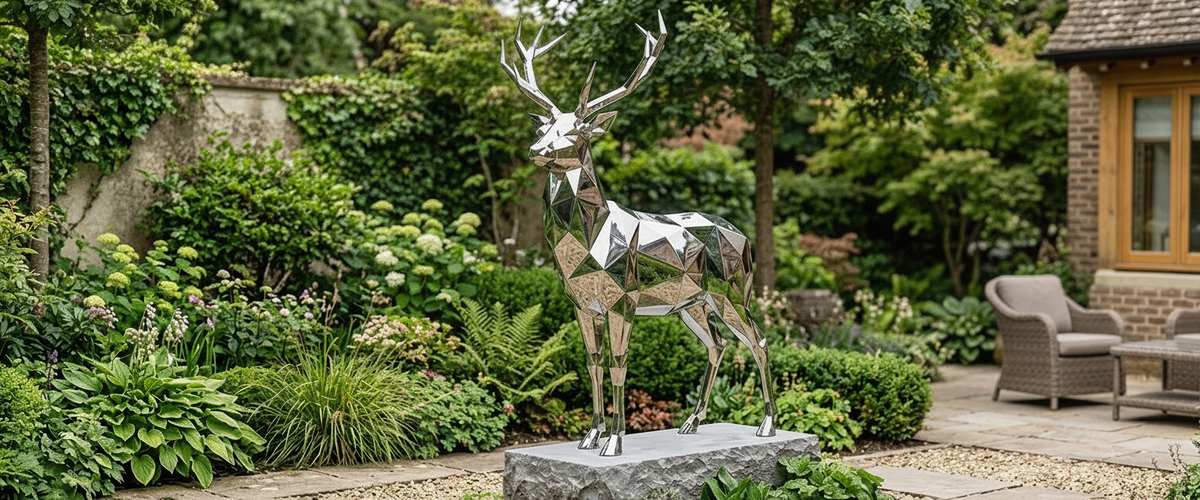

A mirror-polished sculpture has no color of its own. It wears yours: the asphalt, the parked SUV, the trash enclosure you keep meaning to screen with hornbeam. That is the part buyers miss when they choose an outdoor stainless steel sculpture from a catalog photo shot against clean sky in a fabricator's yard. The steel is completely honest about its surroundings. Get the siting right and it hands you back sky and planting all day. Get it wrong and it hands you back the driveway.

At a Glance
Finish sets the volume. Mirror polish is the loudest surface in any garden; brushed and bead-blasted versions of the same form read quieter and hide fingerprints and water spotting far better.
Grade sets the lifespan. Within a few miles of salt air, 316 stainless is the sensible specification and 304 is a false economy.
Siting decides the image. Point an outdoor stainless steel sculpture at foliage, water or open sky, never at parking or service areas.
Weld quality shows first in a mirror. Ask how seams are dressed, blended and polished before you talk about anything else.
Two washes a year keep steel reading as bright metal rather than flat gray.
Mirror Polish Borrows the Drive, the Bins and the Roofline Next Door
A highly polished convex surface compresses a whole hemisphere of view into one image, which is why an outdoor stainless steel sculpture is a site decision long before it is an object decision. Stand a mirrored form in the middle of a Texas motor court and you have effectively built a lens that magnifies concrete and car paint. We shipped a faceted piece to a property outside Napa where the client had originally marked the plinth position on a gravel turning circle. Two site photos later, we moved it fifteen feet into the olive planting. Same sculpture, entirely different object: green and silver instead of gray and beige.
Moved into the planting, the same mirrored form reflects foliage and sky instead of gravel and parked cars.
Faceted geometry helps, which is one reason it dominates large reflective work. Where a garden needs height without a single uninterrupted mirror, a faceted figure such as the Noble Deer III Geometric Steel Sculpture at roughly 6 ft 6 in (198 cm) breaks the view into dozens of small angled panels. Each plane catches a different slice of sky or shrub, so the piece sparkles instead of reproducing your hardscape in high definition.

Brushed and Bead-Blasted: Two Ways to Mute a Reflection You Cannot Relocate
Sometimes the plinth position is fixed. Permitting, a structural slab, a sightline the architect will not give up. When you cannot move the work away from a noisy backdrop, the finish on an outdoor stainless steel sculpture is the second lever you have.
Brushed (satin) finish runs directional grain across the steel. It still lifts light, but reflections soften into smears of tone rather than legible images. It also disguises the halo of handprints that collects on anything within reach of guests.
Bead-blasted finish goes further, scattering light into a soft pewter glow. In our experience it is the most forgiving choice for windy coastal sites, because it does not telegraph every water spot and salt speck the way mirror polish does. The trade-off is drama: bead blast is calm, and calm is not always what a large abstract form needs.
Mixed finishes are the underused option. Mirror on the leading faces, satin on the flanks, blast on the base. Ask for finish sampling on offcuts before the whole piece is polished; it costs almost nothing at that stage and saves regret at installation.
Point It at Planting, Not Parking
Before you commit a position, do the phone test. Hold your camera where the sculpture's center will sit, turn a slow 360, and look at what the lens collects. Whatever fills that circle is what the finished surface of an outdoor stainless steel sculpture will show you every day. Foliage, lawn, pool water and sky are generous; fencing, gutters, HVAC units and driveways are not.
Two more siting habits worth adopting. First, keep dark evergreen mass behind a reflective piece so the silhouette stays readable. Second, treat sightlines in pairs. A tall piece near a Hamptons pool terrace reads one way from the house and another from the water's edge, and the second view is usually the one guests see longest. On a terrace where a full-height figure would crowd the space, a tabletop-scale form like the Cubic Geometric Steel Sculpture at 75 cm is an honest way to watch how reflective metal behaves through a day before you commit to something six feet tall.

Why the Same Piece Reads Silver at Noon and Gunmetal by Four
Polished steel has no fixed tone. At midday it takes color temperature from a high, bright sky and reads near-white. By late afternoon it picks up warmth from low sun and the ground plane, going brassy, then settling into gunmetal as the light drops. Overcast days flatten it toward soft aluminum.
That shifting quality is the main argument for seeing an outdoor stainless steel sculpture in person, or at least requesting photographs at different hours, before final placement. It is also why lighting matters more here than with stone. Uplighting a mirrored surface from directly below usually produces glare and hot spots; grazing light from the side reveals form. Where a position goes dark early and there is no clean way to run exterior lighting to it, an illuminated piece such as the Luminous Stag Gold Steel LED Sculpture solves the problem from the inside out, becoming its own light source after sunset rather than depending on what you can aim at it.
Weld Seams Show Up in a Mirror Long Before They Show Anywhere Else
This is the single biggest quality divide in fabricated metal work. A faceted sculpture may carry hundreds of feet of seam. On a bead-blasted surface, moderate dressing passes unnoticed. On mirror polish, an under-blended weld appears as a faint ripple your eye catches from thirty feet away, because the distortion breaks the reflected image.
Seams are ground, blended and taken up through finer grits until they vanish into the surrounding panel.
Good fabrication grinds, blends and progressively polishes each seam through finer grits until it disappears into the surrounding panel. It is slow, skilled handwork, and it is where a large commission earns or loses its money. When you request a quote for an outdoor stainless steel sculpture, ask three specific questions: how seams are finished, whether weld areas are passivated after grinding, and what internal framing supports the skin. Passivation restores the chromium-rich oxide layer that gives stainless its corrosion resistance, and heat-affected weld zones need it most.
304 Near the Coast Is a False Economy, and Tea Staining Proves It
Grade 304 is a perfectly capable alloy inland. Add airborne chlorides and it starts to show brown-gold surface discoloration known as tea staining, which is cosmetic rather than structural but ruins the read of a polished piece. Grade 316 contains molybdenum, which markedly improves resistance to chloride pitting, and it is the grade we specify for any outdoor stainless steel sculpture within reach of sea spray. The Nickel Institute publishes detailed guidance on how alloy content drives outdoor durability, and published guidance on tea staining consistently points to two factors: grade selection and surface smoothness, since rougher finishes trap salt and dirt.
The practical rule we give clients: coastal or poolside means 316 with a fine-finished surface, urban and inland can consider 304, and heavily salted winter roads in Aspen or the Northeast behave more like a marine environment than people expect. Work through the stainless steel sculptures collection with that filter in mind, then confirm the grade for your exact location before ordering.

The Twice-Yearly Wash That Keeps Steel Reading as Steel
Stainless is low maintenance, not no maintenance. Left alone, an outdoor stainless steel sculpture slowly accumulates a film of pollen, road film and dust that kills reflectivity and turns bright metal muddy gray.
Rinse first with clean water to lift grit that would otherwise scratch during washing.
Wash with warm water and a mild pH-neutral detergent using a soft cloth or sponge, working along the grain on brushed finishes.
Never use steel wool, wire brushes or chloride-based cleaners. Carbon steel particles embed and rust, and bleach attacks the passive layer.
Rinse thoroughly and dry with a microfiber cloth to prevent water spotting, which is the most common complaint on mirror surfaces.
Inspect fixings and the plinth interface for pooling water, trapped leaves or movement.
Increase to quarterly within a mile of salt water, and after any winter with road salt.
Serious marks, scuffs from a landscaper's trimmer or a scratch from a delivery strap are repairable in place by a finisher who can rework the affected panel back up through the grits. Keep a record of the original finish specification so the repair matches.
Commissioning Criteria Worth Fixing Early
Budget for a bespoke outdoor stainless steel sculpture is driven by material grade, overall scale, geometric complexity, engineering for wind load, foundation work, finishing hours and installation access, so the only useful figure is a tailored quote against your actual site. What you can fix early is the specification. Confirm grade, finish (including any mixed-finish zones), seam treatment, internal armature, base detail and fixing method, plus who is responsible for the concrete pad. Send us site photographs from every approach, not just the pretty one. Our studio has turned down more than one proposed position because the sculpture would have spent its life reflecting a neighbor's roofline.
Chosen well, reflective metal is the most site-responsive material we work with. It changes hourly, holds its edge for decades with modest care, and makes a garden or forecourt feel considered rather than decorated. If you are comparing materials, our metal sculptures and broader outdoor sculptures collections are the sensible next stop before you commit to a commission.
For wider placement ideas, Choose Your Outdoor Large Garden Sculpture for February, Not July is useful companion reading before finalising the setting and sightlines.