




























































































Most faux leather wall art fails for one reason: the maker treated it like upholstery instead of relief sculpture. Stretch a coated fabric over a flat board, quilt it, hang it, and you get something that looks fine in a photograph and flat in a room. The faux leather wall art that holds a wall for a decade is built the way a bronze relief is built, with a considered profile, controlled shadow, and edges that survive being looked at closely. That difference starts in the studio, not in the showroom.
Looking for the full range of faux leather wall art and related finishes in this category? Browse our Wood Wall Art collection for every available finish, size, and configuration.
We build large-format faux leather wall art at Giant Sculptures alongside bronze, stainless steel and stone commissions, and the conversations that produce a good leather art wall are surprisingly technical. Substrate. Relief depth. Seam logic. Where the viewer stands. Below is how those decisions actually get made.

Key Takeaways
- Depth beats pattern. Relief profile controls how faux leather wall art reads across a room; surface color is secondary.
- Substrate decides lifespan. The hidden board and frame matter more than the skin wrapped over them.
- Viewing distance is a design input. A piece tuned for a 10 ft (3 m) hallway will look weak on a 30 ft (9 m) double-height wall.
- Seams are a design feature or a defect. There is no middle ground.
- Budget is driven by scale, relief complexity, hand-finishing, framing engineering and install method, so ask for a tailored quote rather than a catalog figure.

What Sculptors Think About Before Taking on a Faux Leather Wall Art Commission
The first question is never "what color." It is "what is this wall doing?" A faux leather wall art commission for a dining room behind a long table has to survive candlelight raking across it at close range, which punishes sloppy edges. A five-story atrium needs the opposite: bold massing that still resolves from the mezzanine. Same material family, two completely different builds.
Next comes the wall itself. Solid masonry, stud partition, or a curved feature wall all change the mounting strategy, and a heavy multi-panel faux leather wall art piece on plasterboard needs a cleat system anchored into structure. We ask for a photo and, where possible, a wall build-up before quoting. Studios that skip this step are the ones whose work ends up on the floor.
Then there is the honest conversation about material behind any faux leather wall art build. Quality faux leather (usually a polyurethane skin on a woven backing) is dimensionally stable, colorfast under normal interior light, and far less fussy than hide about humidity swings. It is also not indestructible. Conservation guidance on skin and leather objects consistently points to light exposure and dry heat as the main enemies, and the same logic applies to synthetic substitutes; the National Park Service Conserve O Gram series is a useful primer on why direct sun and radiator heat shorten the life of any flexible surface. If your only available wall faces a west-glazed elevation with no shading, we will say so and suggest a metal or bronze relief instead.

Craft Decisions That Change a Faux Leather Wall Art Panel (and the Cost)
The substrate you never see
Under every good piece of leather wall hanging art sits a rigid core: marine-grade ply, engineered board, or an aluminum honeycomb for larger spans. Cheap work uses thin MDF that bows within a season in a room with underfloor heating. Better work uses a braced back frame with a slight standoff so air moves behind the panel. On big commissions we specify aluminum sub-frames for the same reason we do on metal wall pieces: the panel stays flat, and flatness is what makes faux leather wall art read cleanly at any distance.
Relief depth and shadow
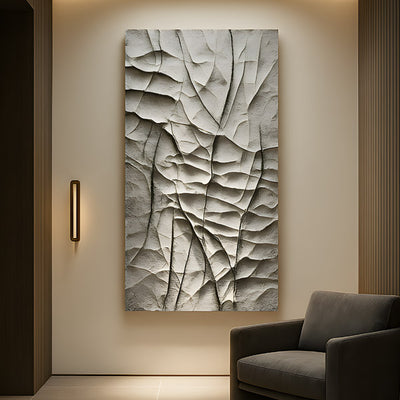
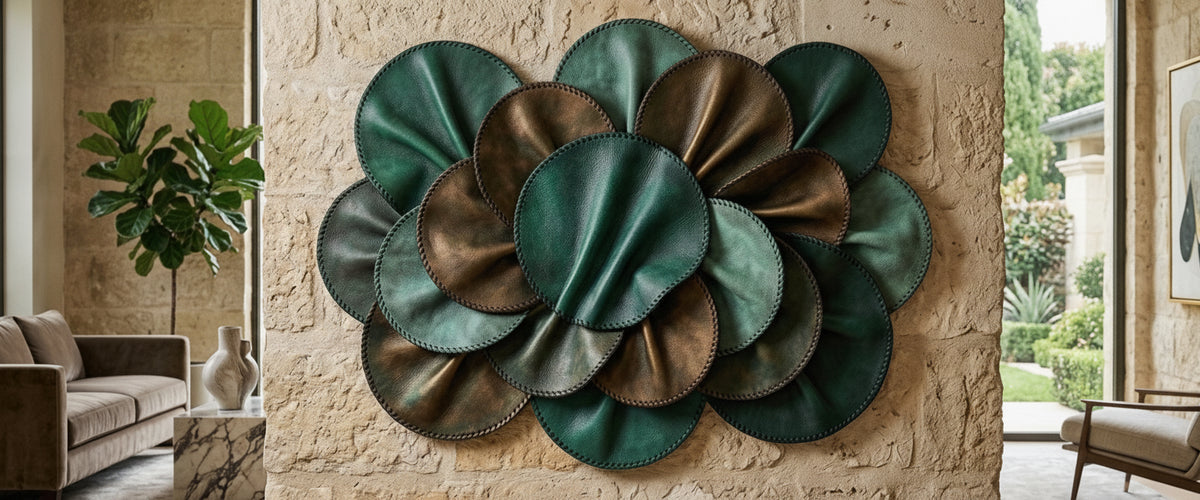
This is the sculptural decision that separates one faux leather wall art panel from another. Shallow tooling gives a quiet, textile-like surface. Deeper forms, folded ribbons, stacked discs and layered plates throw real shadow and change through the day as light moves. Where a room needs that second approach, a folded ribbon piece such as Rivora Green Ribbon Leather Circular 3D Wall Art only holds together because the folds are built deep enough to cast a continuous shadow line, and it is that shadow, not the color, that carries the form across a room.
Seams, edges and returns
Where the skin wraps a corner, you either see a crisp mitered return or a puckered fold. Hand-stitched seams can be a feature when they follow the geometry, and a distraction when they cut across a form at random. Ask any studio quoting faux leather wall art to show you a corner detail photo before you commit. It tells you more than the hero shot.
Finish and color depth
Flat pigment looks cheap under warm lighting. Layered tinting, burnishing at the high points, and a darker recess give leather wall art decor the depth people associate with real hide. That work is done by hand, panel by panel, and it is one of the honest reasons a considered piece costs more than a mass-produced board.

Why Some Faux Leather Wall Art Reads Right at 10 Feet and Wrong at 30
Scale failure is the most common problem we are asked to fix. A client buys a piece sized for a hallway, then hangs it above a 12 ft (3.7 m) sectional in an open-plan great room. The forms are correct. The panel is simply too polite for the volume of air around it.
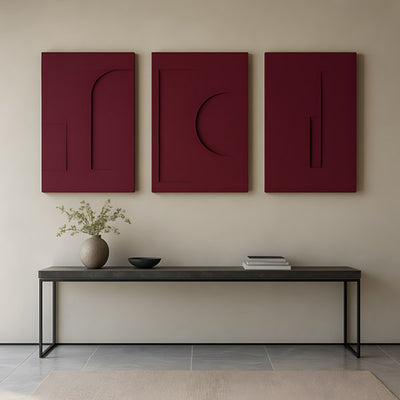
The rule we work to: at close range, the eye reads texture and stitch. At mid range, it reads relief and shadow. At long range, it reads silhouette and mass only. So a faux leather wall art piece intended for a double-height wall needs a strong outer profile and bold internal grouping, not fine detail that dissolves at distance. Multi-panel compositions solve this well because the gaps between panels become part of the drawing. Across a wide wall, a spread like Centria III Multicolour Disc 5-Panel 3D Leather Wall Art covers ground a single square panel never could, and the rhythm of the gaps does as much compositional work as the discs themselves.
Lighting is the other half of the equation. Faux leather wall art wants grazing light from above at a shallow angle, roughly 20 to 30 degrees off the wall, so the relief casts shadow rather than being washed flat. Down-lights aimed straight at the panel kill it. Where architectural lighting is not an option, an integrated backlit build such as Vanguard Jade Surge Leather 3D LED Wall Art lifts the form off the wall plane, which is useful in a media room that needs presence without a spotlit gallery look.

Studio Process: Maquette, Sample, Fabrication, Install
- Brief and site check. Wall construction, dimensions, sightlines, light sources, and the furniture that will sit under the piece. We also ask what the room is used for at night, which changes the finish choice more often than people expect.
- Maquette or scaled drawing. For a sculptural faux leather wall art commission we build a small three-dimensional study. For a repeating geometry we render at scale and tape the outline on your wall. Both catch proportion errors while they are still free to fix.
- Material sample. A physical swatch showing color, grain, stitch and a section of relief. Judge it on your wall, under your lighting, at your normal viewing distance. Never approve color from a screen.
- Fabrication. Substrate cut and braced, forms built up, skin cut and wrapped, seams closed, finishing by hand. Larger works are broken into panels sized for the access route, which is a practical constraint people forget until a crate meets an elevator.
- Crating and shipping. Panels travel face-protected with corner armor. Humid transit routes need sealed crates rather than wrap, and each crate is marked with its panel position so the hanging sequence is obvious on site.
- Install. French cleats or a bespoke bracket set, leveled as a group rather than panel by panel. On multi-panel work we supply a spacing jig so the gaps stay honest.
Red Flags to Raise Before You Commit
- No substrate specification. If nobody will tell you what is behind the skin of your faux leather wall art, assume the cheapest board.
- No physical sample offered. Screen color is not color.
- Mounting left to "your installer." The maker should specify the fixing method and total hanging weight.
- Vague repair path. Ask how a scuffed panel gets refinished in five years and whether the finish is recorded.
- Detail sized for the wrong distance. If the sample looks busy from 10 ft (3 m) away, it will look like noise on a large wall.
- A quote with no line items. Scale, relief complexity, hand-finishing, framing engineering and install all move the number. A serious studio will break that down for you rather than quoting a round figure.
Personalized Leather Wall Art, Portraits and What Not to Attempt
Personalized leather wall art works beautifully when the brief is geometric, monogrammatic, or based on an abstract motif drawn from the architecture. It works less well when someone asks for photographic realism. Leather face wall art, for example, can be superb as a stylized mask form with strong planes, and disappointing as an attempt at a likeness, because the material wants planes and edges rather than soft gradients. If a client wants a true portrait, we usually steer them away from faux leather wall art and toward bronze: cast metal holds undercuts, soft transitions and modeled detail that a wrapped skin never will.
For contemporary schemes, modern leather wall art usually means restrained color, repeated geometry, and a single strong gesture. Browse the Leather Art collection to see how different faux leather wall art relief strategies behave, then compare against the metal wall art range if your wall gets hard direct sun or sits in a high-traffic commercial corridor.
What About DIY Leather Wall Art?
A small DIY leather wall art project is genuinely satisfying and worth doing. Cut a rigid board, wrap it with faux leather using contact adhesive, staple the returns on the back, and mount it on a cleat. Simple woven or folded panels are within reach of a competent hobbyist over a weekend.
What does not scale is everything above roughly 4 ft (1.2 m): flatness, seam control, consistent relief across panels, safe hanging weight, and a finish that will not scuff off at shoulder height. That is the line where a faux leather wall art commission stops being an indulgence and becomes the cheaper option, because a failed large panel is a wasted material bill plus a wall that still needs solving. Keep the DIY at accent scale and commission the statement piece.
Living With the Piece
Care for faux leather wall art is undramatic and worth doing properly. Dust with a dry microfiber cloth along the grain, not across it. Blot spills rather than rubbing. Skip solvent cleaners and silicone polishes entirely; general conservation advice from the American Institute for Conservation is a sound reference point on why aggressive cleaning products cause more damage than the dirt they remove. Keep panels off walls that back onto unheated spaces, and give any large piece an annual look at the fixings.
Done well, faux leather wall art holds its own beside bronze and steel in the same room, and it does something those materials cannot: it absorbs sound, warms a hard interior, and gives a wall a tactile quality at close range. If you are weighing a commission, send us the wall dimensions, a photo, and a note on lighting. We will tell you honestly whether faux leather wall art is the right answer or whether your wall wants something cast, welded or carved instead. You can also start with the wider wall art and wall decor range to see how scale behaves across materials.
For wider placement ideas beyond faux leather wall art, Sculpture 3d Wall Panels: A Buyer's Guide to Relief Art That Holds a Room is useful companion reading before finalizing the setting and sightlines.