
























































































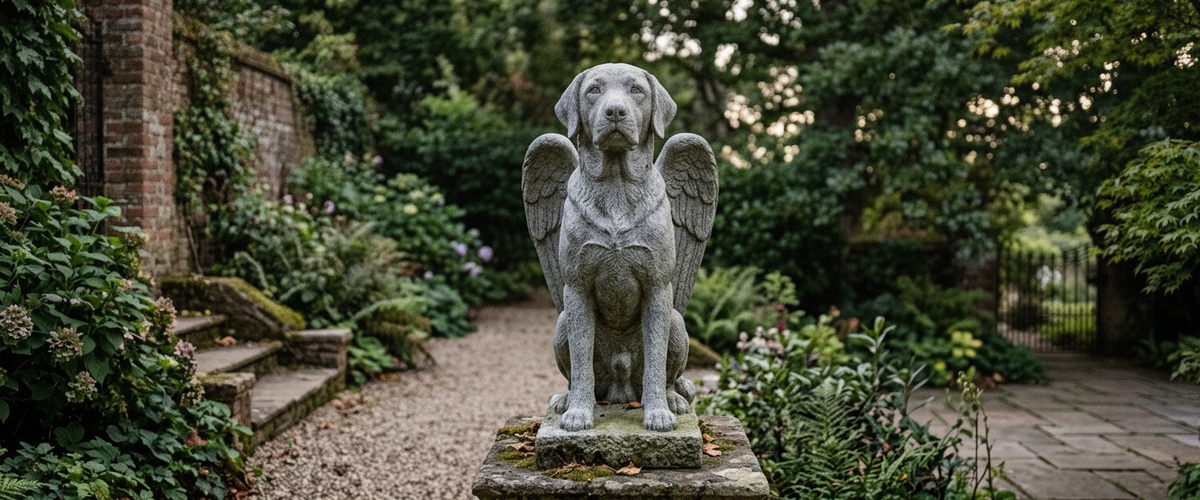

Dog angel granite statues fail at the same place nearly every time, and it is almost never the face. It is the outer feather edge of a wing, three winters in, where a hairline that nobody could see at the studio finally opened up. Granite is one of the toughest materials we carve, but it does not forgive careless block orientation or an undercut cut too deep for the crystal size. Most of the dog angel granite statues we have been asked to repair for other yards failed on one of those two decisions, not on the carver's skill. Get both right and you have a piece that will outlive the person who commissioned it.

Quick Answer: What Decides Good Dog Angel Granite Statues
Grain direction beats every other technical decision. Wing edges must run with the stone, not across it.
Crystal size sets detail limits. Coarse grey granite holds silhouette and mass; fine-grained black granite holds wrinkle and eye detail.
Undercut depth is a durability choice, not a style choice. Deep air gaps behind feathers invite frost damage.
Lettering needs width, not just depth, to stay readable outdoors.
Reference photos decide the likeness. Ear set and shoulder height matter more than a cute head shot.
Grain Direction Decides Whether Dog Angel Granite Statues Crack
Granite splits more easily along certain planes, a property quarrymen call the rift and the grain. You cannot see it from the outside of a sawn block, which is why experienced yards mark orientation before the stone leaves the quarry. When a carver lays out dog angel granite statues, the wing tips are the most exposed, most cantilevered part of the whole piece. If those feather edges run across the weak plane, freeze and thaw cycles will find the fault long before the muzzle shows any wear.
Two fixes work. The first is design: keep the wings semi-folded against the shoulder so the stone supports itself, or tuck them into a recessed back panel. A niche-built form such as the Angel in a Niche Grey Granite Headstone at roughly 5 feet (150 cm) survives brutal weather partly because the surround takes the wind and rain that would otherwise land on the most fragile carved edges. The second fix is honest proportion: a slightly thicker feather edge that reads correctly from ten feet (3 m) away is better than a paper-thin one that reads beautifully for two seasons.
Wing edges on dog angel granite statues are cut with the grain, never across it.

Coarse Crystal, Soft Muzzle: Breed Features That Survive And Features That Blur
Granite is an assembly of interlocking crystals, and you cannot carve smaller than the crystal. In coarse grey stone with visible feldspar, a whisker line simply disappears into sparkle. Features that hold up well: head shape, ear set and carriage, jaw mass, chest depth, the break where a double coat parts along the flank, and tail set. Features that blur fast: eye moisture, deep facial wrinkles on a bulldog or shar pei, wiry terrier coat texture, and any lettering thinner than the crystal grain.
This is the honest conversation to have before commissioning. A flat-coated breed such as a Labrador or a Weimaraner reads brilliantly in coarse granite because the form does the work, while dog angel granite statues of a schnauzer need a finer-grained stone, or a shift to marble or bronze. Across our wider range of angel statues and sculptures, the winged animal pieces that hold their likeness longest are the ones matched to the right stone at the sketch stage, not corrected later with abrasives.
Machine Roughing Versus Hand Finishing, And Where The Difference Shows First
Almost all serious granite work now, dog angel granite statues included, starts with machine roughing: diamond wire, then a point-cutting head to bring the mass down to within an inch of the final surface. That is efficient and it is fine. The difference shows in three places, and you spot them within a minute. The inner corner where the wing meets the shoulder blade. The underside of the muzzle. The junction where paws meet the base.
Machines leave those transitions uniform. A hand carver varies the plane angle by a degree or two so light breaks unevenly and the form looks alive. The tell is simple: run a flat rule across the brow. Machine-only work gives you a consistent arc. Hand-finished work gives you a subtle asymmetry that matches how real skulls actually sit.

Choosing The Block: Crystal Size, Color Consistency And The Seams You Cannot See
Two blocks from the same quarry, cut the same week, can differ noticeably in color, and on a single figure that shows as a pale band drifting across a wing. Clients read it as a stain even when it is perfectly sound geology. Blocks destined for dog angel granite statues get rejected for color drift at least as often as for structural faults.
The faults you cannot see matter too. Healed fractures, quartz seams, and scattered iron sulphide inclusions that later bleed rust down a pale surface are all worth checking before carving begins. Conservation guidance on stone decay from Historic Environment Scotland is a useful primer on how water movement, salts, and frost drive most long-term deterioration in exposed stonework. Sounding a block with a hammer and wetting it down to reveal color shifts costs an hour and saves a commission.
Inscription Depth And Letter Width That Still Read After Ten Frosts
Most disappointing memorial lettering is not shallow, it is narrow. A V-cut letter needs enough width at the top of the cut for shadow to form; go too fine and the shadow closes up, especially in overcast light. Sandblasted lettering on polished black granite gives the strongest contrast because the frosted cut sits against a mirror surface, which is why so many pet memorials, dog angel granite statues among them, split the work between a carved figure and a polished panel. That is the logic behind a piece like the Kneeling Angel and Black Heart Granite Headstone - 120cm, where the figure carries the form and a separate surface carries the text.
If you want gilding or paint fill, plan it at the design stage. Fills sit best in a cut with clean vertical shoulders, and retouching later is far easier when the letter has body.
Placing Dog Angel Granite Statues For The Garden
Dog angel granite statues are heavy enough that placement is a construction decision. Set the piece on a compacted, free-draining pad rather than directly on lawn or soft topsoil, or frost heave will slowly tilt it. We shipped a pair of grey granite figures to a hillside property in Napa where the client wanted them directly under a mature oak; we moved them about ten feet (3 m) clear because tannin drip and bird traffic stain pale stone within a season.
Granite garden statues need a compacted pad and clearance from tannin drip.
Think about the wider group too. A granite buddha garden statue sits comfortably beside a winged dog because both are closed, weight-bearing forms that read well in low winter light, and neither needs the seasonal cover that a delicate marble figure appreciates. Where a border planting is too thin to hold the figure visually, a relief backdrop such as the Blessing Character Grey Granite Garden Screen - 200cm gives it a permanent stone ground instead of foliage that disappears by November.

Photographs Our Carvers Ask For
Likeness in dog angel granite statues is decided at the reference stage, so send these six:
Straight-on profile, camera at the dog's shoulder height, standing square.
Head-on portrait at eye level, showing ear set and the width between the eyes.
Three-quarter view of head and chest for the muzzle-to-skull ratio.
Top-down of the head, which fixes skull width better than any front shot.
Full standing side view with all four legs visible for leg length and topline.
One casual photo in a familiar pose, plus a note on coat color so we can suggest the right granite tone.
Include something of known size in one frame for scale. Six well-planned photographs beat sixty phone snaps taken from above.
Commissioning Dog Angel Granite Statues Without Regret
Decide first on viewing distance, because it sets both scale and detail level. Then choose stone: coarse grey for weather resistance and mass, fine black for lettering and facial subtlety, marble where softness of skin and drapery matters more than sheer durability. Confirm foundation and access before delivery day, since granite of any size needs machinery and a route in.
Cost depends on stone selection, block size, carving complexity, finishing, engineering, and installation, so ask for a tailored quote against your drawing rather than a headline figure. Giant Sculptures carves bespoke dog angel granite statues alongside our cast pieces, including bronze dog statues for clients who want portrait detail that granite cannot physically hold. Whichever route you take, the goal is the same: a figure that still reads as your dog decades from now, not a generic winged animal on a plinth.
For wider placement ideas, Angel Cherub Garden Statues: Putto, Cherub, or Full-height Angel? is useful companion reading before finalising the setting and sightlines.