







































































































Bronze flatters a bull and betrays a dolphin. That is the first thing to understand before buying a bronze animal sculpture, and most catalog copy skips it. The metal loves texture, tension and dark mass; it struggles with wet, glassy skin. Choose the right creature, patina and viewing distance, keep up basic waxing, and an animal bronze sculpture will look better after thirty years outdoors than it did on delivery day.

Key Takeaways
Textured subjects win. Fur, feathers and rough hide hold patina beautifully and improve with weather.
Bronze carries thin forms. Slender legs, raised hooves and long necks are where it outperforms stone and resin.
Glossy animals need care. Polished seals and dolphins can read as plastic unless the surface is worked.
Distance sets size. A hare reads at ten feet; a horse needs around thirty.
Commissions are decided early. The maquette stage matters more than the foundry invoice.
Hide, Fur, Feather and Scale Take Patina Differently
Patina is chemistry applied to a surface, and the surface decides how it behaves. Deeply chased fur breaks the color into highs and lows: the patina pools in the grooves and wears back on the ridges, so a bear or a wolf becomes more legible as it weathers. Feathers do the same at a finer grain. Smooth hide, such as a bull's flank or a horse's shoulder, holds an even film and shows every mark the chaser left behind, good or bad.
Scales are the tricky one. A tight repeating pattern turns to visual noise under a uniform patina, so on fish and reptiles we often lift individual rows with a lighter wash. Whatever the texture, outdoor bronze needs a protective wax layer renewed over time, and the Getty Conservation Institute has published research on why coated outdoor bronzes corrode more slowly and evenly than neglected ones.

Thin Legs and Long Necks: Poses Only Bronze Can Carry
Look closely at classical marble horses and you will nearly always find a tree stump or strut under the belly. Stone is strong in compression and weak in tension, so it cannot hold a deer on four slender legs or a crane balanced on one. Resin creeps and flexes in summer heat. Bronze, cast hollow and reinforced with an internal stainless steel armature where the load demands it, holds a cantilevered neck or a lifted hoof for generations.
Even mixed-media designs reach for metal where the form is thinnest. On a piece like the Clear Stag with Bronze Antlers on Black Marble Resin Sculpture - 180cm, the body is clear resin, but the antlers are bronze, the material best suited to tines that fine. If your shortlist includes an animal mid-stride, mid-leap or mid-preen, that is a strong argument for a bronze animal sculpture over stone or resin.
Where Bronze Struggles: Sleek and Glossy Subjects
Dolphins, seals, otters fresh from the water, koi. These animals are defined by wet shine, and a high-polish bronze version often looks like a trophy or a toy. The eye expects water, gets lacquer, and reads it as plastic.
There are fixes. A faint hand-worked texture under a satin patina suggests skin without imitating gloss. Dark, warm patinas help more than bright ones. And for a truly abstracted marine form, polished stainless steel can be the more honest material. A good advisor should say so rather than sell you the wrong metal.
Choosing a Patina: Brown-Black for Bears, Verdigris for Herons
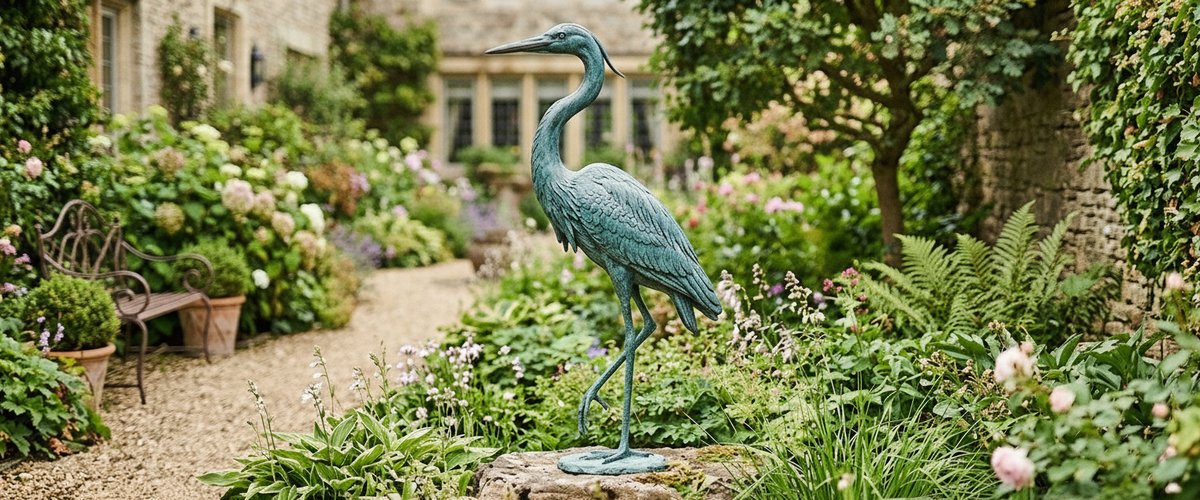
Match the patina to the animal's weight and habitat. Brown-black suits bears, bulls, boars and gorillas, where mass and shadow do the work. Golden and mid-browns flatter hares, foxes and deer. Blue-green verdigris belongs with water creatures: a heron at a pond's edge or a frog on a fountain rim looks as if the garden grew it.
Climate shifts the plan. Salt air in the Hamptons pushes bronze toward green on its own, so a brown patina there needs more frequent waxing. Buyers placing a bronze animal sculpture in Tucson, AZ face the opposite problem: intense UV and dry heat bake wax off faster, dark surfaces get hot to the touch, and verdigris can look out of place against desert stone. Warm browns and a firmer maintenance schedule usually serve the Southwest best.

Scale and Viewing Distance: A Hare at Ten Feet, a Horse at Thirty
Every animal has a distance at which its silhouette makes sense. A hare reads at about ten feet (3 m). A life-size horse needs closer to thirty feet (9 m) of clear sightline before the eye takes in the whole gesture. Put that horse in a compact Manhattan townhouse courtyard and visitors see a wall of flank. Set it at the end of a Napa vineyard allée and it finally looks right.
At the other extreme, a tabletop animal works at arm's length, where the eye reads surface detail rather than outline. The same rule holds across materials: a 15 cm piece such as the Brown Faceted Animal Cast Resin Sculpture - 15cm belongs on a desk or console, where its planes can be studied up close, not lost in a border. For outdoor placement, measure your actual viewing distance rather than guessing it, then browse our bronze garden statues with that number in hand.
Commissioning a Bronze Animal Sculpture: Maquette to Foundry
A commissioned animal is won or lost between the maquette and the foundry. The maquette fixes gesture and weight distribution. Enlargement is where proportions drift: ears, eyes and paws that look alert at small scale can look startled or clumsy at full size. A hare's ears are the classic case: what reads as watchful in the maquette can read as alarmed at three times the size, and that is far cheaper to fix in clay than in metal.
The great 19th-century animaliers sketched live animals relentlessly before modeling; the Walters Art Museum holds one of the strongest collections of that tradition. The lesson still applies: insist on reference photography, approve the enlarged clay in person or by detailed video, and sign off the wax chasing before casting. Budget depends on material, scale, complexity, engineering, installation and finishing, so Giant Sculptures prices every bespoke commission with a tailored quote.

Buyer Checklist Before You Commit
Does the animal have texture that bronze will flatter, or gloss it will fight?
Is the pose thin or cantilevered enough to justify bronze?
Have you measured the real viewing distance from the main vantage point?
Does the patina suit the animal, the setting and your climate?
Who approves the enlarged clay and the wax before casting?
Is the base or footing engineered for the weight and wind load?
Do you have a waxing schedule for long-term care?
If the answers point to bronze, start with our bronze animal sculptures for finished pieces, or explore the wider bronze sculptures range before briefing a commission.
For wider placement ideas, Bronze Garden Bird Sculpture: When Verdigris Reads as Plumage and When It Reads as Neglect is useful companion reading before finalising the setting and sightlines.