






























































































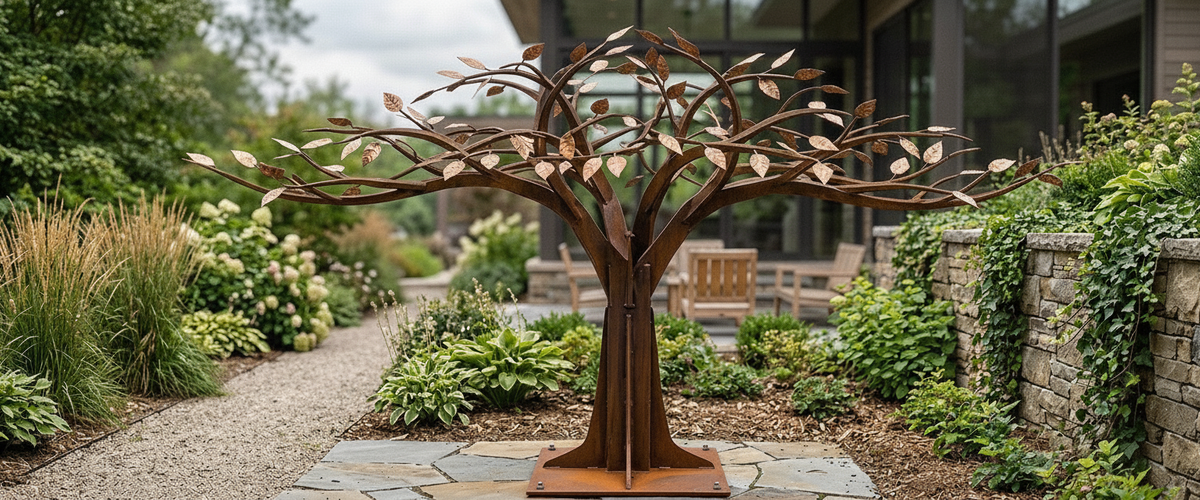

The trunk almost never fails. In fifteen years of building and shipping large metalwork, the repairs that come back to our bench are branch tips, leaf stems and the last six inches of a twig that someone leaned a ladder against. A metal tree sculpture is a cantilever problem dressed up as a botanical one, and the failures are boringly predictable once you know where to look.
Taper and gap: an open canopy sheds wind instead of catching it.

Key Takeaways
Branch tips crack from fatigue, not force. Taper and gauge matter more than total weight.
A generous canopy behaves like a sail. Leaf count is a structural decision, not a styling one.
The baseplate under a freestanding metal tree sculpture absorbs both wind load and whip. Undersize it and the trunk weld pays the price.
Copper, stainless steel and Corten age very differently across the first three winters.
A metal tree sculpture wall hanging shares the same weak points minus the wind, plus fixings that are usually wrong.
Ten minutes once a year saves most branches.
Branch Tips Crack Before Trunks Do: Gauge, Taper and Weld Sequence
Every branch is a lever. The tip moves the most, carries the least metal, and sits furthest from a support, so it accumulates fatigue cycles faster than anything else on the piece. Fabricators who build a metal tree sculpture in constant-gauge tube produce trees that look right for a season and then develop hairline cracks at the first joint behind each tip.
The fix is taper. A branch should step down in diameter and wall thickness three or four times between trunk and tip, so stiffness falls gradually and no single junction becomes the hinge point. Weld sequence matters just as much. Welding a canopy outward from the trunk locks in shrinkage stress that pulls the whole armature off plumb; we build branches as sub-assemblies, stress-relieve them, then hang them on the trunk. A metal tree sculpture that leaves the studio 2 in (50 mm) off plumb looks far worse than that on a lawn, where there is nothing straight nearby to reference it against.

Overloaded Canopies: The Leaf Count That Behaves Like a Sail
Almost every metal tree sculpture starts with a client asking for more leaves. It reads as generosity on a rendering. On site, a dense canopy turns a delicate branch structure into a solid surface, and solid surfaces catch wind. We have taken density out of a design more often than we have added it, and the finished piece nearly always looks better for the gaps.
Gaps also do visual work. Light passes through, shadows move across paving during the day, and the silhouette stays legible from a distance. Distribution beats density: on a flowering piece such as the Red Cherry Blossom Tree Floral Metal Sculpture at roughly 5 ft 4 in (163 cm), the blossom clusters are spread through the crown rather than massed at the branch ends, which keeps the color high and the wind area low.
Wind Load, Whip and the Baseplate That Absorbs Both
Two separate forces hit the base. Steady wind pushes; gusts make the canopy whip and then snap back, cycling the trunk-to-plate weld thousands of times a season. A plate sized only for dead weight will hold the sculpture up and still crack around the fillet within a few years.
For freestanding metal tree sculptures we specify plate thickness, bolt pattern and gusseting against the exposure of the actual site, then ask for a concrete pad detail. A courtyard where vineyard rows funnel afternoon wind needs different anchoring from a sheltered city terrace. Coastal sites add salt to the equation, which changes fixing material as well as size. This is where a bespoke commission earns its keep: the engineering follows the location, not a catalog default.

Copper, Stainless and Corten After Three Winters
Three winters in, material choice is the loudest thing about a metal tree sculpture. Copper leaves start bright, dull to bronze within months, and drift toward green patina over many years, depending on rainfall and pollution. That patina is protective rather than destructive, as the Copper Development Association notes, but it does stain masonry underneath, so plan run-off away from pale stone.
Weathering steel stabilizes only where water can drain and dry.
Mirror-polished or brushed stainless steel holds its color and needs washing rather than refinishing. Grade selection matters near salt air; 316 outperforms 304 by a wide margin on the coast. Corten develops its oxide layer over roughly two to three years and then stabilizes, provided water can drain and dry. Trapped moisture in a closed branch section is the classic mistake, which is why weathering steel guidance from the Federal Highway Administration puts so much emphasis on drainage detailing. Every hollow branch we build gets a weep hole at its lowest point.
Metal Tree Sculpture Wall Hanging: Same Failure Points, Minus the Wind
A metal tree sculpture wall hanging removes wind from the equation and replaces it with fixings. Most metal sculpture wall hangings that come back for repair were hung from two points into plasterboard, with the load concentrated at the top corners and the lower branches free to flex every time a door slams. The branch tips still fail first, exactly as they do on a freestanding metal tree sculpture.
Spread the load across at least three points, into studs, masonry anchors or a concealed batten. Suspended and framed pieces solve the problem differently by putting the structure in the perimeter: with a design like the Red Fish Pair in a Metal Frame Sculpture - 120cm at around 47 in (120 cm), the frame carries the load so the delicate interior work never has to.
Indoor branch-work follows the same logic. Where the brief calls for fine, twig-scale members rather than a full canopy, something like the White and Gold Abstract Deer with Metal Branches Sculpture - 121cm is the closer comparison: the antler structure reads as intricate precisely because every slender element is welded back to a stiff core. If you are still comparing freestanding and wall-mounted formats, the wider metal sculptures collection covers both.
What a 1:10 Maquette Hides
Scale models lie in a specific way. At 1:10, a branch built from the nearest available rod ends up proportionally chunkier and far stiffer than the member it stands for, so a maquette that reads elegant can translate into a full-size metal tree sculpture with alarming droop. Surface texture disappears too; hammer marks and weld beads that give life at 12 ft (3.7 m) vanish on a tabletop model.
We work around this by building one full-height branch at final gauge before committing the canopy. Clients see the real taper, the real finish and the real shadow, which is worth more than any render.

Choosing a Metal Tree Sculpture: The Questions That Matter
Exposure: coastal, inland, sheltered courtyard or open lawn? This drives alloy, fixings and baseplate.
Viewing distance: under 20 ft (6 m) rewards fine leaf detail; longer sightlines need silhouette strength.
Ground condition: is there a pad, or does one need pouring before delivery?
Finish tolerance: do you want a fixed color, or are you comfortable with patina that keeps changing?
Access: can a crane or forklift reach the spot, or must the tree ship as bolt-together sections?
Budget: cost tracks material, height, branch count, engineering, finishing and installation, so ask for a tailored quote rather than guessing from height alone.
The Annual Ten-Minute Inspection
Walk the canopy and flex three or four branch tips gently. Any that feel loose or sound gritty need looking at.
Check leaf and blossom attachment points for hairline cracks in the paint or patina, which usually show before the metal itself cracks.
Clear leaf litter and nesting debris from branch crotches where water sits.
Confirm weep holes are open.
Check baseplate bolts for movement and rust staining around the washers.
Wash stainless with mild detergent and fresh water; rinse copper to keep patina even.
Photograph the piece from the same spot each year. Lean and sag show up in comparison long before they show up in person.
Do that once a year and most metal tree sculptures will outlive the planting around them. Giant Sculptures builds these pieces as long-term fixtures, and if you are commissioning rather than buying from stock, tell us the site conditions first. The design follows the engineering more often than the other way around.
For wider placement ideas, Pick the Wall First: How to Get Outdoor Metal Wall Art Right is useful companion reading before finalising the setting and sightlines.