



























































































Most restaurant wall art is chosen standing up, in an empty room, at 11am. Guests experience it seated, at 8pm, in a full house, from an angle they cannot change for the next ninety minutes. That gap explains why so many rooms end up with a handsome piece nobody looks at, and a blank stretch of plaster that every single diner stares at through the appetizer course.
At a Glance
Design for seated eye level, roughly 44 to 52 inches (112 to 132 cm) off the floor, not standing eye level.
Relief and dimensional metalwork scatter sound; flat paint does nothing for a loud room.
Anything sharing air with an open kitchen needs a finish you can degrease weekly without dulling it.
Painted murals age faster than metal or bronze relief in a working dining room, and they cannot be moved when you refit.
Budget depends on material, scale, mounting engineering and install access, so get a tailored quote rather than guessing from a catalog photo.

Where Restaurant Wall Art Actually Gets Seen
Walk your floor plan and sit in every seat before you commit to a wall. The best position for a statement piece is almost never the one the architect drew from the entrance. It is the wall facing the banquette run, the plane above the bar back, and the panel that fills the awkward view from the tables nobody wants to book.
Hung for the seated diner, not the host stand: the banquette wall stays in view for the whole meal.
We worked with a seafood room in Austin where the owner had earmarked the entry wall for a large piece. Forty minutes of sitting in each chair changed the plan entirely: the entry wall was seen for four seconds on arrival, while the wall opposite the six-top banquette was in view for the whole meal. The commission moved. A feature wall by the host stand gets admired on the way in and forgotten by the time the bread lands.
One more sightline rule. Whatever hangs behind the pass or above a service station will appear in every photograph guests take of their food. Choose it as though it is part of your marketing, because it is.
Depth Does Something Paint Cannot
Hard rooms with concrete floors, glazed frontage and exposed ceilings get loud fast, and guests register that as a bad room rather than as bad acoustics. A three-dimensional relief will not turn a warehouse into a library, but broken, faceted surfaces scatter reflections instead of firing them straight back across the room, which softens the flutter you get between two parallel plaster walls. The Acoustical Society of America publishes accessible material on how surface geometry and absorption shape a room's sound.
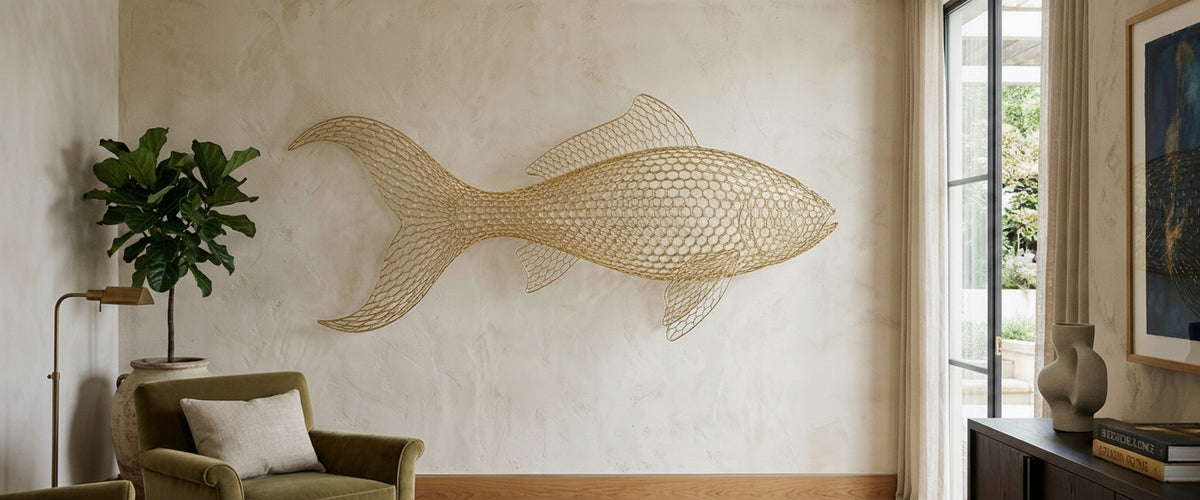
This is where dimensional metalwork earns its keep. On a long banquette wall that needs coverage without the solid mass of a boxed canvas, an open wire-formed piece such as the Gold Wire Honeycomb Fish Wall Art Sculpture - 370cm at 12 ft (370 cm) carries the full width while still reading as air and shadow, and that shadow changes as your lighting shifts from lunch to dinner service. Other pieces in our metal wall art collection follow the same logic at shorter spans.
Open wire-formed work covers a long span while shadow, not mass, does the visual work.

Grease, Heat and the Nightly Wipe-Down
Airborne fat travels. In rooms with open kitchens or plancha stations, a fine film settles on every horizontal edge within weeks, and it grabs dust. Your finish has to tolerate a degreaser and a cloth, over and over, for years.
What survives that regime: patinated bronze with a wax or lacquer coat, brushed and satin stainless, powder-coated steel, and sealed hardwood. What struggles: unsealed plaster, chalk-finish paint, raw MDF, and anything with a deep matte texture that traps residue in the grain. Wood pieces read beautifully in a warm room, and our wood wall art works well in the cooler zones of a floor plan; keep it away from the direct heat plume above a grill line.
Painted Mural or Relief Panel: An Honest Five-Year Comparison
An art restaurant wall painting, commissioned and applied straight onto the plaster, has real charm and an immediate story, especially when the artist works on site. It also lives or dies with the building. Five years in, a mural has usually taken chair-back scuffs, a plumbing repair patch, one lighting change that flattened its color, and a slow shift in tone from UV and cooking vapor. Touch-ups need the original artist, and artists move on.
A relief panel behaves differently. It is a discrete object with fixings, so it comes off the wall for a refit, moves to a second site, or gets re-hung after a repair. Bronze and stainless take cleaning without losing depth, and the relief profile hides minor surface marks that would show instantly on flat paint. If your lease is short or your group plans a second location, the movable piece is the better commercial decision.

Cuisine-Led Motifs Without the Cliché
The trap is literal illustration. Nobody needs another chili pepper. Work from the culture's material language instead of its menu photography.
Chinese restaurant wall art: lattice screens, cloud-scroll geometry, carp and crane forms rendered in brass or blackened steel rather than printed scenes.
Japanese restaurant wall art: restraint wins. A single long relief with wave or seigaiha rhythm, generous empty wall around it, and a raking light source.
Italian restaurant wall art: classical relief carries real weight in a trattoria. When a banquette wall wants one solid object rather than a framed print of Tuscany, a cast panel such as the Classical Cherub Subduing a Lion Bronze Relief - 70cm at 28 in (70 cm) holds its own at close seated range.
Indian restaurant wall art: pierced jali patterning, lotus and peacock geometry in cut metal, backlit so the shadow does half the work.
Mexican restaurant wall art: think Talavera color logic and folk-art line, translated into powder-coated steel or carved timber, not painted signage.
Our bronze wall art pieces suit rooms aiming for permanence and warmth; brushed stainless suits sharper, contemporary fit-outs.
Booth Walls, Pass-Throughs and Chair-Back Height
Here is a lesson we paid for once. A panel mounted with its lower edge at 38 inches (97 cm) behind a run of booths met a chair back within a month, and the finish showed it. Keep the bottom edge above 48 inches (122 cm) where chairs can reach, or accept that the piece needs a hard finish and a rail below it.
Other placement rules worth following: never center a piece on a wall if the servers' path cuts that wall in half; treat pass-throughs and column faces as frames, not obstacles; and check every proposed height against your pendant lighting so nothing casts a shadow across a guest's face.
Pre-Install Checklist
Confirm substrate: stud, masonry, steel frame or hollow partition, and locate services before drilling.
Specify fixings rated well beyond the piece's actual weight, with mechanical anchors rather than adhesive in any public space.
Check local fire code on wall-mounted decorative materials and combustible finishes; the NFPA is the reference point most US jurisdictions build from.
Send weight, fixing method and installer credentials to your insurer before install day, not after.
Book installation outside service hours and protect floors and upholstery; dust travels further than you think.
Agree a cleaning protocol in writing with your GM, including which products are safe on the finish.

Commissioning Bespoke Pieces at Scale
Bespoke work solves the problems a catalog cannot: an awkward wall length, a ceiling drop that kills standard proportions, a motif tied to your concept. At Giant Sculptures we build large-scale and bespoke wall pieces in bronze, stainless steel and engineered metalwork, sized to the wall rather than to a shipping carton. Start with photographs of the room from the seats that matter, your floor plan, and a note on kitchen proximity and lighting. Cost tracks material, scale, relief complexity, mounting engineering and site access, so ask for a tailored quote rather than working from a guess. Our full wall art and wall decor range is a useful place to test proportions before a commission conversation.
For wider placement ideas, Bronze Metal Wall Art: How Placement Changes What You See is useful companion reading before finalising the setting and sightlines.