




























































































Put a lacquer-bright pop figure on the same console as a plain matte cube, and within a week one of them will be losing the argument. That tension is the whole appeal of pop minimal figurative art as a collecting idea. Three strands of postwar art spent the 1960s disagreeing with each other, and you are asking them to share a room. Placed well, the disagreement reads as conversation. Placed badly, it reads as clutter with a theme.

At a Glance
Treat Pop, Minimalism and figuration as separate voices, not one decorative style.
Minimal pieces want floor and clearance. Pop figures want your eye line.
Two pieces in dialogue beat five pieces in a row.
Fix a reflective surface that overpowers its neighbor by changing the light direction. Hiding it is the wrong answer.
Edit a pop figure collection before it hardens into a period set.
Three 1960s Arguments: Pop's Gloss, Minimalism's Silence, Figuration's Body
Pop borrowed the finish and confidence of advertising: flat color, hard shine, instant recognition. Minimalism went the other way and stripped out reference, story and the artist's hand, leaving industrial forms that ask you to notice space, weight and your own position in the room. Tate's overview of Minimalism is a good primer on how literal those objects were meant to be. Figuration kept insisting on the body as something worth looking at.
Every piece of pop minimal figurative art leans toward one corner of that triangle. Work out which corner, and you already know half of where it belongs in your home.
What the Fisher Collection Teaches a Private Collector
Doris and Donald Fisher built one of the deepest private holdings of postwar American art. At SFMOMA it was presented as Pop, Minimal, and Figurative Art: The Fisher Collection. The title tells you the curatorial bet. The movements are set close together, so a screenprinted icon and a floor-bound steel piece can sit within sight of each other.
For a collector, the lesson is that a collection gets interesting where categories touch. The catch is space. A museum can give one minimal work many feet of clear floor, and a Manhattan apartment or a Malibu living room usually cannot. You make up for it by owning fewer pieces in each sightline, not by shrinking the gaps between them.
Give the Minimal Piece the Floor and the Pop Figure Your Eye Line
Most placement mistakes with pop minimal figurative art come from setting every piece at the same height. Minimal sculpture was made to share the floor with you. Keep it low, directly on the ground or on a plinth no higher than your knee, and leave walking clearance on at least two sides. Raise it to a shelf and it starts to look like a paperweight.
Pop figures work the opposite way. They were made to be read like a face on a billboard, so they need height. A figure of around 20 inches (50 cm), such as the Urban Pop Bear, suits a standard 36-inch (91 cm) console for exactly this reason: its head lands near the eye line of someone standing, which is where a pop figure starts to return your stare.

One Glossy Figure Beside One Matte Box: Why Pairs Beat Clusters
Two objects make a dialogue. Five make a shop window. Set a single lacquered figure, a Pop Art Gorilla for instance, against one patinated bronze block or Corten cube, and leave a gap at least as wide as the larger object. Each piece then frames the other.
One glossy figure, one quiet form, and a gap as wide as the larger piece.
A collector in Austin once sent us photos of six pop animals lined up along a limestone fireplace ledge. We suggested keeping the gorilla, moving one matte steel form beside it, and putting the rest into rotation. The ledge looked far more considered overnight, and the collector admitted the gorilla had never really been seen before.
When a Reflective Pop Surface Bullies a Quiet Cube
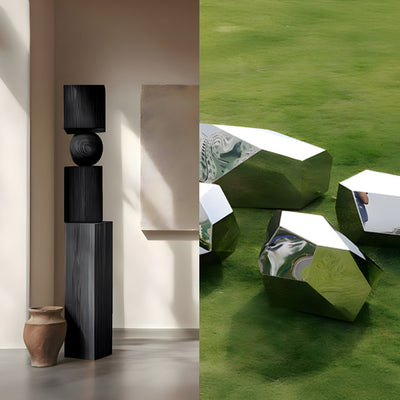
High gloss throws hotspots onto anything nearby, and a matte surface can't answer back. Light the glossy figure from above and slightly in front, steep enough that its reflection drops toward the floor rather than across to its neighbor. Give the minimal piece a broad, low-angle wash instead, so its texture and edges carry the drama.
Steep light on the gloss, a low wash on the matte piece.
Before anything leaves our studio we photograph it under both warm and cool light. Seen side by side, those photos make it obvious how much a gloss finish can dominate a shelf. Polished stainless steel commissions are even more assertive, so they need the same discipline outdoors, where low winter sun can turn a mirror finish into a floodlight.
When a Pop Figure Collection Tips Into a Period Set
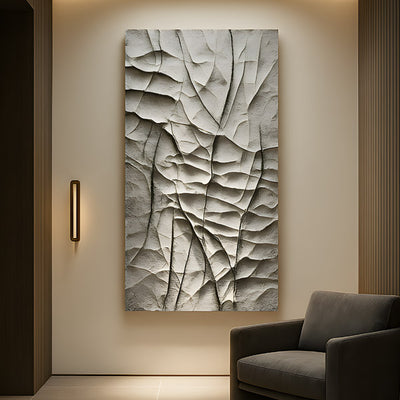
Pop figure collection art multiplies easily, because each new piece seems to fit. The warning signs are a single palette, the same decade of references, and a room that feels themed rather than collected. The fix is to add material contrast rather than another figure, which is what keeps pop minimal figurative art feeling like a conversation. A carved, matte surface on a nearby wall, such as the Poppy Blooms and Lobed Leaves Marble Relief - 80cm, gives the eye somewhere quiet to rest, and its flowers nod to pop's love of the motif without repeating its shine.

Buying Pop Minimal Figurative Art: A Collector's Checklist
Which corner does it lean to? Pop, minimal or figurative decides height and spacing.
Surface: gloss, satin, patina or raw stone, and what sits next to it.
Light source: where daylight and fixtures hit it, and what that bounce will touch.
Scale to sightline: photograph the spot from the doorway before you buy.
Indoor or outdoor: outdoor pieces in Napa or the Hamptons need bronze, stainless steel, Corten or stone suited to the local climate. Corten, for instance, struggles in salty coastal air.
Partner piece: know what the new work will be paired with, not just where it goes.
If the right partner piece doesn't exist yet, that is where a commission helps. Giant Sculptures makes bespoke pieces at architectural scale, from oversized pop figures in polished stainless steel to quiet bronze and stone forms built to stand beside them for decades. Budget depends on material, scale, complexity, engineering, installation and finishing, so we quote each pop minimal figurative art commission individually. Our figure art collection is a useful place to start, and our bestsellers show what other collectors are choosing.
For wider placement ideas, Why a Custom Figurative Bronze Sculpture Should Be Signed off on Site, Not in the Studio is useful companion reading before finalising the setting and sightlines.