






































































































Grease does not stay near the pan. It rides the steam column, spreads across the ceiling plane, and settles as a thin, sticky varnish on every surface within a few feet of the range. That is the single fact most people ignore when they buy metal wall art for a kitchen. A metal wall art kitchen scheme lives or dies on that film: the piece looks perfect on install day, and twelve months of searing, frying and boiling later, the finish tells you whether you chose well.

Key Takeaways Before You Buy
Keep at least three feet (about 900 mm) of clearance between the cooktop and any metal wall art kitchen piece, more if you cook with high heat.
Powder-coated steel and brushed stainless survive weekly cleaning. Lacquered and waxed finishes do not.
Size the piece to the length of the cabinet run behind it, not to the dining table in front of it.
Ceiling downlights flatten shallow texture and exaggerate deep relief. Check the light before you commit to a surface.
Tile, plasterboard and glass splashbacks each want a different fixing, and one of them refuses anchors entirely.
Weight and bracket choice need extra care in a metal wall art kitchen install, because the wall behind may hide pipework, wiring and cabinet carcass fixings.
The Cooktop Wall Is a Trap
Designers love the wall above and beside a range. It is the natural focal point, it sits at eye level, and it is usually the only large uninterrupted plane in the room. It is also the worst environment in the house for a finished metal surface. Radiant heat from a gas burner, airborne fat, and repeated condensation cycles will attack anything that relies on a clear topcoat. On the metal wall art kitchen projects we quote for, we push the artwork onto the adjacent wall or the far end of the run and leave plain tile or stainless directly behind the burners instead. The rule we hold to is a minimum of three feet (about 900 mm) of horizontal clearance from the nearest burner, and never directly above a cooktop that has no downdraft or hood.
Clearance is the first design decision in any metal wall art kitchen layout: keep wall-mounted metalwork at least three feet from the nearest burner.

Steam Rises and Grease Travels: Which Finishes Hold Up
Extraction changes everything for metal wall art in a kitchen. A properly specified hood captures most of the plume at source, and the Home Ventilating Institute publishes independent airflow ratings worth checking against your range output before you decide where art can safely live. Under-powered or recirculating units let the grease escape sideways, and it lands on your walls.
Lacquered steel is where most metal wall art kitchen buyers get caught. Fresh from the workshop it looks superb, deep and glossy. After a year in a working kitchen, the lacquer has micro-crazed where heat cycled it, grease has bonded into those hairline breaks, and every attempt to clean it leaves a dull cloudy patch. Raw and waxed steel is worse. Wax is a sacrificial layer by design; a degreasing spray strips it in one pass, and the exposed steel starts speckling within weeks in a humid room.
Powder coating is the finish we specify for almost all interior metal wall art in kitchen settings. The coating is electrostatically applied and oven-cured into a continuous thermoset film, which is why the Powder Coating Institute rates it so highly for chemical and abrasion resistance compared with conventional wet paint. In practice that means you can wipe it weekly with warm water and a mild detergent for years without the color shifting. Brushed or satin stainless is the other reliable option; it hides fingerprints better than mirror polish and takes a degreaser without complaint.
Size to the Cabinet Run, Not the Dining Table
The most common sizing mistake we see in metal wall art kitchen projects is buyers measuring against the furniture instead of the architecture. Kitchens are built on horizontal rhythms: the base run, the upper cabinets, the counter line, the backsplash band. Artwork that ignores those lines looks like it landed by accident. Take the length of the uninterrupted cabinet run or wall bay and aim for a piece covering roughly two-thirds of it. In a galley layout with a short bay, a single vertical relief works better than a wide horizontal panel that crowds the returns.
Depth deserves the same thought, whatever the material. Anything projecting more than a few inches into a walkway becomes a hazard in a room where people carry hot pans. A layered relief such as Aurelian Butterfly Display Acrylic 3D Wall Art earns its projection on a breakfast-nook wall or a dining-side return where nobody brushes past, but the same depth becomes an obstacle in a tight passage between island and counter, where a near-flat metal wall art kitchen panel is the safer specification.

Downlights, Extractor Shadows and Flat Texture
Kitchen lighting is almost always ceiling-mounted and almost always pointed straight down. That vertical wash is brutal on wall-mounted metal, so test the light before you commit to a texture for kitchen metal wall art. Shallow hammered or brushed surfaces disappear completely under a downlight, because there is no raking angle to throw a shadow. Deep relief goes the other way and casts hard black bars across itself. Before choosing a surface, stand in the room at night with the working lights on and hold a sample or a piece of card against the wall. If the hood over your island throws a shadow across the display wall, favor a bolder silhouette and a satin finish that picks up ambient bounce rather than fine tooling that will vanish. Work built around one legible outline, in the manner of Blossomkin Elephant 3D Floral Wall Art, holds its form under flat downlight where a finely textured surface simply reads as a blank sheet.
Under a vertical downlight wash, silhouette does the work that fine surface tooling cannot.
Warm Brass Against Gray Cabinetry, Matte Black Against Oak
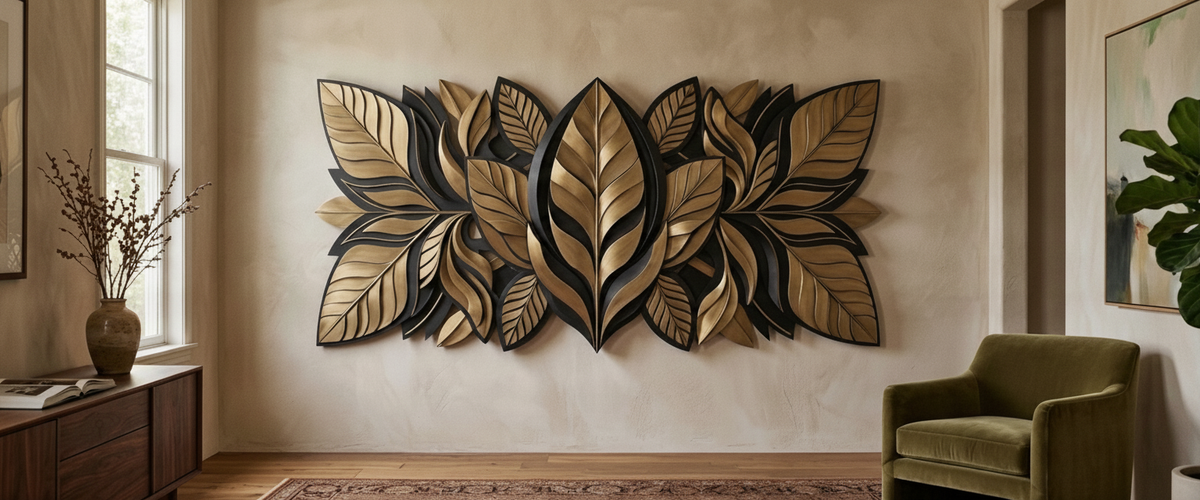
Color pairing is where a metal wall art kitchen either resolves or fights itself. Brushed brass and bronze tones work hardest against cool gray or blue-gray cabinetry; the warmth keeps the room from reading clinical, and it ties into faucet and handle hardware without matching it exactly. Matte black does the opposite job. Against white oak, walnut, or terrazzo with visible aggregate, black graphic forms give the eye a hard anchor among all that grain and speckle. Where the room needs that hard anchor rather than warmth, Panthra Shadow Black Acrylic Stripe 3D Wall Art is closer to the right design language: strong outline, restrained surface, nothing competing with the countertop. Browse the full metal wall art range with your cabinet samples in hand rather than from memory.
Fixing Into Tile, Plasterboard and Splashback
Three surfaces, three answers, and each one changes how metal wall art in a kitchen has to be mounted. Ceramic or porcelain tile takes a fixing well if you drill slowly with a diamond-tipped bit and land the anchor in the substrate behind, not in the tile body. Plasterboard needs the right hardware for the load: toggle or spring anchors for anything of real weight, and ideally a stud for heavier engineered panels. Glass splashbacks are the ones that refuse anchors. Toughened glass cannot be drilled after tempering, and attempting it will shatter the panel. If your design puts artwork over glass, the fixing has to go above or beside it, or the piece needs a standoff frame anchored into the adjacent wall. Sort this out before you order, because bracket design for a metal wall art kitchen install is far easier to change at the drawing stage than on install day.

Metal Wall Art Kitchen Pre-Install Checklist
Measure the cabinet run and the clear wall bay, then confirm the two-thirds coverage figure.
Confirm at least three feet (about 900 mm) of clearance from the nearest burner.
Check your extraction type: ducted, recirculating, or none. It dictates finish choice.
Identify the wall substrate and locate studs, pipework and cabinet fixings.
Test the piece's projection against walkway width with a taped cardboard mock-up.
View a finish sample under the actual kitchen lighting, at night.
Agree the fixing method and hardware for your metal wall art kitchen piece with the maker in writing before production.
Commissioning Bespoke Metal Wall Art for Kitchen Spaces
Kitchens are rarely standard, which is why so many metal wall art kitchen projects end up as commissions. A bespoke panel can be cut to the exact bay width, coated in a color drawn from your cabinetry sample, and built with a concealed rail so the whole piece lifts off for a deep clean twice a year. That last detail is the one clients thank us for later. Budget depends on material, scale, relief depth, coating specification and how the piece is engineered to mount, so the sensible next step is to share your kitchen elevations and ask for a tailored quote. If you want to compare formats first, the 3D wall art and broader wall art and wall decor collections show how depth and silhouette behave at different sizes. Giant Sculptures builds large-scale and bespoke work for homes and hospitality venues worldwide, and a metal wall art kitchen commission gets the same engineering attention as an outdoor bronze.
For placement ideas beyond the metal wall art kitchen brief, Metal Sculpture Wall Hangings: Two Picture Hooks Will Not Cut It is useful companion reading before finalizing the setting and sightlines.