






































































































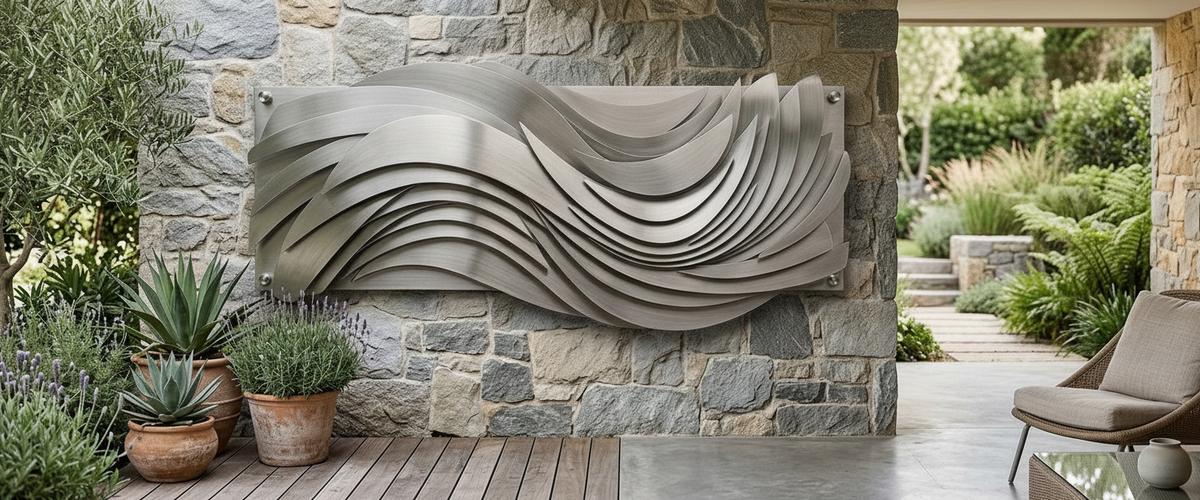

Metal sculpture wall hangings almost never fail at the sculpture. They fail an inch behind it, at a fixing someone chose in thirty seconds because the piece "felt about the same as a mirror." We have seen a beautifully fabricated brushed steel panel come off a hallway wall in a Dallas new build because two toggle anchors were carrying a load that wanted four points and a cleat. The metal was fine. The plasterboard was confetti.
Looking for the full range in this category? Browse our Metal Sculptures collection for every available finish, size, and configuration.

Key Takeaways Before You Drill
Wall build matters more than weight. Metal sculpture wall hangings at 40 lb (18 kg) sit happily on solid brick; the same panel on hollow plasterboard is an engineering decision.
A French cleat spreads load along a horizontal rail and sits the work close to the wall. Standoff bolts push it forward and create a shadow line.
Anything over roughly 3 ft (0.9 m) wide should hit structure: studs, blockwork, or a resin-anchored backing rail.
Large metal panels expand, contract, and rattle. Isolation pads and a slight fixing tolerance stop the noise.
Take five measurements first. Two of them are about the wall, not the art.
Two Picture Hooks and a Prayer: How Weight Actually Loads a Wall
A picture hook works in shear. The nail sits at an angle, the load hangs straight down, and the wall face resists it. Metal sculpture wall hangings change that arithmetic, because most of them stand proud of the wall. The moment the center of mass moves forward, the top fixings start being pulled out of the wall rather than pressed down against it. That pull-out force is what tears plasterboard.
Rule of thumb from our workshop: the further the piece projects, the more the top fixings are doing and the less the bottom ones are. A flat 1 in (25 mm) deep panel loads almost vertically. A layered piece that stands 5 in (125 mm) off the wall is levering against the top row all day.

Plasterboard, Brick and Rendered Block: What Each One Will Genuinely Hold
Plasterboard over timber studs. The board itself carries very little. Everything meaningful goes into the studs, usually spaced 16 in (400 mm) apart in US construction. Hollow-wall anchors have real published limits and those limits assume perfect installation in undamaged board; the Gypsum Association guidance on board performance is worth reading before you trust a toggle with anything substantial.
Solid brick. The friendliest wall you will meet. Drill into the brick body rather than the mortar joint wherever you can, and use a sleeve or resin fixing sized to the load.
Rendered concrete block. Deceptive. The render feels solid, then the drill drops into a void. Blockwork with cores needs a longer fixing and often a resin anchor to bridge the void wall.
Exterior walls with insulation or rainscreen. Never fix into cladding. Find the structural substrate behind it and specify a fixing that clears the insulation depth without crushing it.
French Cleat or Standoff Bolts: The Same Panel, Two Completely Different Looks
Two systems carry most metal sculpture wall hangings, and they read very differently once the piece is up. A French cleat is two interlocking angled rails, one on the wall and one on the back of the sculpture. It spreads load across a long horizontal line, forgives small errors, and lets one person lift a heavy panel into place and feel it drop home. It also sits the work tight to the wall, which suits dense, textured pieces where you want the sculpture reading as a surface.
A cleat rail fixed into two studs turns a point load into a line load across the wall.
Standoff bolts do the opposite. Four to six machined barrels hold the panel forward, so the wall becomes background instead of backing. For a hallway or stair core where the wall is a good color, that gap earns its keep. Small suspended pieces sidestep the debate entirely: at 22 cm (roughly 9 in), something like the Black Suspended Swallow Bird Sculpture (Wings Swept Back) - 22cm is light enough for a single-point fixing, so the difficulty moves from load path to spacing and flight direction across the wall.

Standoff Depth and the Shadow Line
Standoff depth is a design control, not a hardware afterthought. At 0.5 in (13 mm) you get a hairline gap and the panel reads flat. At 1.5 in (38 mm) the shadow under a polished stainless edge becomes a second drawing on the wall, shifting through the day. Go deeper than about 2 in (50 mm) and you need to think about lever arm and fixing count again.
Standoff barrels lift the panel forward so the shadow line moves with the daylight.
Framed and glazed hanging works sit in their own category. A rigid perimeter piece such as the Glacia Jellyfish Crystal Hanging Framed Wall Art carries its weight in the frame rather than across a fabricated back, so the top rail has to be dead level or the frame telegraphs the error instantly.
Hanging into Studs You Cannot See, and When to Bring in a Resin Anchor
Stud detectors lie near pipework, foil-backed insulation, and metal framing. Confirm with a fine bradawl probe before you commit to a hole you cannot hide. When studs do not land where the composition needs them, the professional answer is a backing rail: a steel or hardwood batten fixed into two or more studs, with the sculpture hung anywhere along its length.
Resin anchors come in when the substrate is variable: perforated block, old lime-bound brick, or masonry near an edge where an expansion bolt would split it. Injected resin bonds along the full depth of the hole instead of wedging outward, which is why it is the standard choice for heavy exterior metalwork.
Why Big Panels Move: Thermal Expansion, Door Slams and Rattle
Metal is dimensionally honest. Austenitic stainless steel expands more than mild steel across a temperature swing, which matters on a sun-facing garden wall or a glazed atrium; the British Stainless Steel Association publishes the expansion figures if you want the numbers. On a panel of any real width, fully rigid fixings at both ends leave nowhere for that movement to go, so it goes into stress or noise.
The fix is undramatic. Slot one set of fixing holes so the panel can breathe, and put thin neoprene washers between metal and wall. That also kills the buzz you get when a hollow stud wall carries the vibration of a slammed door. We learned that on a large hallway commission where the client could hear the sculpture every time the mudroom door closed.

Five Measurements to Take Before Anyone Drills
These are the five numbers that decide how metal sculpture wall hangings get fixed, and in what order the work happens on site.
Finished weight of the piece, including frame, backing rail and fixings.
Projection depth from wall face to the furthest forward point, which drives pull-out load.
Wall build-up: board thickness, cavity depth, and what the structural layer actually is.
Stud or joint spacing, mapped and marked before the sculpture arrives.
Sight line height, measured from the position people will usually stand, not from a tape on the floor.
Choosing Metal Sculpture Wall Hangings for the Space You Have
Scale first. A 4 ft (1.2 m) piece on an 18 ft (5.5 m) double-height wall in an Aspen great room will look apologetic. Tall rooms need vertical answers, and at 230 cm (about 7.5 ft) the Teal Resin Botanical Wall Feature Sculpture - 230cm is the kind of single vertical run that holds a stairwell elevation without a second piece propping it up. Then finish: brushed stainless steel for cool daylight, patinated bronze for warmth, Corten for exterior walls where you want the color to keep developing. Then viewing distance, because deep relief reads well across a room and flattens up close.
Commissioning a Bespoke Wall Piece
Bespoke metal sculpture wall hangings let you fix the geometry to the wall rather than the other way around: fixing centers set to your stud spacing, panel splits sized to fit an elevator, standoff depth chosen for the light you actually get. Budget depends on material, scale, complexity of the metalwork, engineering, installation and finishing, so send us the wall photos and dimensions and we will quote it properly. Ask for the fixing schedule as part of the commission; a maker who cannot tell you how their work attaches has not finished designing it.
For wider placement ideas, Metal and Wood Wall Art: What a Sculptor Weighs Before Saying Yes is useful companion reading before finalising the setting and sightlines.