





































































































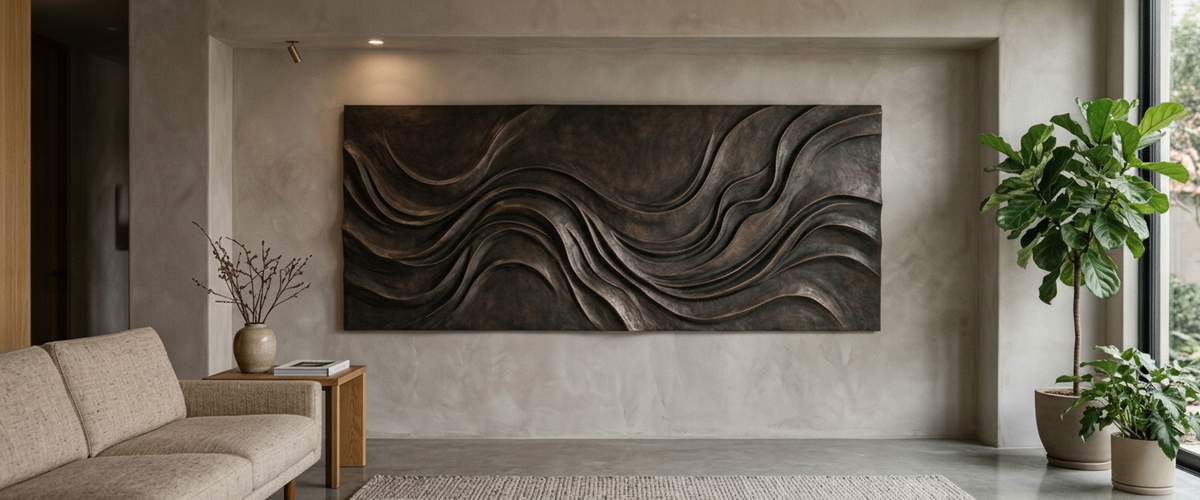

Hang a piece at the standard 57 inches (145 cm) to center and you have hung it for people standing up. A dining room is the one room where your audience spends the whole evening sitting down. Eye level drops by roughly a foot for two hours, and the dining room art you measured so carefully now floats above the conversation like a notice board. Getting this right is less about taste than geometry, light and material behavior.

Key Takeaways
Drop your center line. Seated eye level lands around 44 to 48 inches (112 to 122 cm) off the floor, not 57 inches (145 cm).
Scale to the table length, not the wall width. A long table wants a long piece.
Candlelight and pendants throw light upward, which flatters carved relief and kills flat gloss.
The damage zone is predictable: steam on the serving side, soot above candles, grease near a pass-through.
Test any piece from the far chair, eight to ten feet (2.4 to 3 m) away, before you commit.
Drop the Center Line: Why 57 Inches Fails at the Table
The 57-inch rule comes from galleries, where visitors walk past on their feet. Move it into a dining room and the bottom edge of the work sits in the diner's peripheral vision while the top edge drifts toward the ceiling. Set your center line for a seated head instead. Sit in the chair opposite, look straight ahead, and mark the wall. That mark is usually 44 to 48 inches (112 to 122 cm) from the floor depending on chair height. Set the center of the artwork a few inches above it, so the seated sight line lands in the lower half of the piece rather than dead center.
One caveat. If the room doubles as a circulation route, split the difference so the piece still reads on approach. Where a sideboard sits below, clear its top by 6 to 10 inches (15 to 25 cm) so the work and the furniture read as one group rather than two stacked objects, and allow more than that if the sideboard carries hot service.
Seated sight line at roughly 44 to 48 inches (112 to 122 cm) from the floor, with the center of the work just above it.

The Far-Chair Test for Dining Room Art
Before anything gets fixed to a wall, we ask clients to run what our installers call the far-chair test. Cut paper or card to the outline of the piece, tape it up at the seated center line, then sit at the opposite end of the table and look at it for a full minute. Detail that reads beautifully from three feet often disappears from ten. Fine line work, subtle glaze variation and small signatures vanish. Mass, silhouette, shadow depth and a single strong gesture survive. That test has changed more commissions than any mood board we have ever been sent.
Candlelight Goes Up, Gloss Throws It Back
Dining rooms are lit from below and from the middle. Candles push light upward at a shallow angle. Pendants hang low over the table and spill sideways. Both conditions are hostile to high-gloss surfaces, which mirror the pendant bulb straight back into a guest's eye. Satin, matte, hand-patinated bronze and honed stone absorb that raking light and hold their form instead.
If you are lighting the artwork itself, keep the beam off-axis and the intensity modest. Heat, wax vapor and soot are already at work in this room, so the surface needs a maintenance plan as much as a lighting plan. The V&A's guidance on caring for metals is a sound starting point for patinated bronze living near candles.
Scale to the Table, Not the Wall
Designers often size dining room art to the wall, then wonder why it feels unmoored. The table is the visual anchor of the room, so the artwork should answer to it. A reliable working ratio is two-thirds to three-quarters of the table length for a single piece hung on the long wall behind it. A 10-foot (3 m) table can carry a piece around 7 feet (2.1 m) wide without crowding. Go smaller and the wall swallows it.
Height matters just as much in rooms with tall ceilings. One dining room we supplied had 14-foot (4.3 m) walls and a narrow refectory table; the answer was a vertical bronze relief rather than a wide horizontal one, so the piece rose with the room while staying proportionate to the table below. Browse the dining room art collection with a tape measure on the table, not the wall, and the shortlist shrinks fast.

Why Carved Relief Beats Flat Canvas Under Low Light
A flat canvas needs even, front-facing light to show what it is doing. Dim the room for dinner and it goes gray. Carved and cast relief works the opposite way: the lower and more angled the light, the deeper the shadow, and the more the surface comes alive. Bronze relief panels, carved stone, cast marble and engineered metalwork all hold their read at candle level. That is why so many of our bronze commissions end up in dining spaces rather than hallways.
Depth of relief is the variable to discuss at commissioning stage. Shallow bas-relief of half an inch (13 mm) or so gives a quiet, architectural effect. Deeper modeling reads dramatically at night but can look busy under bright daytime light, so consider how the room is used across a full day.
Raking light from candles and low pendants deepens shadow across a cast bronze relief.
Steam on One Side, Soot Above the Candles
Damage in dining rooms is not random. It starts in two predictable places: the serving side, where a warming dish or an open kitchen doorway sends steam up a wall, and the strip directly above a candelabra, where soot and wax vapor deposit a fine gray film over months. Neither is dramatic on day one. Both are visible after two winters.
Practical fixes: keep the bottom edge of any piece at least 18 inches (46 cm) above a sideboard used for hot service, avoid hanging directly over a permanent candle position, and dust patinated bronze with a soft dry cloth rather than a damp one. Sealed stone and stainless steel tolerate the environment better than paper-based works or unvarnished canvas, which is a genuine argument for sculptural wall art in a room that generates heat and moisture nightly.
Warm Timber, Cool Plaster and Painted Paneling
Read the backdrop before you choose a finish. Warm walnut or oak paneling pulls yellow out of a surface, so golden or light-brown bronze patinas can disappear into it; a darker chocolate or verdigris patina separates cleanly. Cool white plaster does the reverse, making warm metals glow and flattening cool grays. Painted paneling adds a third problem, because the molding grid competes with the artwork's own frame. On paneled walls, a single piece centered within one panel field almost always beats a group.

Your Dining Room Art Checklist
Mark the seated eye line from the chair opposite, then set the artwork center just above it.
Size to two-thirds or three-quarters of the table length.
Mock up in paper and run the far-chair test at eight to ten feet (2.4 to 3 m).
Turn the pendants on at night and check for specular glare before buying a glossy surface.
Map steam, candle and grease zones, then keep the piece out of them.
Match patina or stone tone against the actual wall color, not a swatch.
Confirm wall construction and fixings for the real weight, especially for cast metal or stone.
Ask whether the work will be seen mostly by day, by candlelight, or both.
Can You Hang Art on Every Wall?
You can, but a dining room rarely wants it. Guests face each other, so the wall behind each principal seat is doing the heaviest visual work, and two competing statement pieces on opposing walls create a tug-of-war. A stronger arrangement is one dominant piece, one supporting piece on a perpendicular wall, and deliberately empty space elsewhere. Rooms with a window wall and a fireplace often only have one honest place for art anyway.
Commissioning at the Right Scale
Where a stock piece cannot meet the table length, a bespoke commission solves the proportion problem outright. At Giant Sculptures we work from the room's measurements backward: table length, seated sight lines, ceiling height, wall build-up and the lighting already installed. Material, size, complexity, engineering, finishing and installation all feed into cost, so the sensible route is to send dimensions and photographs of the space and ask for a tailored quote rather than guessing from a catalog. Start from our dining room art range to set a direction, then talk to us about scaling, patina and fixing before anything is cast.
For wider placement ideas, The Ceiling Is Half the Artwork: Buying an Indoor Hanging Reflective Sculpture is useful companion reading before finalising the setting and sightlines.