



































































































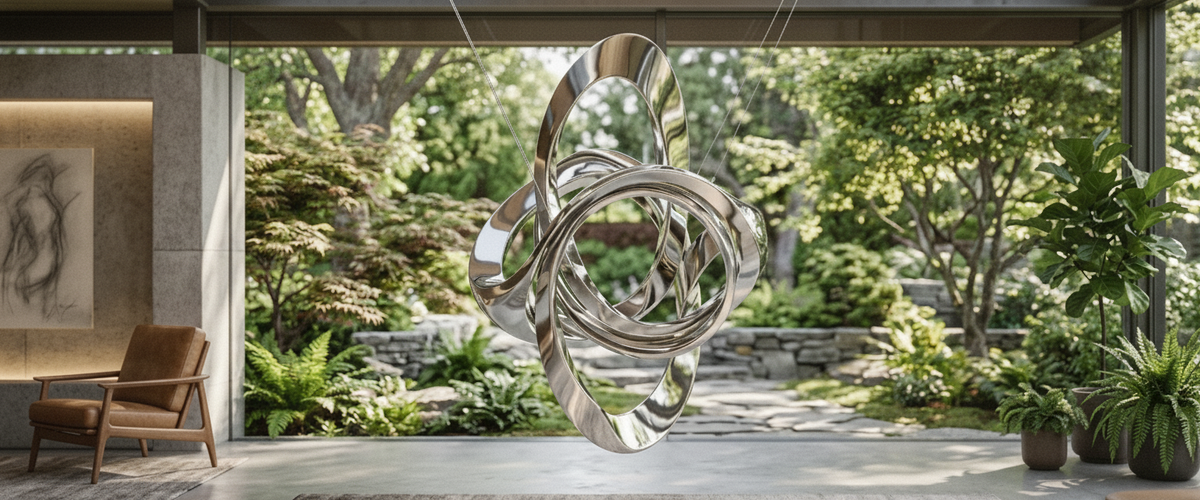

A mirror-polished form that reads beautifully at eye level on a studio floor can behave like a searchlight once it is 16 feet (4.9 m) overhead. That gap between how a piece looks on a plinth and how it performs in the air is the most common surprise for buyers choosing an indoor hanging reflective sculpture. Suspension changes what the object actually is. It stops being a shape and becomes a lens for the ceiling plane, the floor pattern, the window wall and every downlight in the room, handing all of it back to whoever walks underneath.
Looking for the full range in this category? Browse our Hanging Sculptures collection for every available finish, size, and configuration.

Key Takeaways
Finish sets the mood before form does: mirror polish throws hard images, satin diffuses them, faceted chrome breaks them into fragments.
Drop height is a sightline calculation, not a proportion rule. Atriums and stairwells behave completely differently.
Rotation helps geometric abstraction and hurts figurative work that has a front.
Glare is designed out at the lighting plan stage, not fixed later with a dimmer.
Polish demands a cleaning rhythm. Plan access before the piece is hung, not after.
Ceiling capacity, not budget, is often the real constraint, which is where crystal and cast acrylic earn their place.
Mirror Polish, Satin and Faceted Chrome Each Hand You Back a Different Room
Finish is the first real decision on any indoor hanging reflective sculpture, and it shapes the mood of a room more decisively than silhouette does. Mirror polish on stainless steel is the most literal of the three. It returns recognizable images: the coffered ceiling, the chandelier, the person standing below. In a room with something worth reflecting, that is a gift. In a room with a busy ceiling grid or exposed services, it is an audit you did not ask for. Satin and brushed finishes soften everything into light rather than picture, which is why they work so well above dining tables and reception desks where you want glow, not a portrait of the sprinkler heads.
Faceted chrome sits between the two. Each plane grabs a separate slice of the room, so the piece shimmers as you move without resolving into one clear image. We often steer clients toward faceting when the ceiling is honest industrial concrete and a full mirror would simply broadcast it. Browse our stainless steel sculptures and you can see how much personality shifts between finishes on near-identical forms.
Mirror polish hands back a recognizable image of the ceiling plane; satin turns the same form into glow.

Once It Hangs, the Ceiling Plane and the Floor Pattern Join the Artwork
Look up before you buy. An indoor hanging reflective sculpture inherits whatever is above and below it, which means your flooring becomes part of the composition. Wide-plank oak reads as warm horizontal bands. A marble medallion under a spherical piece produces a beautiful concentric pull. A high-contrast checkerboard, on the other hand, will fight a mirror finish and turn it into visual noise.
One Manhattan client learned this usefully. The brief was an indoor hanging reflective sculpture in New York for a Tribeca duplex with a black-and-white stone entry floor. The mirror-polished proposal turned into flickering chessboard confusion every time someone walked through. We rebuilt the concept in satin stainless with a single polished interior face, so the floor pattern only appeared as a soft ghost inside the form. Same sculpture, entirely different behavior.
Drop Heights That Work in an Atrium and Fail in a Stairwell
In a double-height atrium, you are hanging an indoor hanging reflective sculpture for two audiences at once: people at ground level looking up, and people on the mezzanine looking across. The sweet spot tends to be a drop that places the visual center of the piece slightly below the upper floor level, so the mezzanine viewer gets a three-quarter view and the ground-floor viewer gets an underside with depth.
Stairwells punish the same logic. A stair is a moving sightline, and a piece hung at a single fixed height will be crowded at one landing and invisible from another. Vertical, cascading compositions solve this far better than compact ones. Give the piece 8 to 12 feet (2.4 to 3.7 m) of vertical development and every landing gets its own view. Two hard rules we apply on every commission: keep a minimum of 7 feet (2.1 m) of clear headroom under the lowest point in any circulation path, and check the swing envelope if the piece can move at all.
A vertically developed drop gives every stair landing its own view instead of one privileged sightline.
Slow Rotation Versus Locked Orientation
Swivel fittings sound romantic, and on the wrong indoor hanging reflective sculpture they are simply a mistake. Rotation suits radial and geometric abstraction, where every angle is a valid composition and the slow turn reveals new reflections through the day. It undermines anything with a designed front: a figurative form, a logo-derived shape, or a piece whose silhouette was resolved for one specific approach. Nothing deflates a commission faster than a client's signature view drifting to face the coat closet.
If you do want movement, specify a damped bearing rather than a free swivel. Free-spinning pieces respond to HVAC drafts and never settle. A damped unit turns slowly and holds position, which is what most people picture when they ask for rotation in the first place.

Window Glare, Downlights and the Hot Spot on the Landing
A polished convex surface concentrates light. Put a narrow-beam downlight directly above an indoor hanging reflective sculpture with a mirror finish and you create a fixed hot spot that will find someone's eyes at a predictable spot on the floor. West-facing glazing is worse, because late afternoon sun sweeps the reflection across the room like a slow beam.
The fix is coordination with the lighting designer before installation. Wide-beam or wall-grazing fixtures, offset at 30 to 45 degrees from vertical, light the form without the specular punch. Where daylight is strong, a satin finish on the sun-facing side and polish on the interior gives you brilliance without the discomfort; the Illuminating Engineering Society publishes useful guidance on managing discomfort glare in occupied spaces, and the same principles apply to sculpture. Test with a handheld light at the model stage. It takes ten minutes and saves a re-hang.
The Cleaning Rhythm a Polished Surface Quietly Demands
An indoor hanging reflective sculpture stays cleaner than a floor piece because nobody touches it, but dust settles on upper surfaces and reads badly under raking light. Build a simple routine:
Every month: dry microfiber pass on accessible upper faces using a soft extension tool.
Every quarter: full clean with warm water, a drop of pH-neutral detergent, then dry immediately to prevent water spotting on polish.
Never: ammonia-based glass cleaner, abrasive pads, or anything silicone-heavy that hazes over time. The American Institute for Conservation is a sound reference on handling polished metal surfaces.
Annually: have a rigger inspect cable terminations, shackles and the fixing point. Hardware fatigue is silent.
Before you buy: confirm how the piece will be reached. Scissor lift, tower scaffold or a lowering winch built into the mount.
That last point is the one buyers skip. We now specify a discreet lowering mechanism on most atrium commissions because a sculpture nobody can clean stops looking like a sculpture within two years.
Crystal and Cast Acrylic When the Ceiling Load Is the Limit
Plenty of beautiful interiors simply cannot carry steel overhead. Timber joists in a renovated Napa farmhouse, a suspended plasterboard ceiling in a Dallas office fit-out, a historic structure where drilling is restricted. Cast acrylic and crystal elements give you refraction and sparkle at a fraction of the weight, and a multi-element acrylic cluster spreads its load across several points instead of one. The trade-off is honest: acrylic scratches more readily than stainless and needs gentler cleaning.
Where the fixing restrictions are absolute and nothing at all can come off the ceiling, the reflective effect can move onto the wall plane instead. A framed, mirrored piece such as Reverra Starry Night Over The Rhone Hanging Frame Wall Art carries light and depth from a single standard wall fixing, with none of the structural review, rigging access or lowering hardware a suspended commission brings with it. You lose the underside view and the slow turn, which is a real loss in an atrium, but in a corridor, stair landing or lift lobby the wall plane is often where people actually stand and look anyway.
Always get a structural opinion before specifying an indoor hanging reflective sculpture over 100 pounds (45 kg). Our engineering drawings go to the project structural engineer as standard, and on retrofits we frequently redesign to spread load across two or three points rather than fight for one heroic fixing.

Commissioning One Properly
A good indoor hanging reflective sculpture brief starts with documents rather than sketches. Bring us the ceiling section, the reflected ceiling plan, the lighting schedule and a photograph looking straight up from the intended standing point. From there we work through finish samples at full scale, a maquette or digital study hung in context, and a fixing strategy signed off with your engineer. Cost depends on material, scale, complexity, engineering and installation access, so we quote each piece individually rather than from a list. If you are weighing a suspended commission against a floor-standing one, our abstract sculpture collection is a good place to compare how the same language behaves at ground level, and Giant Sculptures can take a concept from sketch to installed artwork wherever the site happens to be.
For wider placement ideas, Where an Indoor Tiger Statue Actually Works is useful companion reading before finalising the setting and sightlines.