







































































































Most tiger statues fail in the first five seconds, and the foundry is rarely to blame. A prowl is a sideways pose, yet buyers keep setting the animal at the end of a driveway with its nose pointed at the front door, where the whole body collapses into a head and two shoulders. Prowling tiger garden statues reward a different kind of planning: a lower base, a longer sightline, and a path that walks visitors past the animal instead of straight at it.
Quick Answer
Show the flank. The realism of a prowl lives in the spine and shoulder blades, which only read in profile or at three-quarters.
Keep it low. Set the tiger at or near ground level so the eye meets it the way you would meet a real animal in cover.
Route people past it. Lay paths and seating so the first view is side-on.
Anchor through the paws. A low profile does not mean a light one; cast bronze needs proper pinning into a footing.
Trust chased stripes. Stripes cut into the bronze surface read further than painted ones and age with the patina.

The Prowl Is a Horizontal Pose
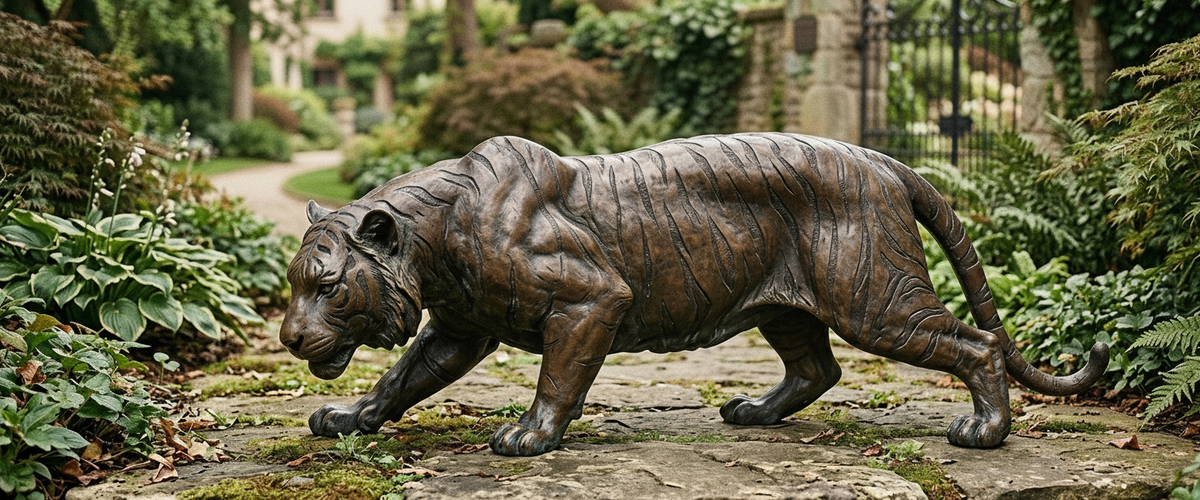
A standing or seated big cat has a vertical silhouette you can read from almost anywhere. A prowling tiger is the opposite. The head drops below the line of the back, the shoulder blades ride up and roll with each step, and the spine runs in one long, slightly sagging curve to the base of the tail. Tigers hunt by stalking low before the rush, as the Smithsonian's National Zoo notes, and a good sculptor builds the whole piece around that tension in the forequarters.
That is why we spend so long in the studio modeling the shoulders of every prowling tiger before any casting begins. On a life-size prowling tiger, the raised scapula on the leading side is the single detail that makes visitors slow down. If you cannot see it, you have bought an expensive outline.
Seen in profile, the raised shoulder and dropped head carry the whole pose.
Why a Head-On View Flattens the Animal
Approach a prowling tiger face-first and the length disappears. The low head masks the shoulders, the body foreshortens behind it, and from 30 feet (about 9 m) away the bronze reads as a dark, shapeless mass on the lawn. Catalog photographs of prowling tiger garden statues rarely warn you of this, because they are almost always shot from a flattering three-quarter angle; standing in the garden is another matter.
A typical case: a tiger set dead center at the end of a gravel drive, facing the house. From an arriving car it looks like a boulder with a face. Re-pinning it roughly 60 degrees round on the same footing, so cars catch the flank instead, solves the problem. Same sculpture, entirely different presence.
Keeping Prowling Tiger Garden Statues at Ground-Level Eye Line
Plinths suit lions and stags. They rarely suit prowling tiger garden statues. Lift a crouched cat onto a waist-high block and it stops stalking and starts posing. Keep the base at or just above grade and let the setting do the framing.
Three settings work consistently. Long, loosely mown grass or ornamental grasses around the paws suggest cover and hide the base plate. A raked gravel bed gives a clean, desert-garden contrast that suits Texas and Southern California properties. A terrace edge lets the tiger appear to step off the stone, which works well where the lawn falls away below.
Scale follows the setting. In a planted border or a Napa or Hamptons courtyard, a casting around 5 ft 11 in long, such as the Life-Size Traditional Prowling Tiger Bronze Sculpture, 180cm, holds its own without overpowering the space. On an open lawn with a long approach, the extra length of the Life-Size Traditional Prowling Tiger Bronze Sculpture, 220cm (about 7 ft 3 in) lets the spine and that raised shoulder carry from much further away.

Lay the Path So Visitors Meet the Tiger Side-On
Placement is half the job with prowling tiger garden statues; circulation is the other half. Before you fix the footing, walk the route guests will actually take: from parking, from the terrace doors, from the pool house. The first full view should be the flank or a three-quarter angle, ideally with the head turned slightly toward the viewer.
A path that curves past at 10 to 15 feet (3 to 4.5 m) works better than one that terminates at the sculpture. If you want a moment of surprise, let planting hide the tiger until the path bends, then reveal it in profile. A simple test before anyone pours concrete: cut a sheet of plywood to the sculpture's footprint, lay it on the proposed spot, and photograph it from each approach.
A path that bends past the tiger delivers the first view at three-quarters.
Low but Not Light: Pinning a Cast Bronze Tiger Through the Paws
A crouching pose looks stable, so buyers assume it can simply sit on the ground. It cannot. Prowling tiger cast bronze garden statues are heavy, carry their weight over small contact points, and attract climbers, curious dogs and, occasionally, thieves. Our standard approach is to fit threaded stainless steel rods through the paws, bonded into a reinforced concrete footing sized to the specific casting and soil.
The pinning plan should be agreed before casting, because the foundry needs to set internal fixings in the right paws. On soft lawns or slopes, ask for a footing that extends past the outline of the body so frost heave or settling cannot tilt one shoulder lower than the other. A tiger that lists two degrees reads as broken.
Chased Stripes or Painted Ones
Every tiger's stripe pattern is unique, as WWF points out, and in bronze you have two ways to suggest it. Chased stripes are cut and textured into the metal after casting, so they catch raking light and shift through the day. Painted or lacquered stripes look sharp in the showroom but flatten at distance and need retouching as weather works on them.
From across a garden, texture beats color on prowling tiger garden statues. Our chasers vary the depth of the cut across the flank so the pattern stays legible at a distance while the coat still reads as fur up close. Where the setting calls for a modern, architectural language rather than naturalistic fur, a faceted form such as the Monumental Contemporary Prowling Tiger Bronze Sculpture, 220cm lets sharp planes catch the light and do the work stripes would otherwise do.

Buyer Checklist Before You Commission
Photograph the proposed spot from every approach and confirm the first view is side-on.
Decide on base height before choosing size; a low setting changes how large the tiger feels.
Agree the paw-pinning plan with the studio before casting.
Ask whether stripes will be chased, patinated, painted, or a combination.
Confirm access for delivery and lifting equipment to the footing.
Request a tailored quote; budget depends on material, scale, complexity, engineering, installation and finishing.
Prowling tiger garden statues are some of the most rewarding animal pieces we make, provided the garden is planned around the pose. Giant Sculptures handles bespoke sizing, patina and installation guidance for clients across the US and worldwide, and you can start a commission conversation from our homepage.
For wider placement ideas, Choosing a Tiger Statue for Garden Weather: Where the Stripes Go First is useful companion reading before finalising the setting and sightlines.