
































































































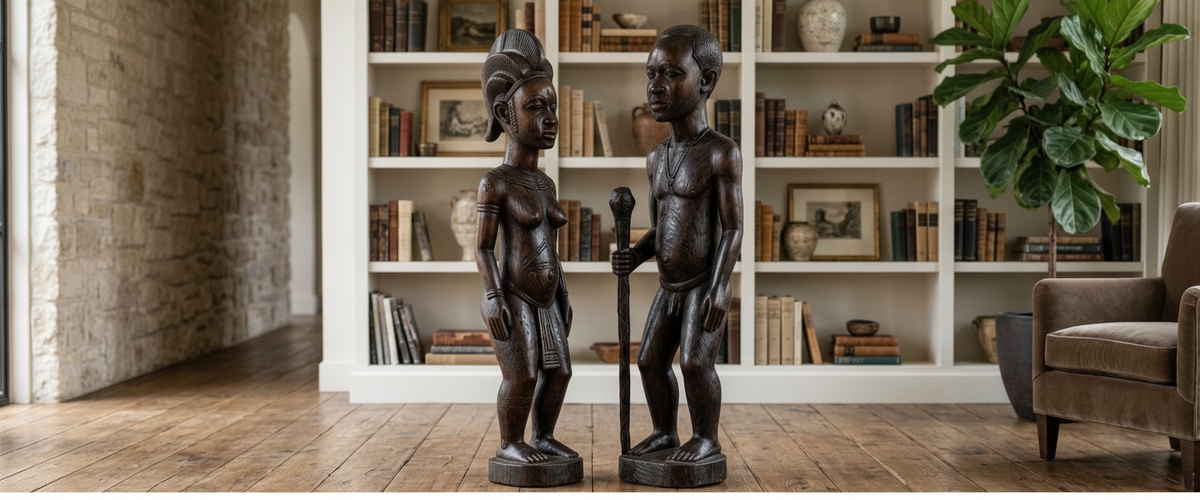

Most large vintage African statues fail at home for the same reason. Someone puts a deeply carved figure under a recessed ceiling light and then wonders why it reads as a dark silhouette with a face. Carvers cut these pieces with adzes and knives, often from dense hardwood, and their character lives in the facets. Place one badly and a carving with decades of history looks like furniture. Place it well and a near life-size figure holds a room better than most paintings can.

Large Vintage African Statues: Quick Answer
- Light: aim a spot at roughly 30 degrees off the surface, not straight down.
- Height: small and mid-size figures belong at waist level. Near life-size figures want a low plinth so their eyes meet yours.
- Background: dark wood needs a lighter or textured wall behind it.
- Outdoors: most vintage wood should stay under cover. Choose bronze for open planting.
- Pairs: angle a man and woman toward each other, never flat and symmetrical.

Flat Downlight Kills a Deep Cut; 30 Degrees Gives It Back
A downlight directly overhead fills every chisel mark with shadow on one side and glare on the other, so the surface goes flat. Move the source to around 30 degrees from the figure's face plane and the adze marks, scarification patterns and hairline ridges come back. For most large vintage African statues, a narrow-beam track spot of 15 to 25 degrees, placed to one side and slightly above, is enough. Add a weak fill from the opposite side if the shadow side turns black. Warm white (around 2700K to 3000K) suits oiled hardwood better than cool LED, which makes old patina look gray and dusty.
Pedestal Height Sets the Encounter
The plinth decides whether you look at an object or meet a presence. A figure of 2 to 3 feet (60 to 90 cm) sits well at around 36 to 42 inches (90 to 105 cm), roughly waist height, where you read it like something on a table. Near life-size pieces work differently. A 5 to 6 foot (150 to 180 cm) figure on a low base of 4 to 8 inches (10 to 20 cm) puts its eyes close to yours, and that is when the carving starts to feel like someone standing in the room. Raise it further and it becomes a monument looking over your head, which rarely suits a domestic hall.
Weight matters too. Dense old hardwood is often heavier than buyers expect, and a tall, narrow figure on a small plinth tips easily. Fix larger carvings to their bases with discreet steel mounts rather than trusting gravity, especially in homes with dogs or busy staircases.
Why Dark Carvings Vanish Against Walnut and Charcoal
Many large vintage African statues are blackened or deeply oiled. Set one in front of walnut panelling or charcoal plaster and the outline disappears; you see a face and hands floating in a dark field. Brighter spots rarely fix this, because more light on the figure does nothing for the wall behind it. What works is separation: pale limestone plinths, and pulling the figures about 2 feet (60 cm) forward from the wall so a wash of light can hit the panelling behind and give each figure an edge. Limewash, raw plaster, travertine and sand-colored linen all make better backdrops than anything close to the wood's own tone.
Hall Niche or Courtyard Planting: Which Pieces Can Go Outside
Very few vintage carvings should live in open planting. Wood moves with humidity, and aged timber that has spent decades indoors will check and split once it cycles through rain and sun; the US Forest Products Laboratory's Wood Handbook explains how moisture swings drive that movement. A deep covered loggia in Napa or a shaded courtyard gallery in Santa Barbara can work for a sturdy piece if it stays clear of rain and irrigation spray. Anything with old cracks, glued repairs or thin projecting limbs belongs in a hall niche.
If the courtyard needs a permanent African subject, bronze is the honest choice. For open planting at true scale, a cast group such as the Life-Size Pair of African Elephants Bronze Sculpture, 280cm takes Texas heat, Aspen snow and sprinkler overspray without complaint, while the vintage wood figures stay inside where they last. Giant Sculptures also takes bespoke bronze commissions scaled to a specific courtyard, which is usually a better route than forcing an antique into the weather.
Staging a Near Life Size Man and Woman Pair
Buyers searching for large vintage African statues near life size man and woman usually have a carved couple in mind, a format with a long history across West and Central African carving traditions (the Metropolitan Museum's African collection holds many seated and standing couples). The common mistake is lining them up either side of a fireplace like bookends. Set them closer than feels natural, 18 to 36 inches (45 to 90 cm) apart, and turn each one roughly 15 degrees toward the other. A slight stagger in depth helps as well. Figures that overlap a little from the main viewpoint and face slightly different directions read as a relationship; matched profiles side by side read as two separate objects.
Old Repairs, Insect Damage and Honest Wear
Raking light flatters carving and shows no mercy to condition. Expect it to expose filled cracks, replaced toes or fingers, old insect exit holes, glue lines at the base and patches where patina has been touched up. None of this is automatically a problem, since honest wear is part of what vintage means. Fresh frass (fine wood powder) collecting below a figure is a different story. It needs a conservator before the piece goes near other wood in your home. Test your lighting well before guests arrive, and decide which repairs you are happy to show.
Rotation and Seasonal Sun
A figure near a window changes character through the day. If the window faces east, morning sun lights the face; by late afternoon the same carving can drop into silhouette. Watch it for a week before fixing the plinth, and consider a turntable base for large pieces so you can give the figure a quarter-turn as the seasons shift. Keep wood out of direct midday sun, which fades patina and dries timber. Bronze outdoors needs no such protection and actually benefits from strong sun. Where a garden has room for a single figure seen from several sides, a striding form like the Life-Size Walking African Elephant Bronze Sculpture, 280cm gains from low, moving sun that tracks across the modeled hide.
Buyer Checklist Before You Place Large Vintage African Statues
For wider placement ideas, Large African Statues: How to Read the Carving Before You Buy is useful companion reading before finalising the setting and sightlines.
- Confirm weight and base footprint before choosing a plinth.
- Check floor loading for heavy figures on upper floors.
- Plan a lighting position at about 30 degrees before the piece arrives.
- Pick a backdrop clearly lighter than the wood.
- Inspect under raking light for active insects and unstable repairs.
- Keep vintage wood indoors or under deep cover; choose bronze for open gardens.
- Ask for provenance paperwork and stay realistic about age claims.
If you are planning plinths, mounts or a bronze companion piece for the garden, talk to Giant Sculptures about a tailored quote. Budget depends on material, scale, engineering, installation and finish, so we price each commission to the site.