
























































































Search for large African statues and you get a wall of listings that all say roughly the same thing: tall, carved, dark, tribal. That label hides more than it explains. A Senufo rhythm pounder and a Makonde blackwood figure have about as much in common as a Renaissance marble and a Brancusi, and the price you pay should reflect which one you are actually looking at. The good news is that large African statues confess almost everything about their making through surface, grain and stance. You just have to know where to look.

Key Takeaways
"African" is not a style. Large African statues span dozens of traditions, so ask which region and workshop a piece comes from before you ask the price.
The surface talks. Faceted adze marks read as hand-carved; uniform satin smoothness usually means a belt sander did the last hour of work.
Grain decides where it cracks. On near life size figures, checks start at the base and around narrow ankles and necks.
Pairs need agreement. Height, timber, stance and finish all have to match, or the couple reads as two strangers.
Weather decides material. Carved hardwood usually belongs under cover in US and UK climates; bronze and stone are the outdoor answer.
The Traditions the Market Flattens Into One Label
Yoruba shrine figures, Baule spirit spouses, Dogon granary door imagery, Senufo ceremonial forms and Shona stone carving from Zimbabwe are separate visual languages with separate rules about proportion, scarification and posture. Contemporary Makonde and Kamba workshops produce large African statues for export that are genuine craft objects in their own right, but they are not ritual pieces and should not be sold as such. The Smithsonian's National Museum of African Art is a useful reference for seeing how much variation sits inside that one flattened search term.
For buyers, the practical point is simple. When a seller cannot name the tradition, the region or the maker, you are buying decor, and decor should be priced as decor. That is not a problem if decor is what you want. It becomes a problem when a generic carving is dressed up with ceremonial language it has not earned.
Adze Rhythm Versus Belt-Sanded Blandness
Run your hand across the back of the figure, where finishing effort usually drops off. Hand-carved large African statues show shallow, overlapping facets left by the adze, running in a rhythm that follows the muscle rather than the grid. Those facets catch raking light and give the form its movement. Belt-sanded pieces lose that entirely; the surface goes flat and even, and the figure starts to look like a mannequin in wood.
We have seen genuinely good carvings ruined in the last stage by someone trying to make them look "finished" for export. If a photograph shows uniform satin smoothness across every plane, ask for close-ups of the shoulder blades, the inside of the arms and the underside of the base. The neglected zones tell the truth.
Adze facets catch raking light across the back.
Grain Direction and Where Large African Statues Split First
Big carved figures are usually cut from a single log, which means the tree's drying behavior travels with the sculpture. Wood shrinks far more across the rings than along them, so checks tend to run radially, opening outward from the pith. They show first where the section is thin or end grain is exposed: the base, the crown of the head, the ankles and any narrow neck. The US Forest Products Laboratory's Wood Handbook is the standard technical reference on that movement, and it explains why a figure carved in a humid climate can crack within a year in a dry one.
One client outside Scottsdale learned that with an imported iroko pair bought elsewhere. Two summers on an open terrace and both figures had opened long checks down the spine. Desert air pulled moisture out faster than the wood could cope with. Nothing was wrong with the carving; the placement was wrong for the material.
Buying Large African Statues Near Life Size as a Man and Woman Pair
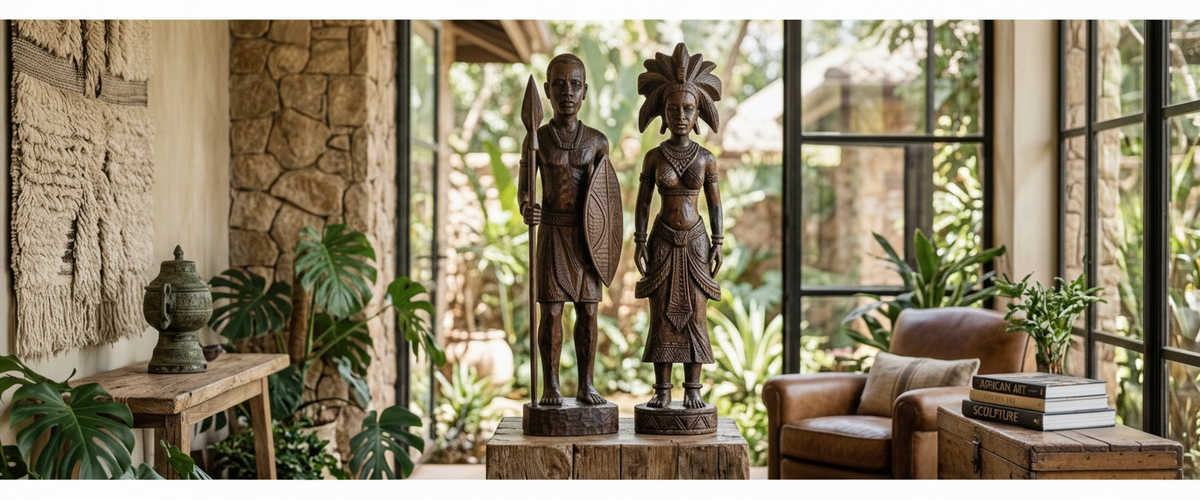
Couples are the most requested format and the easiest to get wrong. When buyers ask us for large African statues near life size man and woman, four things have to agree. Height needs a deliberate relationship, usually the male figure slightly taller, not randomly different by five inches (13 cm). Both figures should come from the same timber and ideally the same log, so color and grain age together. Stance has to read as a pair, with weight and gaze either mirrored or clearly complementary. And the finish, oiled, waxed or patinated, must be identical.
Scale creep is the other trap. "Near life size" in a photo studio is around 5 to 6 feet (150 to 180 cm), which feels commanding indoors and can vanish in a big garden. Across a wide lawn or a vineyard entrance you usually need to go past human scale, and paired mass at 280 cm, such as Life-Size Pair of African Elephants Bronze Sculpture, 280cm, holds open ground in a way a 6-foot carved figure cannot.
A matched couple reading as one group indoors.

Cast Stone and Bronze Copies: What the Mold Keeps and What It Loses
Casting large African statues for outdoor life is legitimate and often the right call, but it changes the object. Silicone picks up tool facets beautifully; what it cannot reproduce is the depth of hand-cut undercuts, which get softened during mold release. Cast stone blurs crisp edges further because the aggregate has its own texture. Bronze holds detail best, and chasing after the pour can restore the edges the mold rounded off, which is exactly where an experienced foundry earns its fee.
Bronze also lets you scale up honestly rather than pretending a carving can survive weather it was never made for. Where a long drive reads better with a single moving form than a static pair, Life-Size Walking African Elephant Bronze Sculpture, 280cm is closer to the right design language, since both the mass and the patina belong outdoors. It is worth comparing finishes across the wider bronze sculpture collection before committing to a form.
Provenance Questions Worth Asking
The same short list applies to all large African statues, ritual or contemporary, cheap or serious.
Which tradition, region and workshop, and who carved it?
Is this a ritual object, a contemporary carving, or a cast reproduction?
Was it made for sale, and when?
What timber is it, and how long was it seasoned?
What export documentation exists, including any CITES paperwork for restricted species such as African blackwood?
Answers that should worry you: "tribal, over 100 years old" with no region named; "antique" alongside a machine-flat surface; and any reluctance to discuss export paperwork. A vague seller is a risk you carry for the whole life of the piece.
Why Carved Wood Pairs Belong Under Cover
Rain is survivable. Cycling is not. Wood that soaks and dries repeatedly through a Connecticut winter or a wet UK spring will check, lift its finish and eventually rot from the base up. Covered loggias, orangeries, atriums, double-height entry halls and hotel lobbies are the right homes for large African statues in hardwood. If you want a pair holding a driveway or a terrace year-round, commission the same design in bronze or stone instead.
Commissioning at Scale With Giant Sculptures
As a bespoke sculpture supplier, most of the large African statues we ship start as a conversation about site rather than catalog. We look at sightlines, viewing distance, plinth height and ground conditions, then decide the material. Anything at the scale of Monumental Traditional African Elephant Bronze Sculpture, 330cm, close to 10 feet 10 inches, needs an engineered footing and crane access booked well before casting begins; a near life size pair for an interior atrium needs floor loading checked and a delivery route measured door by door.
Budget for large African statues depends on material, scale, carving or casting complexity, engineering, installation and finishing, so the honest answer is always a tailored quote rather than a guessed range. Send us the site photographs, the ceiling height or the sky behind the piece, and the mood you are after. We will tell you which material will still look right in twenty years, even if that means talking you out of wood.
For wider placement ideas, Choose Your Outdoor Large Garden Sculpture for February, Not July is useful companion reading before finalising the setting and sightlines.