





































































































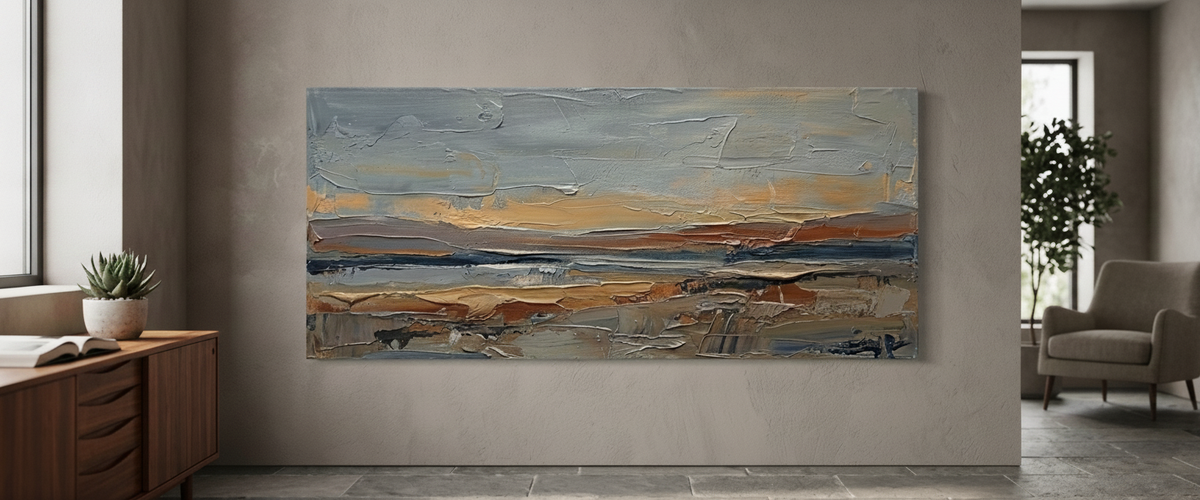

Stand back from any piece of abstract landscape art and your eye does something automatic. Before it registers color, texture or brushwork, it hunts for the horizon. Even when the artist never painted one, the brain invents a dividing line between what reads as ground and what reads as sky, then measures everything else against it. Get that implied line sitting at the right height on your wall and the piece settles into the room. Get it wrong and the whole thing floats, tilts, or feels like it is sliding off the plaster.

Abstract Landscape Art at a Glance
For wider placement ideas, How to Place a Modern Abstract Metal Sculpture so It Actually Reads is useful companion reading before you commit abstract landscape art to a wall and finalize the setting and sightlines.
Find the implied horizon first. In most abstract landscape art it is the strongest tonal break, not the geometric center.
Hang to the seated eye in living rooms and dining rooms, standing eye in halls and stairwells.
Match palette to daylight direction. Cool blue-gray works in north-facing rooms; warm ochre rescues corridors with no window at all.
Apply the 10-foot test. A piece that only works from across the room is a poster; a piece that also rewards a two-foot look is worth owning.
Landscape forms travel outdoors in Corten steel, stainless and powder-coated aluminum when you want the same horizon language in a garden.
Budget depends on scale, material, finishing and installation. For anything bespoke, ask us for a tailored quote rather than guessing.
The Implied Horizon Does the Work Before the Color Does
Traditional landscape art gives you a literal horizon and asks you to accept it. Abstract landscape art removes the trees and the farmhouse and leaves the structure, which is why it holds up in contemporary interiors where a representational scene would read as hotel decor. What remains is a tonal break: a dark band meeting a lighter one, a scraped edge, a shift in density.
Find that break before you pick up a hammer. Prop the canvas on the floor, walk back, and note where your eye lands. On most wide-format landscape wall art the horizon sits somewhere between one third and two fifths up the canvas, not halfway. That single measurement, not the frame, is what you are actually positioning on the wall.
The tonal break, not the frame edge, is the line you hang to.
Hang to the Seated Eye, Not the Standing One
Gallery convention puts the center of a work at 57 to 60 inches (145 to 152 cm). Galleries are places where people stand. Living rooms are not, and most abstract landscape art at home gets looked at from a sofa. In one sitting room we advised on, a wide acrylic landscape had been hung at textbook gallery height above a low sectional, and every guest sat down to a picture hovering somewhere near the ceiling line.
Drop the piece so the implied horizon sits roughly at the eye level of a seated viewer, usually 44 to 48 inches (112 to 122 cm) from the floor. In a stairwell or entry hall, where everyone is moving and upright, go back to standing height. Where the sofa is wide but the wall height is limited, a three-panel format such as Fantoria 3-Set Abstract Portrait Oil Canvas Wall Art is easier to work with than a single canvas, because the gaps between panels (two to four inches in most rooms) let you stretch the composition out to the furniture width instead of pushing it upward.

Palette Follows Daylight, Not Fashion
North-facing rooms in the northern hemisphere get flat, blue-shifted light for most of the day. Cool-toned abstract landscape art thrives there. Slate, pewter, bone white and the quiet tonal range you find in winter landscape art all deepen rather than go muddy, because the ambient light is already doing half the work.
Windowless corridors and basement media rooms need the opposite. Warm ochre, rust and burnt sienna push back against artificial lighting that would otherwise flatten a cool canvas into gray cardboard. Acrylic landscape art earns its place here: an acrylic film stays clear where old oil varnish yellows, so warm pigments keep their punch for longer. If you are working through our acrylic art or wider landscape art ranges, sort by palette before you sort by size.
Chinese Landscape Art and the Discipline of Empty Space
Anyone serious about abstract landscape art should spend an hour with Song dynasty shan shui painting. Chinese landscape art treats unpainted silk as atmosphere, distance and mist, never as a gap the artist failed to fill. Mountains dissolve upward into nothing and the nothing is the point. The National Palace Museum collection shows how far that restraint can be pushed.
The practical lesson for buyers: resist the urge to crowd. If a piece of abstract landscape art carries large quiet passages, give it wall space on both sides equal to at least a quarter of its width. Hanging a spare composition tight between two doorframes kills exactly the quality you paid for. This is also why some of the most famous landscape art in Western collections, from Hudson River School panoramas to Turner's dissolving skies, needs breathing room to function.
The 10-Foot Test
Every piece of abstract landscape art should pass two viewing distances. From 10 feet (3 m) it needs composition: a legible horizon, a balanced mass, a reason for your eye to travel. From arm's length it needs incident, meaning brush ridges, scraped ground, layered glazes, a visible sequence of decisions.
Digital prints of abstract landscape art on thin canvas usually fail the second test, and you will notice within a month of living with them. Relief and dimensional work survives the close look more comfortably, because the depth is physical rather than printed; a layered piece like Everwyn Tales Forest Stag Fantasy Landscape 3D Wall Art holds its shadows at two feet as well as at ten. If you want an easy landscape art starting point for a collection, buy one piece that survives close inspection instead of three that do not.

Taking Landscape Forms Outdoors in Metal
The horizon logic behind abstract landscape art transfers straight to the garden. A low horizontal Corten screen in a meadow setting does what a canvas does indoors: it sets a line and makes everything behind it read as distance. Corten develops a stable oxide layer over roughly two to five years depending on wet-dry cycling, and guidance from the American Institute of Steel Construction is blunt about the condition attached to that: the steel needs genuine drying periods, so avoid sheltered damp corners and permanently irrigated beds.
Outdoors, a weathering steel screen sets the same dividing line a canvas does.
One hard-won studio note: early-stage Corten runoff stains pale limestone and concrete. Detail a gravel drip zone or set the piece on a discreet plinth. Where staining is unacceptable, powder-coated aluminum gives you the same silhouette at a fraction of the weight, and mirror-polished stainless reflects sky into the composition, which is its own kind of horizon. If you want to live with that reflective language indoors before committing to it at garden scale, a compact polished form such as Eclipse Gold Abstract Stainless Steel Sculpture is the smaller version of the same decision, and our metal wall art sits neatly between the two.
Three Placement Errors We Correct Most Often
Undersizing above furniture. Abstract landscape art should span roughly two thirds to three quarters of the sofa or console below it. A 30-inch (76 cm) canvas over a nine-foot sectional looks like a stamp on an envelope.
Lighting from directly overhead. Straight-down light rakes across texture and throws hard shadows that fight the composition. Aim picture lights at about 30 degrees from vertical.
Competing horizons. If the artwork's horizon line lands within a few inches of a window sill, shelf or wainscot line, the two read as a mistake. Either align them exactly or separate them clearly.
Commissioning Abstract Landscape Art at Scale
Double-height walls are where standard sizes for abstract landscape art run out. Bespoke is the answer, and it starts with a photograph of the wall taken straight on, a floor plan noting window positions, and the seated eye line of the main viewing position. From there we work with makers on canvas, panel or metal, matching palette to daylight and detailing fixings for the wall build. Our abstract art range is a useful place to set direction, then talk to Giant Sculptures about commissioned abstract landscape art built to your dimensions. Scale, material, complexity, engineering and installation all drive cost, so we quote each commission individually rather than publishing a number that would not survive contact with your wall.