





































































































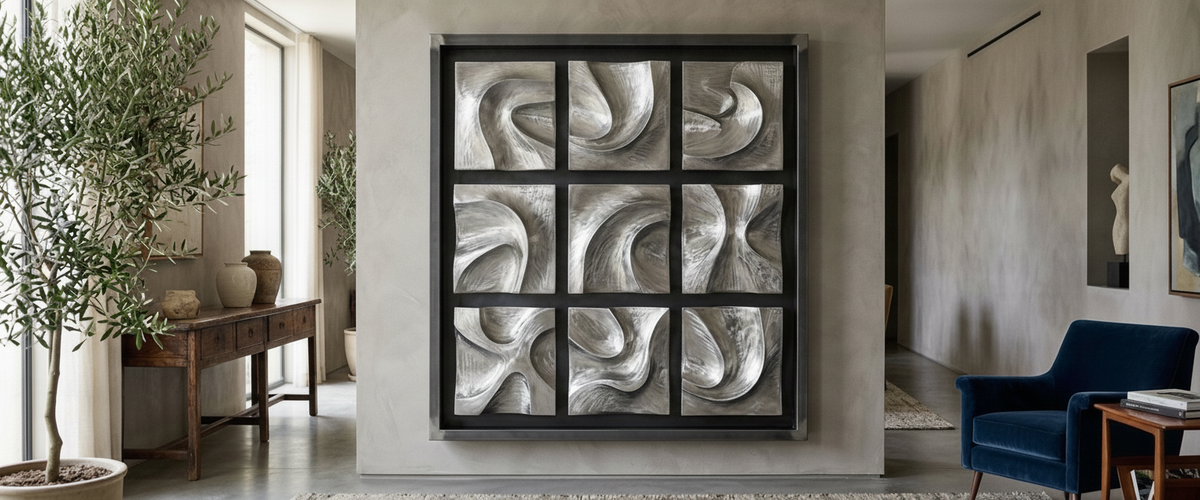

A twelve-foot wall with one small sculpture on it reads like a mistake. Scatter six loose pieces across the same wall and you get a different problem: visual noise with no edge to hold it. A framed array wall sculpture fixes both. Repeated elements sit inside one border, so the wall gets rhythm and containment at the same time, and the eye stops hunting for where the composition ends.

Key Takeaways
A framed array wall sculpture is one object with many parts. A gallery wall is many objects pretending to be one.
The border is structural to the composition, not decoration. It gives loose elements a reason to sit where they sit.
Two numbers govern the shadow play: gap between elements and relief depth off the backing plane.
Indoor and courtyard versions are different builds, with different coatings, drainage and fixings.
Arrays expose tilt instantly, so cleat placement and stud spacing matter more than they would for a single piece.
Budget tracks material, scale, element count, engineering and finish, so ask for a tailored quote rather than guessing.
What Separates a Framed Array Wall Sculpture from a Gallery Wall
A gallery wall is an argument you have to win over and over. Every frame is a separate decision about height, gap, weight and subject, and a single misjudged piece drags the whole group down. An array removes those decisions. The elements are designed as a family, cut or cast from the same stock, spaced on a set rhythm, and held by one perimeter. That perimeter is what earns the phrase framed array wall sculpture rather than "collection."
You see the same logic in box-framed relief work, where the frame gives the carved figures a horizon and a stopping point and the recess casts its own internal shadow line. Scale that idea up, repeat the module, and you have an array. Repetition, held inside an edge, reads as intent.
Why the Frame Calms a Busy Wall
Busy walls kill loose sculpture. Fireplace breasts with stone cladding, board-and-batten paneling, bookmatched marble, exposed brick in a converted Brooklyn loft: all of them already have pattern. A loose metal form pinned to that surface competes and loses. The border of a framed array wall sculpture creates a quiet field behind the elements, so the work is read against its own background rather than the wall's texture.
There is a commercial version of this too. On a hotel elevation or a lobby feature wall, a framed array wall sculpture gives the specifier a defined rectangle to coordinate with lighting, signage and joinery. Designers have handed us a dimensioned void and asked us to fill it exactly, which is far easier to engineer than a free-form cluster with no edges.
Repeated elements inside a single perimeter read as one composition, not a collection.

Element Spacing Versus Relief Depth
These are the two numbers that decide whether a framed array wall sculpture has shadows at all. Spacing controls rhythm; relief depth controls drama. Tight gaps of roughly 1 to 2 inches (2.5 to 5 cm) make elements read as one continuous surface, good for calm, textural walls. Push the gaps to 4 to 6 inches (10 to 15 cm) and each element becomes its own event, which needs stronger individual forms to carry it.
Relief depth is the one buyers underestimate. Elements standing only half an inch (around 1 cm) off the backing plane look flat under ceiling downlights, because the shadow falls behind the element where nobody sees it. Build depth of 2 to 4 inches (5 to 10 cm) and the same piece throws legible shadow lines that move through the day. Angled carvings like the Barwick Mocha Angled Abstract 3D Carving Wall Art work on exactly this principle, catching light on one face and dropping the other into shade.
Rhythm You Read from Ten Feet, Detail You Earn at Two
A good framed array wall sculpture works at two viewing distances. From across a room you should read the pattern and nothing else: the beat of the elements, the proportion of the frame, the overall silhouette. Walk in to arm's length and the reward changes to surface. Hand-ground swirls on stainless steel, hammer texture on bronze, tool marks in carved timber, the granular bite of Corten.
Material decides which distance does the heavier work. Where the brief wants architectural weight and close-range carving detail rather than metal glint, a box-framed stone piece such as the Last Supper Box-Framed Stone Relief Wall Art, 60cm is closer to the right design language, because the recessed border holds the detail and the stone carries the shadow. Ask for close-up finish images before you commit either way. Plenty of wall pieces photograph beautifully at range and disappoint up close, which is precisely the distance guests stand at in a hallway or stairwell. Browsing our 3D wall art and metal wall art ranges side by side is a fast way to calibrate the surface quality you actually want.
Indoor and Courtyard Versions Are Not the Same Object
This is where buyers get caught. A framed array indoor outdoor abstract metal wall sculpture sounds like one product with two locations, but the exterior build is a different animal. An outdoor framed array wall sculpture needs weep or drainage holes at the lowest points, because a box frame is a water trap and standing water behind elements is what starts corrosion. Fixings move to stainless steel or hot-dip galvanized, never plain mild steel. Coatings step up too: architectural-grade powder coating specified to the performance levels used in building facade work holds color far better than decorative interior coatings, and the American Architectural Manufacturers Association publishes the specifications facade fabricators work to.
Corten arrays deserve a separate warning. They need a run-off strategy, because oxide runoff stains pale limestone and stucco permanently. We built a nine-panel weathering steel array for a Napa courtyard where the client's contractor set it directly above a cream travertine plinth; we added a concealed drip edge and a gravel strip below before a single panel went up. On any exterior framed array wall sculpture, the ongoing care regime matters as much as the initial finish, a point the Getty Conservation Institute makes repeatedly in its work on outdoor sculpture. Our outdoor wall art pieces are specified with that in mind from the start.
Exterior builds get drainage holes, stainless fixings and a run-off strategy below the frame.

Sizing an Array to a Sofa Run, Stairwell or Elevation
Three placements, three rules.
Above a sofa or console: target roughly two-thirds to three-quarters of the furniture width. An array narrower than half the sofa run looks stranded.
Stairwell drop: go vertical and let the composition follow the rake. Set its center to the mid-flight eye line, not the upper landing.
Commercial elevation: size against the architecture, not the furniture. Column bays, glazing modules and soffit heights give you the grid. Leave clear margin so the frame is not fighting a ceiling shadow gap.
On a narrow chimney breast or a short console run, a multi-element array will crowd the wall, and a single panel carrying its own internal repetition is the better move: something like the Barwick Mocha Grid Abstract 3D Carving Wall Art delivers the same gridded rhythm at one-panel scale. For double-height rooms, resist the urge to hang a small array high. Either commission at the true scale of the wall or move the piece to a wall that suits it. A bespoke framed array wall sculpture is worth the conversation here, because element count and frame proportion can be tuned to the exact void rather than approximated from stock sizes.
Hanging Checklist: Cleats, Studs and Half a Degree
A framed array wall sculpture shows tilt instantly. A single organic form can sit a degree out and nobody notices; a rectangular frame full of repeating elements turns that degree into an obvious error against the ceiling line.
Use a full-width French cleat, not two hooks. It distributes load and self-levels along its length.
Locate studs first and set the cleat length to catch at least two, or specify a spreader plate on masonry.
Check level on the cleat, then check again on the frame's top edge once hung.
Reference the ceiling line or a datum course, not just a spirit level, in older homes where nothing is square.
Confirm hanging weight in writing before drilling, and ask us for the fixing detail rather than improvising.
Outdoors, pack the frame off the wall for airflow and never seal the bottom edge shut.
Plan the lighting angle before you fix. Grazing light from above at 30 degrees flatters relief depth; flat frontal light erases it.

Commissioning an Array with Giant Sculptures
Most enquiries for a framed array wall sculpture start with a photo of a wall and a rough dimension, which is the right place to begin. From there we work through material, element count, relief depth, frame profile and finish, then engineer the fixing to the substrate you actually have. Cost tracks material choice, overall scale, complexity of the elements, structural engineering, finishing and installation, so we quote per project rather than off a list.
Bring the awkward walls. The stairwells nobody can fill, the courtyard elevation that bakes in Texas sun, the lobby void with a fire panel in the wrong place. A well-judged framed array wall sculpture is the most forgiving large-format answer we make, because the composition can be shaped around the constraint instead of pretending it does not exist. Start with our wall art and wall decor range to see the vocabulary, then talk to us about scaling it.
For wider placement ideas, Large Abstract Wall Art for Hallways: Bold Lines Win at Walking Speed is useful companion reading before finalising the setting and sightlines.