






































































































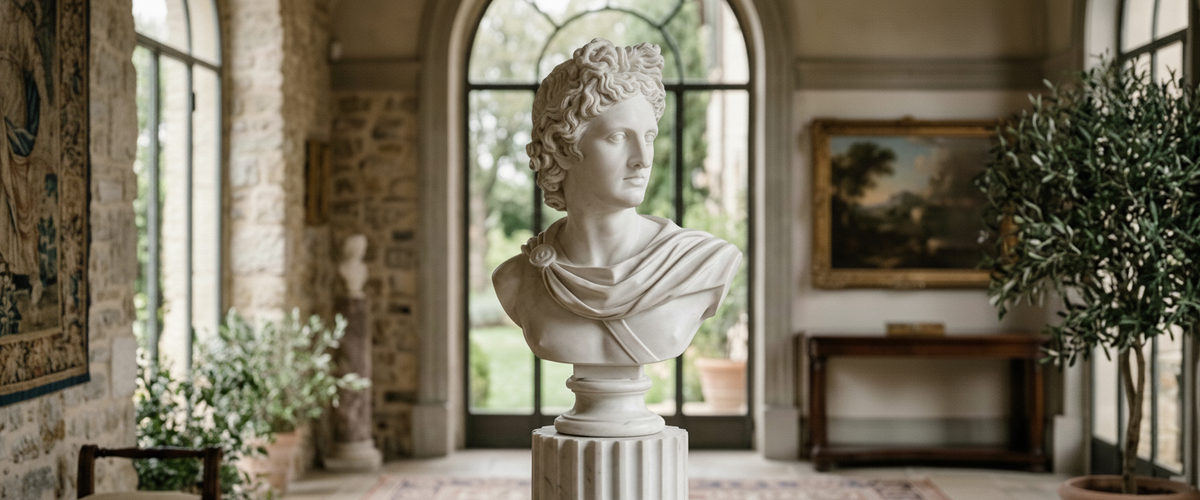

Too many classical busts at home sit too low, lit from straight above, and compete with a television. A classical Greek sculpture bust was carved to be read face on, close to a standing viewer's eye level, and once you drop it onto a coffee table, the face stops working. The fix is mostly placement, and it is the cheapest improvement you will ever make to a piece of sculpture.
At a Glance
Height: aim to put the eyes of the bust close to your own standing eye line, roughly 60 to 64 inches (152 to 163 cm) from the floor.
Room: bearded philosopher heads suit studies and libraries; idealized gods and goddesses suit halls and dining rooms.
Light: one raking light from the side beats a ring of ceiling downlights.
Material: marble, plaster and resin look alike from across a room. Up close, they don't.
Outdoors: only under cover, in a loggia or portico.

A Classical Greek Sculpture Bust Wants Eye Contact
Strictly speaking, the shoulder-length bust is largely a Roman format. Many of the Greek portrait heads we know survive as Roman marble copies of lost Greek bronzes, mounted on herms or busts for villas, gardens and libraries. Cast galleries built to teach classical art, such as the Museum of Classical Archaeology in Cambridge, often show these heads at or near eye height, and the reason is anatomical. The carver put the weight of a classical Greek sculpture bust into the brow, the depth of the eye sockets and the long line of the nose. All of that reads from straight on or slightly below. Look down at it from a sofa and you get the crown of a skull and two nostrils.
On a pedestal, the brow and eye sockets meet a standing viewer head on.
Shelf, Bracket or Column: What Each Height Does to the Gaze
Every support sends the gaze of a classical Greek sculpture bust somewhere different, so choose the support before the spot.
A bookshelf turns the bust into one object among many. That is fine for a small head set at chest height among books, where you glance at it rather than confront it. At around 35cm (about 14 inches), a compact head such as the Ashgate Bronze Bust Sculpture - 35cm sits within a run of shelving without crowding the spines either side. Above 50cm, the shelf starts to crowd the piece instead.
A wall bracket is the most underused option. It lets you put the face exactly at eye level in a narrow hall where a column would block traffic. Check the weight first: a solid marble head can be far heavier than it looks, so the bracket needs fixing into studs or masonry, never drywall anchors alone.
A column or pedestal is the classical answer, and the only one that lets you walk around the head. For a medium bust, a pedestal of roughly 36 to 42 inches (91 to 107 cm) often lands the eyes near standing height, but measure your own piece from base to pupils before you order a plinth.
Philosopher in the Study, Goddess in the Hall
Subject matters as much as height. Bearded philosopher and poet types are inward, lined and thoughtful; they belong in a library, a study or a quiet landing where someone might actually read. Idealized heads of gods and goddesses face outward. In an entrance hall, where guests see the head first and from a distance, a carved marble head such as the Apollo Marble Bust Sculpture, at 75cm (about 30 inches), has the calm, symmetrical presence the space needs. Put the wrong head in the wrong room and it reads as a prop. If you want a set of matching subjects, our Greek and Roman statues collection is the place to start.

Side Light Restores the Greek Profile
Ceiling downlights are the enemy of a classical Greek sculpture bust. They fill the eye sockets with black shadow and flatten the cheekbones, so the face turns hollow-eyed and severe. A single raking light from one side, at roughly 30 to 45 degrees, does the opposite: it draws the line of the nose and lifts the brow back into relief.
One side light at about 30 to 45 degrees brings the profile back into relief.
We see this every week in the studio. Marble heads are photographed beside one tall window, and the moment someone switches on the overheads, the profile goes dead. At home, a window to one side or an adjustable picture spot on a track will do the job. Turn off the downlight above the bust if you can.
Marble, Plaster or Resin: The Arm's-Length Test
From across a room, a classical Greek sculpture bust in marble, plaster or resin can look almost identical. At arm's length the differences show. Marble is slightly translucent, so light enters the surface and the edges of the face look soft and alive; it is also cold to the touch and heavy. Plaster is chalky, dead white and fragile, and it holds dust in every curl. Resin can be convincing with a stone-dust fill, but up close you may notice uniform warmth, lighter weight and occasional seam lines.
The honest rule: if the bust will sit at face height on a hall bracket or desk, where people lean in, buy carved marble or bronze. If it lives higher up, on a cabinet top or tall console where no one leans in, a resin piece is reasonable. There, a bust that makes no pretence of being stone, such as the Coral Draped Woman Bust on a Turned Socle Resin Sculpture - 68cm, with its painted finish and built-in socle lift, is often more successful than a fake marble.
Loggias and Covered Porticos: The Only Outdoor Spots That Work
A bust is a small, detailed object with a horizontal top that collects water, pollen and leaf litter. In open garden beds it looks lost and weathers badly; marble in particular suffers from acid rain and, in cold-winter climates, from freeze-thaw. Under a roof it is a different story. A loggia, covered portico or deep porch protects the surface and frames the head against a wall, and a marble head kept under cover will hold its finish for far longer than one left on an open terrace. Keep the base off the paving to avoid splashback, and choose bronze if the spot gets driven rain.

Placement Checklist Before You Buy
For wider placement ideas, Reading the Classical Ideal of Sculpture Before You Buy a Greek Figure is useful companion reading before finalising the setting and sightlines.
Measure from the floor to your eye line, then from the base of your classical Greek sculpture bust to its eyes. The gap is your plinth height.
Decide the room's job first, then choose the subject.
Find your side light source before you fix the position.
Confirm the wall or floor can carry the weight.
Pick the material for the closest viewing distance, not the farthest.
For outdoor use, confirm a roof overhead and drainage below.
If you cannot find the right head at the right scale among our bust sculptures, Giant Sculptures can carve or cast a bespoke bust to your measurements and make a matching pedestal. Budget depends on material, scale, carving complexity, finishing and installation, so request a tailored quote with your room dimensions and a photo of the light.